Most companies don’t wake up one morning and decide to “adopt data analytics.”
What actually happens is way subtler and quieter.
- A finance head notices margins shrinking even though revenue is stable.
- An operations manager sees teams working harder but output barely improving.
- A founder feels customer growth slowing without a clear reason.
At first, people look at reports. Then they build more reports. Then dashboards. Yet decisions still feel uncertain.
This is usually the point where analytics stops being a technical topic and becomes a business necessity.
In fact, a study published in abacademies shows that data‑driven decision‑making can explain roughly 61% of the variance in overall business performance, which is why this transition from ‘reports’ to analytics matters so much.
Data analytics services are not about collecting more data. They exist because businesses eventually reach a stage where numbers exist everywhere but understanding does not.
This guide explains how to recognize that stage.
What is Data Analytics in a Business Context?
Data analytics is the process of examining business data to explain why something is happening, what will likely happen next, and what action should be taken.
That sounds simple, but inside companies, it solves a very specific problem: turning operational activity into decision clarity.
Data analytics vs reporting vs business intelligence
Many organizations use these terms interchangeably. Some may implement business intelligence solutions, while some may implement data analytics, all without knowing what they exactly mean. They are related, but they serve different purposes.
| Capability | What it answers | Typical output | Business value |
|---|---|---|---|
| Reporting | What happened? | Static reports | Visibility |
| Business Intelligence | Where is it happening? | Dashboards | Monitoring |
| Data Analytics | Why and what next? | Insights & recommendations | Decision-making |
Business intelligence shows revenue by region.
Data analytics explains why one region is declining and whether it will continue.
But it cannot manage complexity without analytics.
What data analytics actually does inside a company
Inside an organization, analytics rarely appears as a single system. It becomes a decision layer across departments.
It connects:
- Sales performance to pricing strategy
- Marketing activity to customer lifetime value
- Operations workload to staffing needs
- Product usage to retention behavior
The goal is not visibility. The goal is action.
One study indicates that organizations using data‑driven strategies for decisions achieve, on average, up to 55% higher revenue growth than those relying mainly on intuition. This underscores that the real value of analytics lies in action, more than merely monitoring.
For example:
- Product profitability analysis determines which offerings should expand or retire
- Retention analysis shows why customers stop returning
- Pricing analytics reveals whether discounts are driving growth or eroding margin
- CRM analytics guides communication timing and messaging
- Website analytics shows where users abandon journeys
Each case converts operational data into a decision the business was previously guessing.
Types of data analytics businesses use

Harvard Business School Online groups business analytics into four core types, which are:
- Descriptive analytics
- Diagnostic analytics
- Predictive analytics
- Prescriptive analytics
Descriptive analytics
Explains what happened. Sales trends, traffic patterns, usage summaries.
Diagnostic analytics
Explains why it happened. Customer churn causes, campaign performance drivers.
Predictive analytics
Estimates what will happen next. Demand forecasting, lead conversion likelihood.
Prescriptive analytics
Suggests what action to take. Optimal pricing, inventory planning, resource allocation.
Organizations rarely jump straight to predictive models. They reach them after realizing descriptive data alone does not guide decisions.
Everyday business decisions powered by analytics
Analytics often sounds abstract until mapped to daily operations.
- Which customers should sales teams prioritize this week
- When inventory should be reordered
- Whether marketing budget should shift channels
- Which features improve retention
- How many support staff are needed next quarter
- Which locations require expansion or consolidation
- Which pricing tier actually generates profit
Why Isn’t Basic Reporting Enough Anymore?
Most organizations start with spreadsheets and monthly reports. That phase works for a while because the business is simple enough to interpret manually.
Eventually, the volume of activity grows beyond human pattern recognition.
The difference between seeing numbers and understanding them
The difference between seeing numbers and understanding them
A revenue drop in a report creates questions:
Is demand declining?
Is pricing wrong?
Are specific customers leaving?
Did operational delays affect fulfillment?
Reports show the outcome. Analytics isolates the cause.
Without that separation, companies often react incorrectly. They may increase marketing spend when the issue is retention, or hire staff when the problem is process inefficiency.
Why dashboards don’t always lead to decisions
Dashboards improve visibility but they introduce a subtle challenge: they create monitoring without interpretation.
Teams start spending time watching metrics rather than explaining them.
You’ll often hear statements like:
- “Traffic is down”
- “Conversion is fluctuating”
- “Usage looks normal”
Yet no one can confidently say why or what action to take.
Analytics introduces structured reasoning. It connects variables instead of displaying them separately.
When manual analysis becomes unreliable
Manual analysis fails gradually, not suddenly.
First, someone exports data weekly. Then daily. Then multiple departments do it independently.
Soon, decisions rely on personal spreadsheets. Different teams report different numbers for the same metric.
At this point the issue is no longer reporting accuracy. It is decision credibility.
Leadership conversations start focusing on whose data is correct instead of what action to take.
That is usually when analytics services become necessary to establish a shared analytical foundation.
How fragmented tools hide operational patterns
Modern businesses run across many platforms: CRM, marketing tools, billing systems, support software, website analytics, finance applications.
Individually, each tool looks clear. Together, they obscure patterns.
For instance:
- Marketing sees leads increasing
- Sales sees conversions decreasing
- Support sees ticket volume rising
- Without integrated analytics, these appear unrelated. With analytics, they often reveal a single operational issue such as onboarding friction or misaligned targeting.
- Fragmentation rarely feels like a data problem. It feels like organizational confusion. Analytics resolves it by connecting operational context.
Who Actually Needs Data Analytics Services?
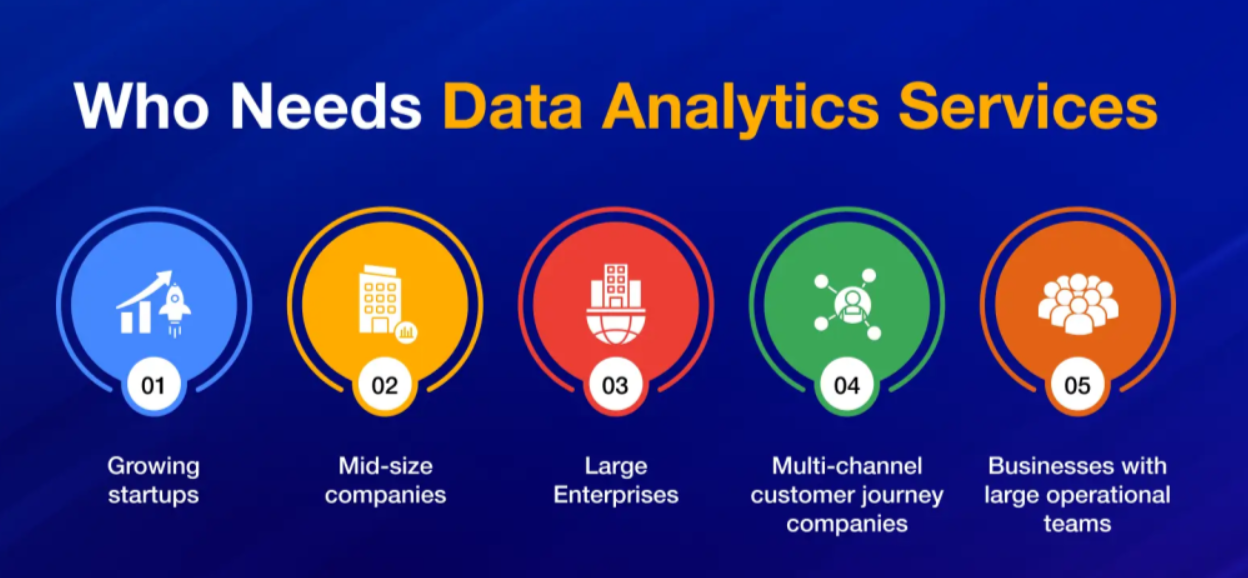
Not every organization requires advanced analytics immediately. But certain business situations almost always lead to it.
Growing startups
Early startups rely on intuition because data volume is small and teams sit close to operations. Growth changes that.
When customer acquisition increases, founders can no longer personally observe patterns. Questions start emerging:
- Which customers are profitable?
- Are promotions attracting the right users?
- Which product features drive retention?
At this stage analytics supports disciplined scaling rather than replacing entrepreneurial instinct.
Mid-size companies scaling operations
Mid-size organizations often feel the strongest need.
They have:
- Multiple teams
- Repeatable revenue
- Increasing operational complexity
Yet they still operate on processes built during early growth.
Here analytics helps transition from effort-based growth to system-based growth. Campaign targeting, capacity planning, and pricing decisions begin relying on measurable behavior instead of experience alone.
Enterprises dealing with complexity
Enterprises usually have large data volumes but fragmented understanding.
Different departments optimize locally:
- Marketing maximizes leads
- Sales maximizes deals
- Operations maximizes efficiency
The company struggles to optimize globally.
Analytics aligns these perspectives by measuring end-to-end outcomes such as profitability, lifetime value, and service cost.
Companies handling multi-channel customer journeys
Businesses interacting across websites, mobile apps, offline channels, and partners face attribution confusion.
They cannot easily answer: Which touchpoints actually influence purchase?
Analytics integrates channel behavior and supports decisions like budget allocation and communication timing.
Businesses with large operational teams
The more people involved in delivering a service, the harder it becomes to identify inefficiencies through observation.
Analytics highlights patterns across workforce scheduling, process steps, and service outcomes. This often reduces cost without reducing output.
Industries where decisions affect cost, demand, or risk
Certain sectors rely heavily on prediction rather than observation:
- Retail and eCommerce
- Logistics and supply chain
- Financial services
- Insurance
- Healthcare operations
- Healthcare operations
- Subscription businesses
- Manufacturing
In these environments, small decision errors scale quickly. Analytics reduces that compounding impact.
What Problems Do Data Analytics Services Solve?
Companies rarely seek analytics because they want insights. They seek it because recurring operational questions remain unresolved.
Identifying inefficiencies in operations
Teams may feel busy but throughput stays flat. Analytics examines process flow and reveals bottlenecks such as handoff delays, redundant steps, or uneven workload distribution.
Understanding customer behavior patterns
Customer analytics clarifies:
- Who buys repeatedly
- Who leaves quickly
- What behaviors precede churn
This often changes marketing and product decisions more than acquisition metrics ever did.
Improving demand and capacity planning
Forecasting demand prevents two costly scenarios: overstaffing and under-servicing.
Predictive models estimate volume based on historical patterns, seasonality, and external signals.
Detecting revenue leakage
Revenue leakage rarely appears as a single large loss.
It accumulates through pricing inconsistencies, discounting habits, contract structures, or billing gaps.
Analytics identifies where expected revenue differs from realized revenue.
Improving cross-department visibility
Many organizations operate on local optimization. Analytics creates shared performance indicators linking actions across departments.
Supporting faster decision-making
Without analytics, decisions require meetings to interpret data.
With analytics, interpretation is embedded into the data itself.
This reduces decision cycles rather than just improving accuracy.
Benefits of Data Analytics for Businesses
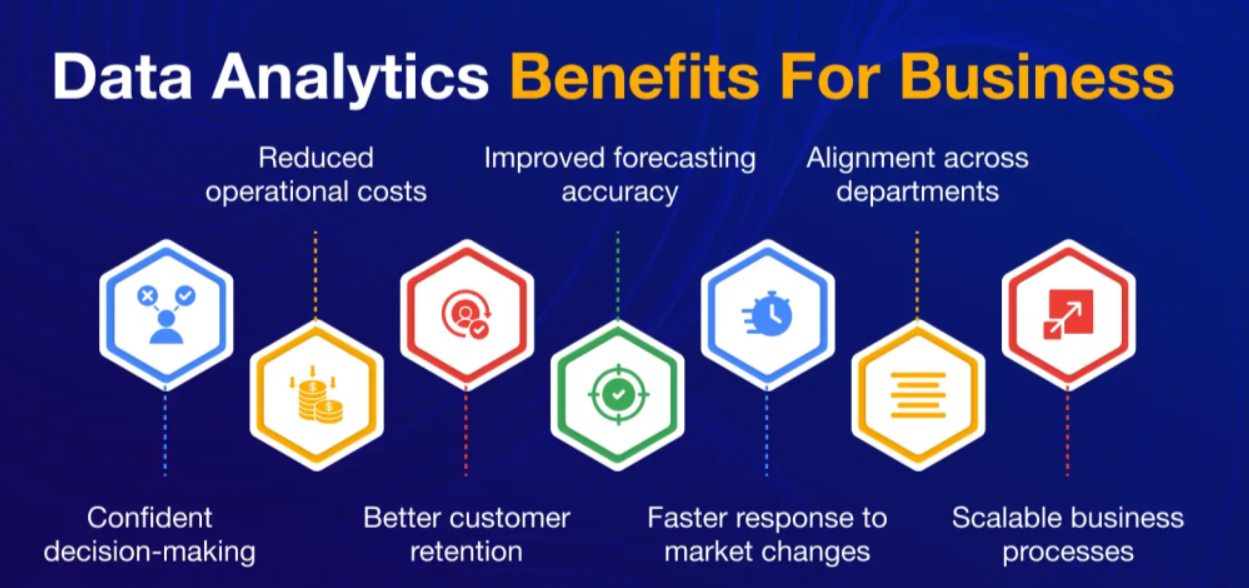
Data analytics benefits businesses beyond mere reporting. It rarely transforms a company overnight. Its impact appears as gradual operational stability.
More confident decision-making
Leaders move from debating assumptions to evaluating scenarios.
Reduced operational costs
Leaders move from debating assumptions to evaluating scenarios.
Better customer retention
Retention drivers become measurable instead of anecdotal.
Improved forecasting accuracy
Planning cycles shift from reactive adjustments to proactive preparation.
Faster response to market changes
Alignment across departments
Scalable business processes
What Happens If a Business Avoids Data Analytics?
Decisions become reactive
Growth creates inefficiency
Operational costs slowly increase
Leadership depends on assumptions
Competitive disadvantage over time
Conclusion
- At small scale, observation guides decisions.
- At moderate scale, reporting helps monitor activity.
- At larger scale, only analytics explains interactions between moving parts.
FAQ
Business intelligence organizes and displays data for monitoring. Data analytics interprets that data to explain causes and recommend actions.
When operational decisions require investigation rather than observation. This usually appears during scaling, multi-team operations, or multi-channel customer interaction.
Not always immediately. But even small businesses benefit from basic analysis such as product performance, seasonal demand, and customer repeat behavior once transaction volume grows.
Initial decision-support analytics can take weeks to a few months depending on data readiness. Advanced predictive models usually require iterative improvement over time.
Start with revenue-linked data: customers, transactions, pricing, and retention. These influence most strategic decisions.
Excel works for early reporting and small datasets. As data sources multiply and relationships matter, structured analytics platforms become more reliable.
Costs vary based on scope. Many organizations begin with focused projects such as retention or demand analysis before expanding into continuous analytics programs.
Yes. Retention analysis identifies behaviors that precede churn and enables targeted engagement before customers leave.
Industries managing demand, pricing, risk, or operational volume benefit the most, including retail, finance, logistics, subscription services, and digital platforms.
They connect operational data to business outcomes, helping teams choose actions based on evidence rather than interpretation alone.

Continue reading the blog
with a Tech.us subscription
You’re now subscribed!