Overview
This post is about that line. Where automation stops and decision-making begins, why the difference matters more than most teams realize, and what it changes about the way you actually put AI to work.
Automation Is Still One of AI's Biggest Use Cases
Before we draw any lines, let's be clear about something that automation is one of the primary benefits that AI has brought to the table. It's doing real work, and for a lot of businesses it's the single most valuable thing AI touches.
What automation is good at
Automation shines when the work is repetitive, the rules are clear, and the volume is high. Think invoice matching, ticket routing, data entry, the endless small tasks that pile up and slow everyone down. The logic is set in advance, the same input gets the same response, and a machine handles it faster and more consistently than a person ever could. There's nothing primitive about that. It saves real hours.
Why most companies start here
It's also the easiest place to begin. The problem is visible, the payoff is quick, and you don't need to rethink how your team works to see results. So automation tends to be the first door companies walk through, and often it's enough to justify the whole investment on its own. It's also why a handful of business processes are the natural starting point for AI.
The thing to notice is what automation isn't doing. It's carrying out decisions someone already made. The rule was written by a human. The system just follows it, reliably, at scale.
Where Automation Ends and Decision-Making Begins
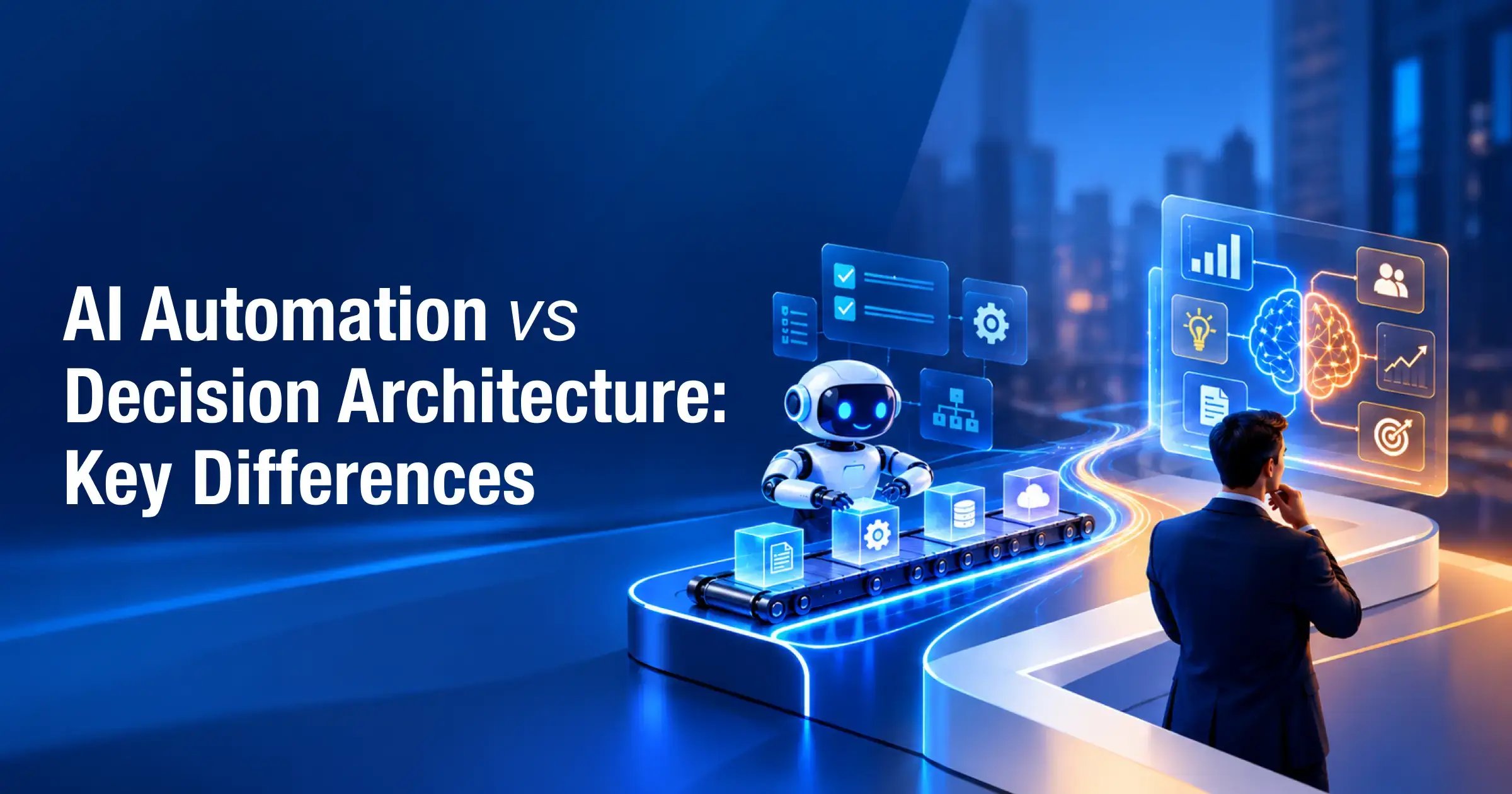
So where's the line? It's simpler than it sounds. Automation follows a rule. Decision-making picks an answer when there's more than one to choose from.
A rule versus a judgment
Picture a warehouse. The old way: when stock drops below 100 units, reorder 500. That's automation. It's a rule someone wrote, and the system fires it every time the number is hit. Clean, predictable, no thinking required.
Now picture the harder question the warehouse actually faces. How much should we order, given that demand spikes in November, the supplier's been running two weeks late, storage costs went up, and last year we got stuck with stock we couldn't move?
There's no single rule that answers that. That's a decision. It's also the kind of call where AI starts reshaping core business operations, not just the task in front of it.
You're weighing things against each other and settling on the best call you can make with what you know. That's a decision.
The first one a machine can run forever without learning anything. The second one is the part that used to sit with a person, because it takes judgment.
What we mean by decision architecture
This is where the term decision architecture comes in. It's the structure a system uses to take in a bunch of signals, weigh them against each other, and land on a choice or a recommendation.
Not a fixed if-this-then-that path, but something closer to how a good manager thinks through a call. That shift, from running rules to weighing options, is the whole point of what follows.
Why AI Is a Decision Architecture
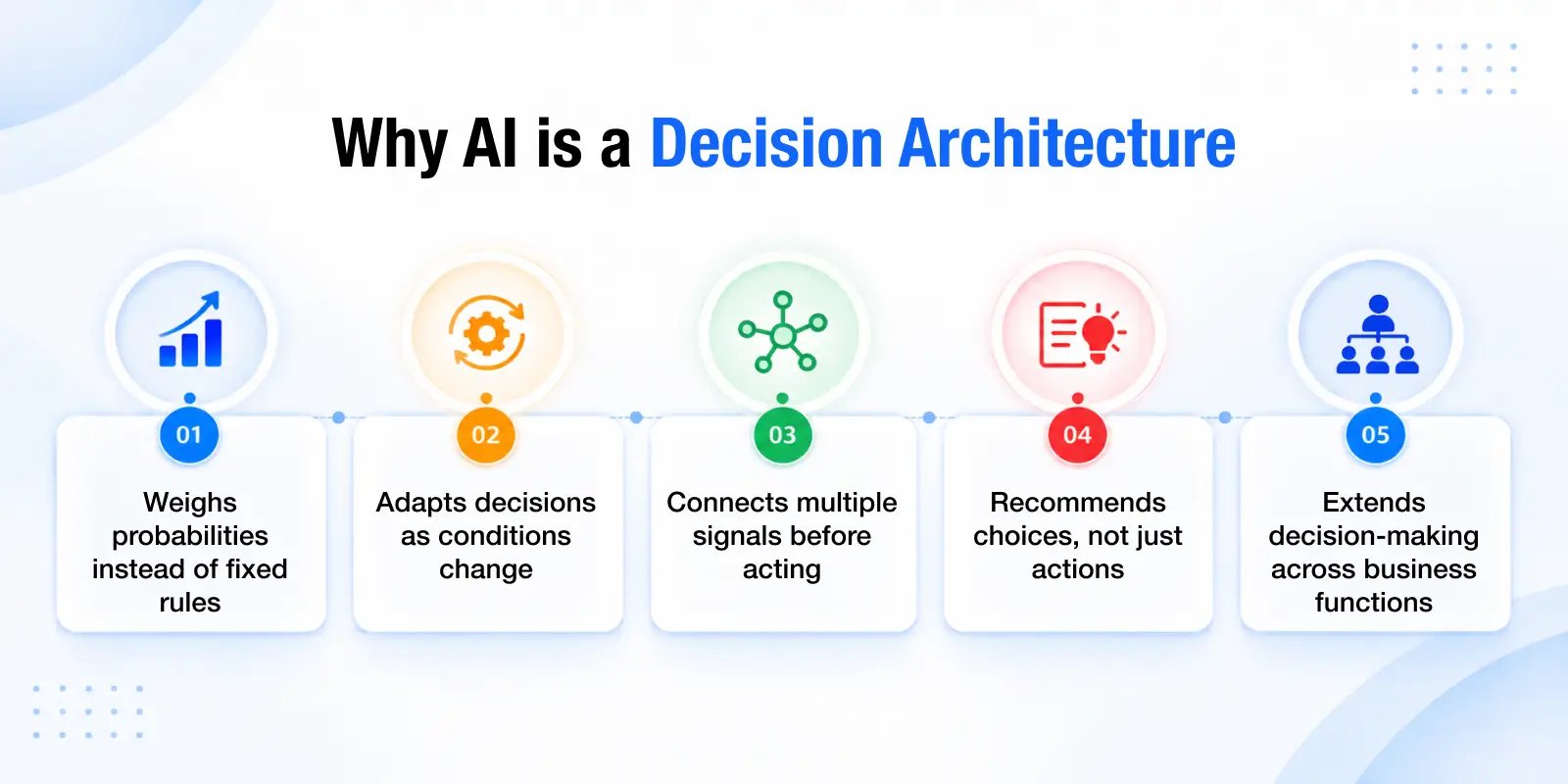
If automation runs the rules, this is the part where AI development starts making the calls those rules used to depend on. The difference isn't speed or scale. It's that the system is doing something closer to reasoning: looking at a messy situation, weighing what matters, and landing on an answer.
Five things separate this from automation, and each one is worth understanding on its own. Here's what actually changes when AI moves into the decision seat.
It Works with Probabilities, Not Fixed Rules
A rule gives one answer. AI gives you the most likely good answer, along with how sure it is. That's a real difference. Instead of "if X then Y," it's "given everything I'm seeing, this option looks better than that one, and here's roughly how much better." It deals in odds and trade-offs, the same way you do when you make a tough call without perfect information.
- It estimates likelihoods rather than firing a predetermined step
- It can rank several options instead of returning one fixed output
- It carries a confidence level, so you know when to trust it and when to look closer
This is why it handles messy questions that rules can't cover cleanly, and why understanding how machine learning actually works matters before you trust it with a decision.
It Adapts as Conditions Change
A rule written last year still does exactly what it did last year, even when the world has moved on. AI doesn't sit still like that. As new data comes in, the logic behind its decisions shifts to match what's actually happening now. The reasoning stays current instead of frozen at the moment someone wrote it.
- It updates on fresh data instead of running stale instructions
- It picks up on shifts in demand, behavior, or risk without a human rewriting the rule
- It gets sharper over time as it sees more outcomes
It Operates Across Inputs, Not Single Triggers
Automation usually waits for one thing to happen, then acts. A decision system looks at everything at once. It pulls demand, cost, timing, risk, and context into the same view and weighs them together, because real decisions are rarely about a single number crossing a single line.
- It reads many signals at the same time, not one trigger
- It weighs those signals against each other instead of treating them separately
- It catches trade-offs a single-rule system would miss entirely
The result is a call that reflects the whole picture, not just the one metric that happened to move.
It Moves from Executing Tasks to Recommending Choices
Here's a quieter but important shift. Automation finishes a task and that's that. A decision system often hands you a recommendation instead, the best option it found, sometimes with a few runners-up. That keeps a person in the loop for the calls that carry weight, which is usually where you want them.
- It surfaces a recommendation or ranked options rather than a closed action
- It leaves room for human judgment on high-stakes decisions
- It explains the why behind a suggestion, so the choice stays accountable
You get the speed of the machine without giving up the judgment of your team.
It Spans Functions Instead of Sitting in One Process
A single automation lives inside one process and stays there. Decision-making tends to spread. The same approach that forecasts inventory also informs logistics, personalization, and hiring, and once those start talking to each other, you've got a decision layer running across the business rather than a handful of disconnected tools.
- It applies the same reasoning across inventory, logistics, personalization, and recruiting
- It connects decisions that used to sit in separate silos
- It builds toward one coherent layer instead of scattered point solutions
That's the move from "we automated a task" to "we changed how the company decides," and it's where AI starts driving real business transformation.
AI as Automation vs. AI as Decision Architecture
Same technology, two very different jobs. When AI runs as automation, it finishes tasks someone defined. When it runs as a decision layer, it weighs the situation and makes the call. Here's how the two compare across the things that matter.
| # | AI as Automation | AI as Decision Architecture |
|---|---|---|
| Goal | Finish a defined task | Make or support a choice |
| Logic | Runs to a preset target | Weighs probabilities and trade-offs |
| Inputs | Acts on one trigger | Reads many signals at once |
| Behavior | Fixed between updates | Adapts as new data lands |
| Output | Completed action | Recommendation or decision |
| Scope | Stays in one workflow | Spans functions |
| Human role | Define the task up front | Stay in the loop on the call |
What This Means for How You Deploy AI
None of this is an argument for ditching automation. If AI is clearing busywork and saving your team real hours, that's a win worth keeping. The mistake is assuming that's the ceiling.
Start by asking what you actually want
The useful question to ask before any AI project is a simple one: are we trying to execute faster, or decide better? Both are valid, but they're not the same build, and they don't pay off the same way. Faster execution saves time today. Better decisions compound, because the company gets a little sharper every time conditions shift.
Know where the real distance opens up
That second goal is where the gap widens. A business that treats AI as a decision layer starts reading its own situation more clearly: what's coming, what's changing, what to do about it. Over time that's what makes a company more predictive and more adaptive, not the number of tasks it managed to automate.
Pick the build that matches the goal
So it's worth knowing which one you're actually building. Automation is a fine place to start, and most companies should. But the move from automating tasks to improving decisions is the one that changes how the business runs, and it's the shift more teams are starting to make, often by choosing the right AI development partner to get there.
FAQs
No. Automation runs tasks someone already defined. AI can go further and make the call itself, weighing options instead of following a fixed rule.
It's the way a system takes in lots of signals, weighs them against each other, and lands on a choice or recommendation, rather than firing a preset rule.
No, they work together. Automation handles the repetitive stuff; the decision layer handles the calls that need judgment. Most companies run both.
On the calls that carry weight. A good decision system recommends, explains its reasoning, and leaves the final say with a person.
Ask what you're after: faster execution or better decisions. The first points to automation, the second to a decision layer. Often you want some of each.