Overview
Think about how work happens today. Teams are no longer tied to desks. Sales teams are on the road. Field technicians are at client sites. Managers are reviewing dashboards from their phones between meetings. Business simply moves faster now.
Then, how do employees stay connected to business systems when they are constantly on the move?
This is where enterprise mobility enters the picture. Many organizations are shifting toward mobile-first business operations so employees can access systems, data, and workflows from anywhere. Instead of waiting to return to a desktop, teams can complete tasks instantly through business mobile applications.
What does that look like in practice?
Employees today expect:
- Real-time enterprise data access to track orders, inventory, or customer information
- Quick approvals and updates from mobile devices
- Seamless collaboration across departments
- Instant notifications when something important happens
According to Straits Research, the size of the global enterprise mobility management market is valued at USD $90.95 billion in 2025 and is expected to reach USD 710.53 billion by 2033, at a promising CAGR of 29.3% during the forecast period (2025–2033).
This shift is driving demand for enterprise mobility solutions that bring core business systems into the hands of employees.
But here is where many organizations hit a roadblock.
Why Generic Mobile Apps Often Fall Short
Many companies start with off-the-shelf apps. It seems convenient at first. But problems quickly appear.
Generic apps often struggle with:
- Limited enterprise system integration with platforms like ERP or CRM
- Rigid workflows that do not match how teams actually work
- Security limitations for sensitive business data
- Poor scalability as operations grow
As a result, employees still rely on emails, spreadsheets, or manual updates. The mobile app exists, but it does not truly support the business.
This is one of the main reasons why enterprises build custom mobile apps.
So What Makes Custom Enterprise Mobile Apps Different?
Custom solutions are designed around the organization itself.
Custom enterprise mobile apps are designed specifically for a company’s workflows, systems, and security requirements.
Instead of forcing teams to adapt to generic software, the app adapts to the business.
For example, a well-designed app can:
- Connect directly with ERP, CRM, and supply chain platforms
- Enable enterprise workflow automation for routine tasks
- Support mobile-enabled workforce productivity across departments
- Provide a foundation for long-term enterprise application modernization
And perhaps most importantly, it strengthens the entire enterprise mobile ecosystem.
In the sections ahead, we will explore the real benefits of custom enterprise mobile apps and why many organizations now see them as a core part of their enterprise mobility strategy.
What Exactly is a Custom Enterprise Mobile App?
Many people hear the phrase custom enterprise mobile apps and immediately think of a regular mobile app built for business. But that description barely scratches the surface.
Enterprise apps operate in a completely different environment. They interact with complex systems. They handle sensitive data. They support employees who rely on them to complete critical tasks during the workday.
So what exactly makes them different?
Let us break it down.
How are Enterprise Mobile Apps Different from Consumer Apps?
Most people are familiar with consumer apps. Think about shopping apps, social media platforms, or food delivery apps. These apps focus on engagement and user convenience.
Enterprise apps serve a different purpose. They are built to support business operations and employee productivity.
Here is a simple comparison.
| Consumer Mobile Apps | Enterprise Mobile Apps |
|---|---|
| Built for the general public | Built for employees, partners, or business clients |
| Focus on engagement and usability | Focus on productivity and operational workflows |
| Limited integrations | Deep enterprise app integration with business systems |
| Data is mostly user generated | Handles sensitive enterprise data |
| Updates focus on features | Updates focus on operational efficiency |
In short, enterprise apps are designed to support mobile-first business operations inside an organization.
Unlike typical apps, they often connect directly with internal platforms.
Unlike generic apps, enterprise mobile apps integrate directly with internal platforms such as ERP, CRM, and supply chain systems.
This deep integration is what makes enterprise mobile application development so valuable for modern organizations.
What Types of Business Functions Can Enterprise Apps Support?
You might wonder where these apps actually fit into daily operations.
The answer is simple. Almost everywhere.
Companies use business mobile applications to support a wide range of workflows, including:
- Field service management for technicians working on-site
- Supply chain tracking for logistics teams
- Inventory monitoring for warehouse operations
- Sales enablement tools for mobile sales teams
- Customer support portals for service teams
- Workforce collaboration tools for internal communication
- Business analytics dashboards for leadership teams
These apps give teams real-time enterprise data access without relying on desktop systems.
Imagine a warehouse manager checking inventory instantly from a phone. Or a field technician updating job status directly from a client location. These are everyday examples of mobile workforce solutions in action.
Why Custom Development Matters for Enterprise Workflows
Now here is the key point. Every organization runs differently. Workflows vary across industries and departments.
That is why many companies invest in enterprise mobile app development services tailored to their operations.
Custom development allows businesses to build apps that support:
- Enterprise workflow automation for repetitive tasks
- Secure authentication and role-based access control
- Direct enterprise system integration with core platforms
- Real-time data synchronization across departments
This approach also supports a long-term enterprise mobility strategy. As systems evolve and operations grow, the app can adapt within a scalable enterprise architecture.
In simple terms, custom mobile apps for business are built around how a company actually works, not around generic software limitations.
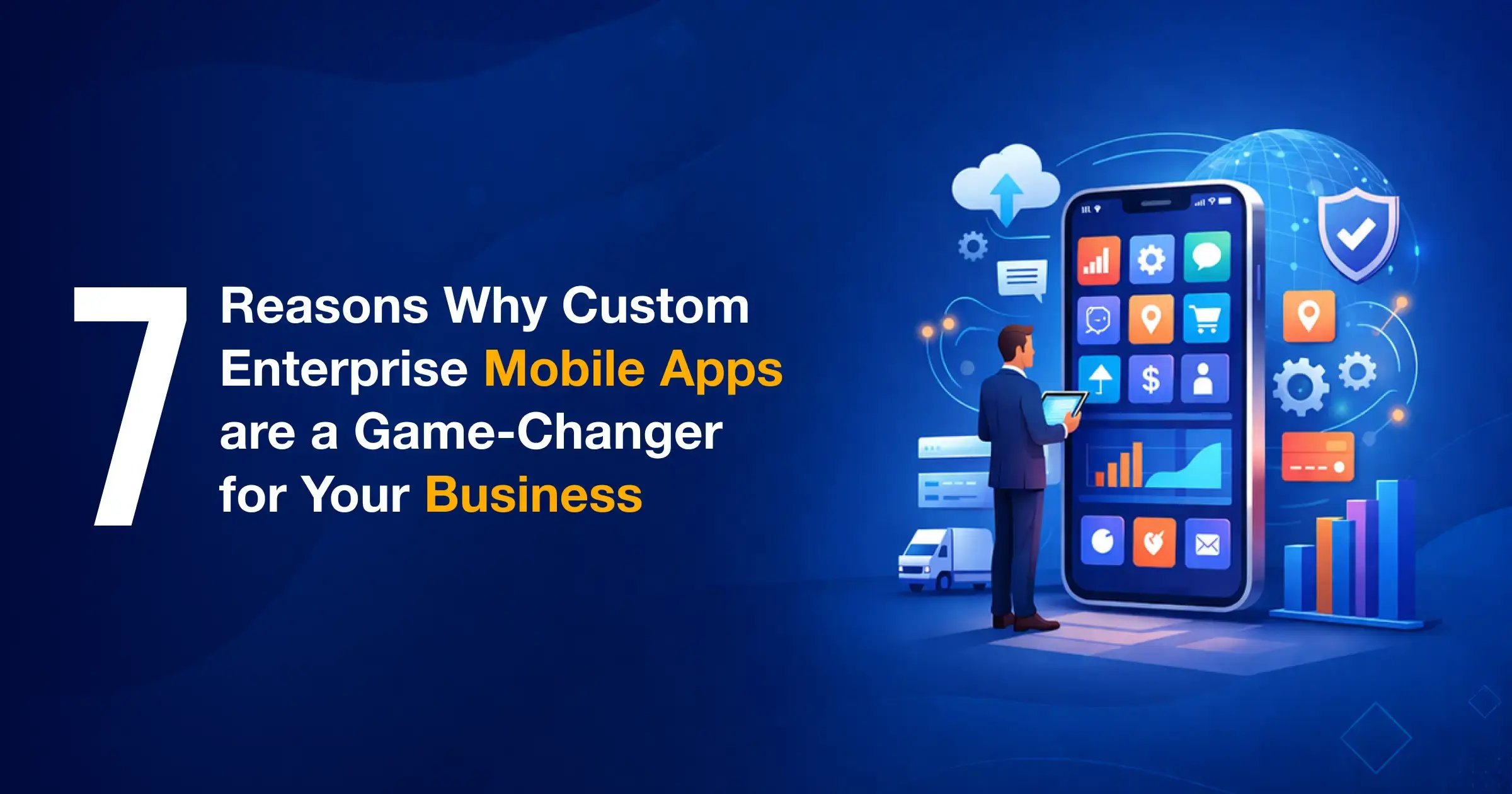
7 Reasons Why Custom Enterprise Mobile Apps Are a Game-Changer
- Boost Workforce Productivity
- Streamline Business Operations
- Enhance Customer Experience
- Strengthen Data Security & Compliance
- Integrate with Enterprise Systems
- Better Scalability than Off-the-Shelf
- Drive Long-Term ROI
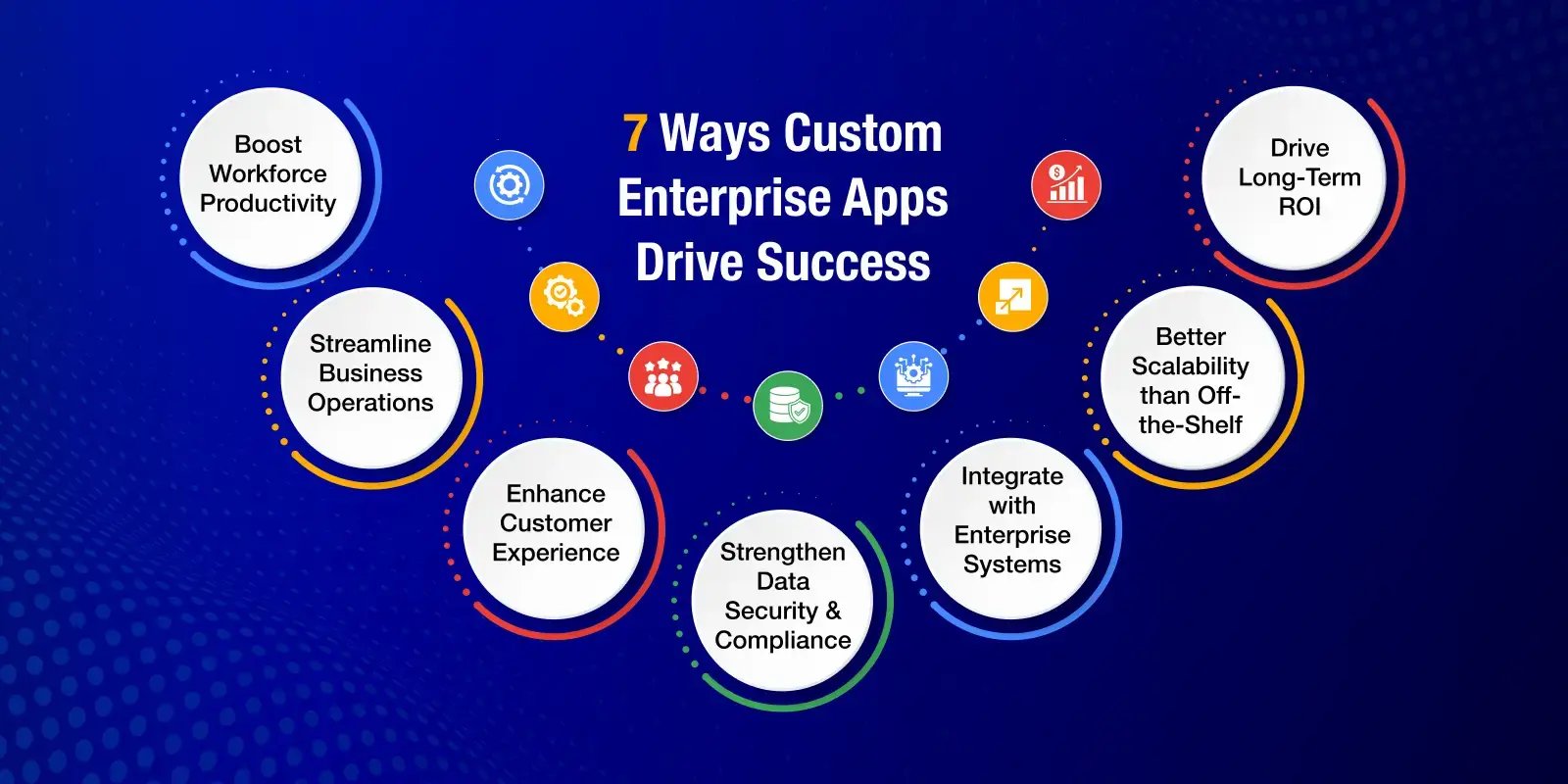
Businesses today operate in a very different environment than they did a decade ago. Teams work from offices, factories, warehouses, and client locations. Leaders expect visibility into operations at any moment. Employees need tools that help them act quickly.
That shift is driving demand for enterprise mobility solutions.
Companies are investing in custom enterprise mobile apps because they bring business systems, workflows, and insights directly to the people who need them. Instead of relying on desktop systems or disconnected tools, teams can access information instantly and complete tasks from anywhere.
So why exactly are organizations prioritizing enterprise mobile app development today? Let us walk through the seven biggest reasons.
1. How Do Custom Enterprise Apps Improve Workforce Productivity?
Imagine a field technician arriving at a job site. They need service history, equipment details, and reporting tools. Without a mobile solution, they may call the office or check emails.
That slows everything down.
Enterprise mobility changes this experience. Custom apps bring core business systems into employees’ hands. Teams can access information, update tasks, and communicate instantly.
According to a study, 69% of enterprise departments typically use 2-5 mobile apps, and around 56% have plans to increase investment over the coming years.
This is why many companies build custom mobile apps for businesses that connect directly to internal platforms.
Employees gain:
- Real-time enterprise data access
- mobile dashboards for daily tasks
- faster communication with teams
As a result, everyday work becomes smoother. Employees spend less time searching for information and more time completing tasks.
Key Features
- Secure access to CRM, ERP, and operational systems
- Real-time dashboards for employees
- Mobile collaboration and task management tools
Custom enterprise mobile apps help employees stay productive anywhere. Work moves faster when teams can access business systems instantly.
2. How Do Custom Mobile Apps Streamline Business Operations?
Many organizations operate with multiple platforms. ERP systems manage operations. CRM platforms track customers. Supply chain software monitors logistics.
Employees often switch between these tools to complete a single task.
Custom apps solve this problem through enterprise app integration. They create a unified interface where employees can interact with several systems from one place.
Think about how much time this saves.
Instead of navigating different tools, employees can:
- update customer data
- track inventory
- approve requests
All from a single mobile application.
This approach simplifies operations and strengthens the overall enterprise mobility strategy.
Key Features
- Unified mobile interface for multiple enterprise systems
- API-based enterprise system integration
- Mobile workflow management for operations
Custom mobile apps simplify complex technology environments. Teams complete tasks faster when systems work together.
3. Can Custom Enterprise Apps Improve Customer Experience?
Customer expectations have changed dramatically. People want fast service, real-time updates, and convenient interactions.
Businesses need tools that support these expectations.
Custom business mobile applications allow organizations to deliver mobile-first experiences for customers and service teams.
For example, customers may use mobile apps to:
- track orders
- submit service requests
- access account information
At the same time, support teams can access customer records instantly.
This improves response time and service quality.
It also helps organizations build stronger relationships with customers through data-driven insights.
Key Features
- Mobile self-service portals for customers
- Real-time access to customer data for service teams
- Mobile sales and customer engagement tools
Custom enterprise apps help businesses deliver faster, more personalized customer experiences.
4. How Do Custom Apps Strengthen Data Security and Compliance?
Enterprise applications handle sensitive information. This includes financial data, customer records, and operational insights.
Security cannot be an afterthought.
Custom enterprise mobile apps are designed with enterprise-grade protection from the start. Organizations can implement strict authentication systems and control how employees access data.
For example:
- executives may view financial dashboards
- technicians may access service schedules
- support agents may review customer history
Access is controlled through roles and permissions.
This approach protects business data and supports regulatory requirements across industries.
- Role-based access control and authentication
- Secure mobile data encryption
- Compliance-ready data architecture
Custom enterprise apps protect sensitive business data while helping organizations meet compliance requirements.
5. How Do Custom Mobile Apps Integrate with Enterprise Systems?
Enterprise environments often include several systems built over many years. ERP platforms, CRM systems, HR tools, and supply chain software all hold critical data.
The challenge is connecting them.
Custom apps enable deep enterprise system integration. They connect these platforms and provide employees with a single mobile interface for accessing enterprise data.
For example:
- sales updates can sync directly with CRM
- inventory changes can update warehouse systems
- delivery status can connect with logistics platforms
This creates a powerful enterprise mobile ecosystem where information flows across the organization.
Key Features
- ERP and CRM system integration
- Real-time enterprise data synchronization
- Centralized mobile dashboards for business operations
Enterprise mobile apps act as a bridge between systems. They make enterprise data accessible and actionable on mobile devices.
6. Why Are Custom Apps More Scalable Than Off-the-Shelf Solutions?
Off-the-shelf apps may work for basic needs. But businesses rarely stay static. Teams grow. Workflows evolve. Technology requirements change.
Custom apps support this evolution.
Built on scalable enterprise architecture, these solutions allow organizations to expand capabilities as the business grows.
New features can be added. Systems can integrate with emerging technologies. Workflows can evolve with the organization.
This flexibility also supports enterprise application modernization and long-term digital strategies.
Companies can extend their apps to support:
- AI-driven analytics
- automation tools
- IoT-enabled operations
Key Features
- Modular and scalable application architecture
- Flexible integrations with emerging technologies
- Cloud-based infrastructure for growth
Custom enterprise apps grow alongside the organization. Technology becomes a long-term asset instead of a limitation.
7. How Do Custom Enterprise Apps Drive Long-Term ROI?
Technology investments must deliver measurable results.
Custom enterprise mobile apps often improve efficiency across the entire organization. Employees complete tasks faster. Operations become more transparent. Customer interactions improve.
These improvements directly affect business performance.
For example:
- automation reduces manual work
- faster service improves customer satisfaction
- better data visibility helps leaders make smarter decisions
This is why many organizations view enterprise mobile application development as a strategic investment rather than a simple technology project.
Over time, the benefits compound.
Key Features
- Enterprise workflow automation tools
- Mobile analytics for performance tracking
- Operational dashboards for business insights
The long-term benefits of custom enterprise mobile apps include improved productivity, lower operational costs, and stronger decision-making capabilities.
To Sum Up
Work today moves fast. Teams operate across locations. Decisions cannot wait for desktop systems. That is why many organizations are investing in custom enterprise mobile apps as part of their broader enterprise mobility strategy.
Think about it. What happens when employees can access systems instantly? Operations become smoother. Decisions become faster.
Here is what businesses gain:
- Better mobile-enabled workforce productivity
- Faster workflows through enterprise automation
- Real-time access to operational data
Custom enterprise mobile apps are designed specifically for a company’s workflows, systems, and security requirements.
Organizations that adopt these solutions early often gain a clear advantage in efficiency, customer experience, and long-term scalability.
FAQ
A custom enterprise mobile app is basically a mobile application like the ones we usually use but built specifically for a company’s internal workflows and business systems. It connects with several platforms so employees can access data and complete tasks from their mobile devices.
Off-the-shelf apps often make companies adapt their workflows to the software. Custom apps do just the opposite. They are designed around the organization’s processes, systems, and security needs.
Businesses typically choose custom apps to:
- integrate with internal enterprise platforms
- automate operational workflows
- support unique business processes
Yes. Usually, the best app development companies integrate strong cybersecurity frameworks and add features like encryption, secure authentication, and controlled access to protect sensitive business data. Many organizations also implement role-based permissions so employees only see the information relevant to their responsibilities.
Many companies struggle with slow workflows and disconnected systems. Enterprise mobile apps bring core business tools to mobile devices so employees can work without delays.
For example, teams can access real-time data, update reports instantly, and communicate across departments more efficiently. This removes many operational bottlenecks.
A strong enterprise mobile app focuses on productivity, integration, and security.
Common capabilities include:
- secure authentication and role-based access
- integration with CRM, ERP, or internal platforms
- real-time dashboards and alerts
- offline functionality for field teams
These features help employees complete tasks efficiently from anywhere.
The timeline depends on how complex the application is and how many systems it needs to connect with. A smaller enterprise app may take a few months to build. A larger platform that integrates with multiple systems may take six months or longer.
The process typically involves planning, design, development, integration, and testing.
Enterprise mobility is valuable across many industries. Manufacturing companies use mobile apps to monitor production. Logistics teams track deliveries through mobile dashboards. Healthcare organizations rely on mobile tools for patient management and field services.
Any industry that relies on real-time information and distributed teams can benefit from enterprise mobile applications.
Yes, integration is one of their biggest advantages. Custom enterprise mobile apps are designed to connect directly with existing business platforms.
Many apps integrate with:
- ERP systems
- CRM platforms
- HR tools
- supply chain software
This allows employees to access enterprise data from a single mobile interface.
Enterprise mobile apps allow employees to access business systems instantly instead of waiting until they return to their desks. Teams can update tasks, review data, and communicate with colleagues directly from their phones.
This real-time access to information helps employees complete work faster and improves overall operational efficiency.
Most enterprise mobile apps are designed for internal teams, but they can also support partners and customers. For example, companies may build apps for suppliers, distributors, or customers who need access to services and account information.
These apps help streamline communication and interactions across the entire enterprise ecosystem.