Overview
A model can pass every offline test and still fail in production because the labels were wrong from the beginning.
The training and test sets may have been labeled by the same people, using the same guidelines and making the same interpretation mistake. The model learns it, the evaluation set repeats it, and the accuracy score looks healthy because everything agrees.
That is the real purpose of human-in-the-loop annotation. It is not about asking people to inspect every label. It is about placing qualified human judgment where an error is most likely, most expensive, or hardest to reverse.
The right review rate differs by project. A content-tagging model may need only a small audit sample. A system supporting medical, insurance, credit, employment, or safety decisions may need expert review and a documented approval path. What matters is whether the process catches errors that normal metrics miss.

What Is Human-in-the-Loop Annotation?
Human-in-the-loop annotation is a data-labeling workflow in which an AI model creates an initial label and a person reviews selected records before those labels are accepted as training data.
The person is part of the decision path. A flagged record waits until the reviewer confirms, corrects, or escalates it.
That makes human-in-the-loop different from several related ideas:
| Approach | Role of the human | Common use |
|---|---|---|
| Human-in-the-loop | Reviews or decides on specific records before they proceed | Annotation review, adjudication, high-impact approvals |
| Human-on-the-loop | Monitors a running system and intervenes when needed | Production monitoring and exception management |
| Human-in-command | Defines the system's scope, authority, and shutdown rules | Governance and deployment approval |
| Active learning | Selects which records are most valuable for people to label | Building an efficient review queue |
| RLHF | Ranks or compares model outputs to create a preference signal | Improving generative model behavior |
Active learning decides which records deserve attention. Human-in-the-loop defines what happens once a person receives them. A good annotation program usually needs both.
Why Labeling Errors Can Hide Behind Strong Accuracy Scores
Random label noise is usually visible. It lowers performance across the dataset and creates scattered errors.
Systematic labeling errors are harder to catch. They often concentrate in one class, one edge case, or one ambiguous instruction. If every annotator follows the same flawed rule, high agreement does not prove the labels are correct. It only proves the team made the same decision consistently.
Imagine a claims model trained to identify cases that require specialist review. The annotation guide describes one exception poorly, so annotators repeatedly mark those cases as routine. The model then learns to route them incorrectly. Because the test data contains the same labeling mistake, the evaluation may never expose the problem.
Warning signs include:
- Offline performance looks strong, but users report a recurring production error.
- Mistakes cluster in one class or around one business rule.
- Adding more training data does not improve the affected cases.
- Domain experts frequently overturn labels during spot checks.
- Annotators agree with one another but struggle to explain the rule consistently.
The cheapest diagnostic is a blind expert review. Give a small, representative sample to someone who understands the real-world task. Do not show the existing label or the model prediction. If the expert regularly disagrees with the supposed ground truth, the first problem to fix is the data, not the model.
How to Tell Whether the Problem Is the Model or the Labels
Start with records from your hardest classes, including rare cases and examples near the boundary between two labels. Ask two qualified reviewers to label them independently.
Then compare three things: the original label, the new human labels, and the model output.
- If qualified reviewers disagree with one another, the definition or annotation guide is probably unclear.
- If reviewers agree with each other but not with the original label, the existing ground truth is unreliable.
- If reviewers agree with the original label but the model is wrong, the problem is more likely to be model performance.
- If disagreement appears only in one segment, such as a language, document type, or customer group, the dataset may not represent that segment well.
Can LLMs Replace Human Data Annotators?
LLMs can reduce annotation work, but they should not automatically become the final authority. They can produce first-pass labels, summarize context, suggest categories, and identify records for closer review. They are less dependable when a task relies on specialist knowledge, local policy, cultural context, subtle intent, or consequences outside the text itself.
A 2026 ACL study compared AI-only, human-only, and AI-assisted workflows for event annotation. In that specific workflow, experts adopted AI-extracted arguments 60% of the time and completed extraction 25% faster, yet the researchers still concluded that the AI was not ready to replace expert annotators. The practical lesson is not that every team should expect those percentages. It is that assistance can improve throughput without making independent human judgment unnecessary.
Where the line falls depends on the task:
| Task condition | LLM pre-labeling | Human review need |
|---|---|---|
| Categories are clear and supported by examples | Reliable first pass | Audit sample |
| Two classes differ by a subtle business or legal rule | Unreliable | Full review on the affected classes |
| The language is direct rather than implied | Reliable first pass | Audit sample |
| The input contains sarcasm, coded language, or mixed intent | Unreliable | Review where confidence is low |
| The model has enough relevant domain context | Reliable first pass | Audit sample |
| The content uses specialized or organization-specific terminology | Unreliable | Expert review |
| The data is monolingual and well represented in training | Usable with checks | Sampled review |
| The data is multilingual or code-switched | Degrades | Native-speaker review |
| An incorrect label is easy to detect and reverse | Acceptable | Audit sample |
| The decision could affect safety, eligibility, access, pricing, or compliance | Not on its own | Qualified reviewer sign-off |
One condition applies across every row. Human reviewers should still audit a representative sample, including records the model handled confidently.
What Percentage of AI-Generated Labels Should Humans Review?
There is no universal review percentage. A flat target ignores where errors occur and what they cost.
A better approach is to route records using several signals:
- Low confidence: Review predictions close to a decision threshold.
- Model disagreement: Prioritize records when two models or prompts produce different labels.
- Business consequence: Review classes where a mistake is expensive or difficult to reverse.
- Novelty: Flag records that differ from the data the model has already seen.
- Known weak segments: Increase review for languages, formats, or classes with poor historical performance.
- Random audit: Always include a small unconditional sample, even among high-confidence predictions.
The random audit matters. A system that reviews only cases it considers uncertain will never discover confident mistakes. Review rates should also change over time. Begin broadly, narrow the queue as performance stabilizes, and increase review when the taxonomy, source data, or production environment changes.
The Hidden Risk of Reviewer Anchoring
Showing reviewers a suggested label can make the work faster. It can also change their judgment.
Once a prediction appears on screen, it becomes a reference point. Reviewers may accept it because it looks plausible, changing it takes more effort, or a confidence score suggests certainty. Over time, review can quietly become approval.
Recent human-AI annotation research treats anchoring as a workflow design problem. One useful safeguard is to require an independent first decision before showing model assistance. This preserves a moment in which the reviewer must interpret the record for themselves.
Practical safeguards include:
- Hide the model prediction for a portion of the queue and compare results with the visible-prediction group.
- Keep confidence scores away from reviewers when those scores are only needed for routing.
- Seed known examples, including deliberately incorrect suggestions, to measure whether reviewers catch them.
- Make correcting a label as easy as accepting it.
- Rotate repetitive task types before attention drops.
- Ask reviewers to record a reason when a genuinely ambiguous case is escalated.
If visible and blind reviewers behave very differently, you may be measuring agreement with the interface rather than label quality.
How to Measure Whether Human Review Is Working
Overall model accuracy cannot tell you whether the annotation loop is healthy. Track the review process itself.
The most useful measures are:
- Inter-annotator agreement: Shows whether qualified people apply the guidelines consistently. Treat it as a diagnostic, not a trophy.
- Model-label overturn rate: Measures how often reviewers change an AI-generated label. Break it down by class and data segment.
- Blind-review difference: Compares decisions made with and without seeing the model suggestion. A large gap can indicate anchoring.
- Gold-item catch rate: Shows whether reviewers identify seeded known errors.
- Adjudication rate: Tracks how often a third opinion is needed. A rising rate often points to unclear guidelines.
- Review time by class: Reveals where the real cognitive effort sits. Unusually fast review may deserve an audit.
- Post-review production errors: Tests whether reviewed labels actually reduce the mistakes users experience.
If qualified experts regularly disagree on a category, the model is being trained against an unstable target. Clarify the definition, add examples, or allow an explicit ambiguous label before demanding a higher model score.
What Does Human-in-the-Loop Annotation Cost?
The main cost drivers are not simply the number of records. They are the expertise of the reviewer, the percentage routed to humans, the time needed per decision, and the amount of adjudication.
Two costs are easy to underestimate:
- Adjudication: Disputed cases are low in volume but often require the most senior and expensive people.
- Guideline maintenance: Every taxonomy change creates work across instructions, examples, training, quality checks, and historical labels.
Calculate the business case by class. A random audit may be enough for internal tagging. Customer-visible routing may justify confidence-based review. Fraud flags, claims decisions, medical findings, or eligibility decisions may need qualified reviewers, documented reasoning, and escalation.
Review stops paying for itself when people repeatedly inspect low-risk records the system already handles reliably while higher-risk error patterns remain outside the queue.
What a Production Human-in-the-Loop Pipeline Looks Like
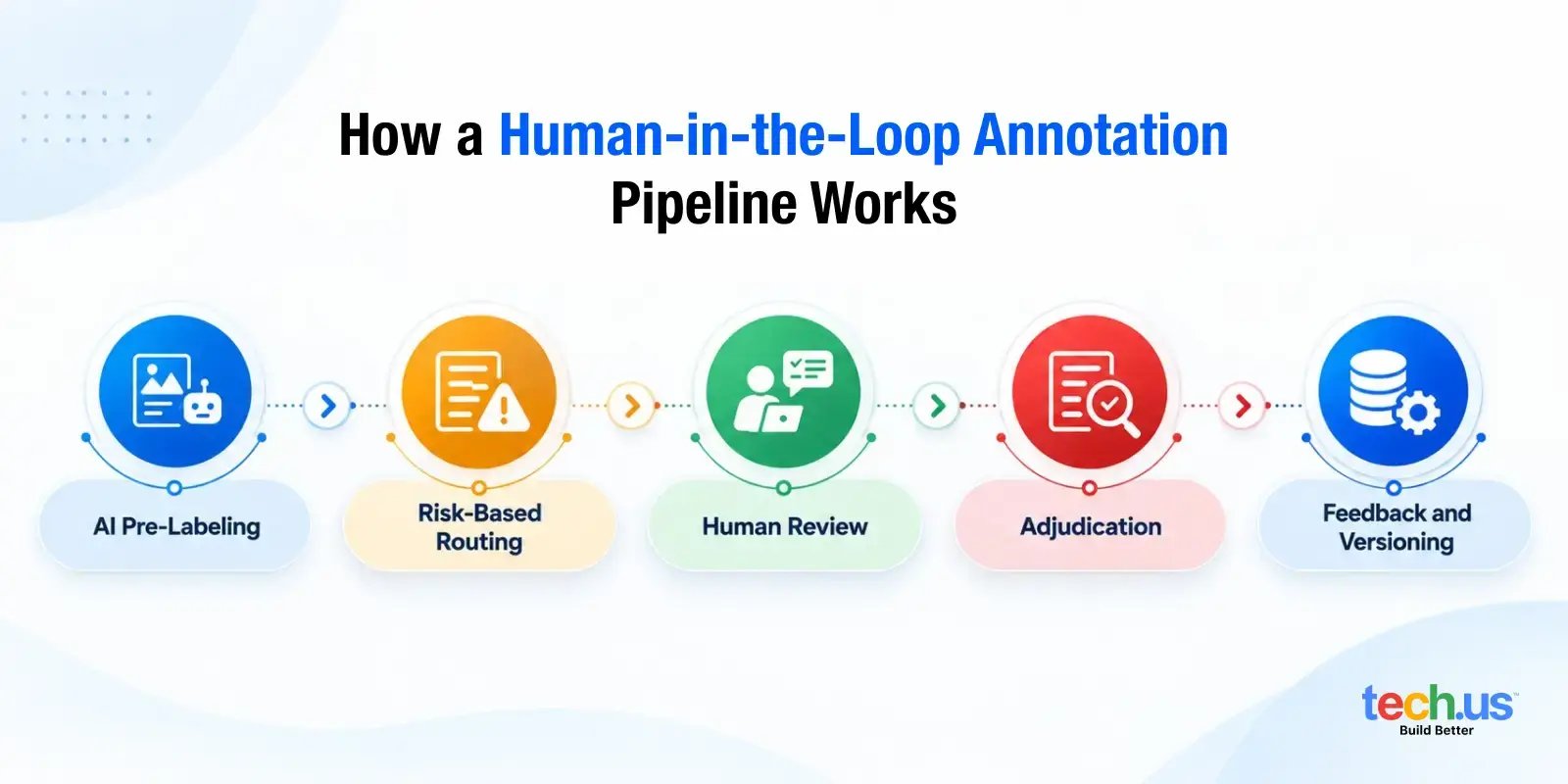
A reliable annotation pipeline usually has five connected stages.
AI Pre-Labeling
A model creates an initial label and the signals needed for routing. Depending on the task, those signals may include confidence, uncertainty, novelty, or disagreement with another model.
Risk-Based Routing
Rules send selected records to the right reviewer. The queue should combine model uncertainty with business consequence and include a random audit sample.
Human Review
Reviewers confirm, correct, or escalate records. The interface should support independent judgment and avoid making acceptance the easiest default.
Adjudication
Disagreements move to a domain expert or senior reviewer. The pipeline retains the reason for the final decision, not only the final label.
Feedback and Versioning
Corrections return to the training process. Annotation guidelines, examples, routing rules, and model versions are tracked together so the team can explain why a label changed.
Clear ownership matters. Annotators apply the rules, reviewers identify patterns, domain experts resolve ambiguity, and ML engineers manage thresholds and retraining. One named owner must keep the guidelines current.
Where Human Review Adds the Most Value
Human review earns its cost when the correct label depends on context beyond the obvious contents of a record.
- Sentiment and intent: People help with sarcasm, indirect requests, mixed signals, and cultural context.
- Named entity recognition: Review is useful when the same term can refer to different entities depending on context.
- Document classification: Experts resolve cases where policy language or business purpose matters more than keywords.
- Computer vision: People are valuable for occluded objects, crowded scenes, poor image quality, and unclear boundaries.
- Medical imaging: Qualified experts remain essential where subtle findings carry high consequences and legitimate expert disagreement exists.
- Multimodal data: Review should be triggered when text, image, audio, or video signals contradict one another.
Multimodal disagreement is easy to miss. An image model and a language model may each be confident while reaching conflicting conclusions. The problem appears only when their signals are evaluated together.
Should You Build the Annotation Workflow In-House?
An internal team can work well when the taxonomy is stable, reviewers do not need scarce expertise, and quality controls and audit trails already exist.
A specialist partner becomes more useful when:
- The taxonomy changes frequently.
- Review requires experienced domain professionals.
- Data cannot leave a controlled environment.
- Multiple languages or data types are involved.
- The project needs independent quality measurement.
- Internal experts are available for decisions but not daily queue management.
- How is agreement measured on our data?
- What happens when two reviewers disagree?
- Are any records reviewed without showing the model prediction?
- How are known test items used to monitor attention and quality?
- Who owns guideline changes?
- Can results be reported by class, language, and data segment?
- Where is data stored, processed, logged, and retained?
A single headline accuracy number is not enough. You need to know how it was measured, which classes it hides, and what happens when the underlying rules change.
Route Human Review by Risk Level
The strongest human-in-the-loop systems do not send everything to people, and they do not trust automation everywhere. They route judgment deliberately.
Start with the cost of a wrong label. Identify the classes where confident errors could hide. Preserve independent human judgment. Measure reviewer behavior as carefully as model behavior. Then reduce review only when the evidence shows that doing so is safe.
Tech.us helps organizations design data annotation services and machine learning systems around real workflows, risk levels, and data constraints. If you are deciding where human review belongs in your AI pipeline, talk to our AI expert.
FAQs
Human-in-the-loop annotation is a workflow in which AI produces initial labels and people review selected records before the labels are accepted as training data. The human reviewer can confirm, correct, or escalate the result.
There is no standard percentage. Review should focus on low-confidence, novel, high-consequence, and historically difficult records, plus a random sample of high-confidence predictions. The rate should change as the model and data evolve.
LLMs can handle useful first-pass work, but they are not dependable final reviewers for every task. Human judgment remains important when labels depend on specialized knowledge, subtle context, multilingual nuance, or consequential decisions.
No. Review helps only when people evaluate records carefully and can disagree with the model. Poor interface design, anchoring, unclear guidelines, and reviewer fatigue can turn review into rubber-stamping.
One reviewer is often enough for routine records. Double review is useful for consequential classes, quality measurement, and ambiguous cases. If many records need a third reviewer, the taxonomy or guidelines probably need revision.
Track agreement between reviewers, model-label overturns, seeded-error detection, blind-review differences, adjudication volume, review time by class, and production errors after review.