AI

The Four Walls of AI Adoption: What Holds Companies Back

Why do AI initiatives stall? Explore four common barriers to AI adoption and learn how businesses can overcome costs, talent gaps, and integration challenges.

By Anand Selvadurai Published Oct 13, 2026 13 min read

Overview 

Companies struggle with AI for different reasons depending on how far they have already gone. 
Before adoption, the biggest barriers are finding a use case worth pursuing and having enough technical capability to begin. After adoption starts, the problems change. Cost rises, specialized talent gets harder to find, and integration with existing systems becomes the real work. 
That distinction matters. 
In a survey of 885 U.S. business executives and managers by the University of Maryland's Smith School of Business, close to 58% said their firms had put AI to work in some form. That sounds like progress until you sit with the other number. More than four in ten have either stalled or never started. The pattern behind why so many AI initiatives fail to deliver is rarely a single cause.
Most companies have made up their mind about AI. The harder question is why so many of them are stuck. 
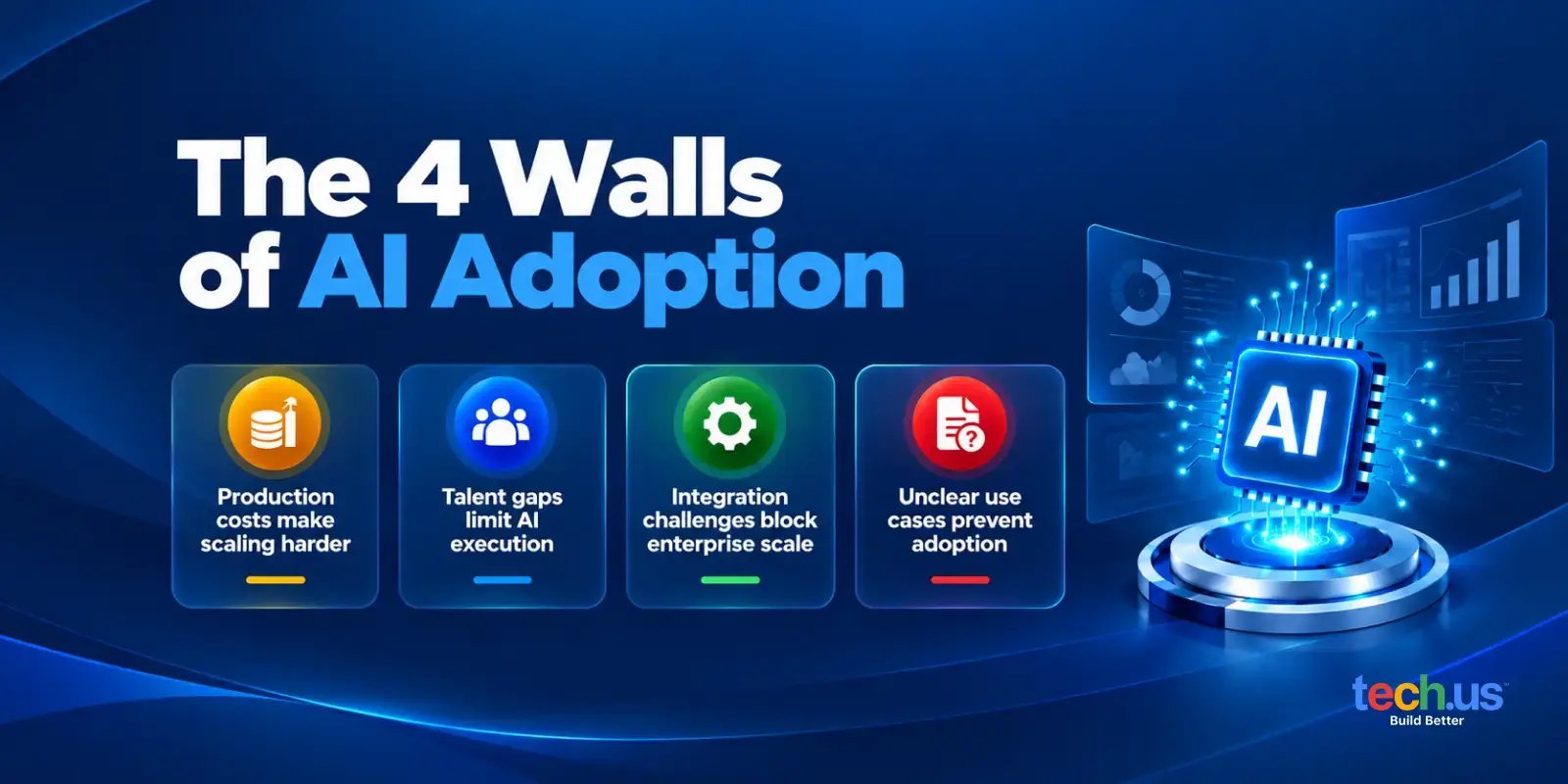
AI adoption tends to run into four separate walls: cost, talent, integration, and mindset. And here is the part most coverage misses. The walls you hit depend on where you already are. Companies that have started AI face a different set of obstacles than companies still standing at the door. 
This blog breaks down all four, and what it takes to get past them. 
ai-adoption-challenges

Why Most AI Efforts Stall Before They Scale 

The difference between companies that have not adopted AI and those struggling to scale it is simple: one group has an entry problem. The other has an execution problem.

Here is something the headlines about AI adoption tend to skip over. The companies that get stuck are not all stuck for the same reason. 
When the Smith School survey looked at what holds companies back, it did not produce one tidy list. It produced two. And the difference between them tells you more than any single statistic. 

The Walls You Hit After You Start 

For companies already using AI, scaling becomes the problem. 
Among firms using AI, more than 35% pointed to the same three hurdles: high initial costs, difficulty recruiting skilled professionals, and the challenge of integrating AI with existing IT infrastructure. 
These are execution problems. You only meet them once you have committed, started building, and tried to move past a pilot. They are the walls of scaling. 

The Walls That Stop You From Starting 

Companies that have not adopted AI face a different problem: they have not yet found a strong enough reason or enough capability to begin. 
For them, the two most common reasons were the absence of a clear use case or perceived need, and limited technical expertise or resources to implement and manage the technology. 
These are entry problems. They show up before a single dollar is spent. 

Why the Distinction Matters 

Put together, the four walls fall into two groups. 
Cost, talent, and integration slow down companies already in motion. Use cases and expertise keep others from moving at all. 
That explains why broad conversations about "AI adoption challenges" are often not very useful. A company deciding where AI fits has a fundamentally different problem from one trying to get its fifth pilot into production. 
Knowing which wall you face tells you where you actually stand. 
ai-adoption-challenges-Infographic

Wall 1: Cost 

AI becomes more expensive when it moves from pilot to production because the model stops being the whole project. 
Infrastructure, data pipelines, integrations, monitoring, security, and the people needed to operate the system begin showing up on the bill. 
High initial cost is one of the leading reasons AI projects stall after they begin. Among firms already using AI, it was one of three hurdles named by more than 35% of respondents in the Smith School survey. 
What makes cost tricky is that it rarely stops a company from trying. It stops them from scaling. 

The Cost of a Pilot Is Not the Cost of Production 

A pilot is cheap. A few licenses, a small team, a contained use case, and you have something to show leadership. The trouble starts when you try to take that pilot into production. 
Now you are paying for infrastructure, data pipelines, integration work, security requirements, monitoring, and people who know how to keep it all running. The bill grows in places you did not budget for. 
This is why a successful pilot can still stop at the funding conversation. 
The technology proved it could work. What nobody proved was what it would cost to make it work every day. 
 This is where intent and outcome part ways. A company can be fully sold on AI and still find that the cost of doing it properly outpaces the appetite to fund it. The pilot works, the business case looks sound, and the project quietly stalls because no one planned for what scaling actually costs.

The companies that get past this wall treat cost as a staged commitment, not a single line item. They fund against value delivered, not promise made, scoping it around the business operations AI can measurably improve. 

That keeps the budget honest and the project alive. 

Wall 2: Talent 

Companies do not need to hire a large permanent AI team before they can scale AI. But they do need access to the right capability. That distinction gets lost when talent is treated purely as a recruiting problem. 
Talent is the one wall that stands in front of every company, whether they have started with AI or not. It is the only obstacle in the Smith School survey that showed up on both sides of the line. 

Two Versions of the Same Problem 

For companies already using AI, the issue was difficulty recruiting skilled professionals. It was one of three hurdles named by more than 35% of firms in that group. 
They have projects underway and not enough people who can build and run them. 
For companies that have not adopted AI at all, the issue reads a little differently. They cited limited technical expertise or resources to implement and manage the technology. 
They are not short on hires. They are short on the basic capability to begin. Same root cause, two faces. One group cannot scale for lack of talent. The other cannot start for lack of it. 

Why Hiring Alone Does Not Solve It 

The reflex is to post more job openings. 
But the people who can design, deploy, integrate, and maintain AI systems are scarce and expensive, and the firms competing for them are deep-pocketed. 
There is also a timing problem. Building a permanent team can take longer than proving whether the opportunity deserves a permanent team in the first place. 
The better question is not, "How many AI people should we hire?" 
It is, "Which AI capabilities need to exist inside the company, and which ones simply need to be available when the work requires them?" 
Companies that get past this wall stop treating talent as a hiring problem. They build capability through training, partnerships, and outside teams that bring the capability with them.
The capability matters. The employment model is secondary. 

Wall 3: Integration 

For most enterprises trying to scale AI, a better model is not the hardest problem. 
Getting that model to work reliably with the data, software, workflows, and infrastructure the business already depends on usually is. 
Integration is where AI projects go to die quietly. Among firms already using AI, the challenge of integrating it with existing IT infrastructure was one of three hurdles named by more than 35% of respondents in the Smith School survey. 
This is the least visible of the walls, and often the most stubborn. 

Why AI Works in a Pilot but Fails at Enterprise Scale 

A pilot proves that AI can perform a task under controlled conditions. Production asks whether it can perform that task inside the business. 
Those are not the same test. 
Most AI pilots run in isolation. They sit on clean, prepared data in a controlled setup, and they perform well precisely because nothing else is plugged into them. 
The demo impresses everyone in the room. Then comes the part no one demos. 
Connecting that model to the systems the business actually runs on. The legacy databases, the aging ERP, the permissions, the workflows, and the data scattered across formats and departments that were never designed to talk to one another. 
That is where momentum stalls. The model works but the plumbing does not. 

Why Old Systems Resist New AI 

Integration is hard because most companies are not building on a blank page. 

They are bolting AI onto decades of infrastructure that was never meant to support it, which is where most AI integration mistakes with existing systems begin.

Data has to be cleaned, standardized, accessible, and available at the right time before a model can use it reliably in production. 
That makes data readiness and integration more than technical preparation. They determine whether a promising model can become a useful business system at all. 
Companies that clear this wall plan for integration at the start, not after the pilot succeeds. They treat data readiness and system architecture as part of the project, not an afterthought to it. 

Wall 4: Mindset 

Companies often struggle to find valuable AI use cases because they start with AI rather than with the business problem. 
"What can we do with AI?" sounds like the right opening question. 
Usually, it is too broad to be useful. 
Mindset is the first wall, even though it shows up last on most lists. Among companies that have not adopted AI at all, the most common reason in the Smith School survey was the absence of a clear use case or perceived need for the technology. 
This is the wall that comes before the others. You cannot run into cost, talent, or integration if you never see a reason to start. 

The "No Use Case" Problem 

It is easy to read "no clear use case" as a polite way of saying no interest. It usually means something more specific. 
The company has heard plenty about AI in the abstract and has not yet seen where it fits its actual work. 
That happens when the conversation starts with technology. 
Starting with a process that is slow, expensive, repetitive, difficult to scale, or dependent on information people struggle to access produces a different conversation. Now AI has something concrete to prove itself against. 
The technology stops being the headline and becomes one possible tool for solving the problem. 
Until that connection happens, there is nothing to fund and no project to start. The first move is an honest read of whether the business is ready for AI at all.

Why This Wall Is Different 

The other three walls are problems of execution. This one is a problem of perception. And perception is harder to budget for, because there is nothing concrete to point at yet. 
This is also where the survey's two groups separate cleanly. Companies already using AI are arguing about how to scale it. 
Companies still behind this wall are not having that conversation at all. They have not been given a reason to. That reason is the work that has to come first. 

What Keeps Successful AI Pilots From Scaling? 

A successful pilot can prove that the technology works without proving that the business is ready to operate it. That gap explains a lot of stalled AI programs. 

Moving into production brings all four walls together. The economics change. The system needs people who can operate it. Real data and infrastructure replace the controlled pilot environment. And the use case has to create enough value to justify everything required to keep it running.

That is why another pilot rarely fixes a scaling problem. If the first pilot already proved the technology, the next question is not whether AI can work. It is whether the organization around it can. 

Breaking Through the Walls 

What separates companies that scale AI from those stuck in experimentation is not one technical advantage. 
It is their ability to treat use-case selection, economics, talent, and integration as one operating problem. 
No single fix gets a company past all four walls. The companies that scale AI successfully are not the ones who solved cost, or hired the right people, or nailed integration. 
They are the ones who stopped treating those things separately. That is the shift. Mindset, cost, talent, and integration are not a checklist to clear one at a time. They reinforce each other. 
  • A clear use case makes the cost easier to justify.
  • The right talent makes integration less painful.
  • Better integration makes the system easier to put into real workflows.
  • Real adoption gives the business evidence that the next investment is worth making.
Plan for one in isolation and the others tend to pull the project back down. 

What Clearing the Walls Actually Looks Like 

The companies getting through share a pattern. 
  • They reframe the use-case question first, so there is a real problem worth funding.
  • They fund AI against value delivered rather than promise made.
  • They build talent through training and partnership instead of assuming every capability has to be hired permanently.
  • And they plan integration from the start, not after the pilot works.
That is four habits, not four projects.

Why the Right Partner Matters 

Most companies do not carry all of that capability in-house, and they should not have to. 
The execution walls, cost, talent, and integration, are exactly where the right partner earns its place. A vendor offering end-to-end artificial intelligence services brings the people, the integration experience, and the staged approach to cost that a first attempt usually lacks.
The best AI partner is not the largest or the loudest. Knowing how to select the right AI development partner matters more than size.
That is the role a partner like Tech.us is built for, helping companies move from a stalled pilot to AI that runs in production. The goal is not more AI experiments. It is getting the right ones through the walls.
Tech.us is an AI development company that builds custom AI solutions for businesses seeking measurable results. We partner with organizations to design, develop, and deploy scalable AI systems that solve complex challenges and unlock new opportunities for growth. Our team delivers practical AI applications that create tangible business impact across industries.
Anand Selvadurai

Anand Selvadurai

Director of AI/ML at Tech.us

Director of AI/ML 16+ years experience AI/ML Specialist

Written by Anand Selvadurai, Director of AI & ML at Tech.us — 16+ years experience designing enterprise ML pipelines and deploying production-grade AI systems across Construction, healthcare, fintech, and logistics. Certified Machine Learning Specialist and Research Scholar.


View all articles