-
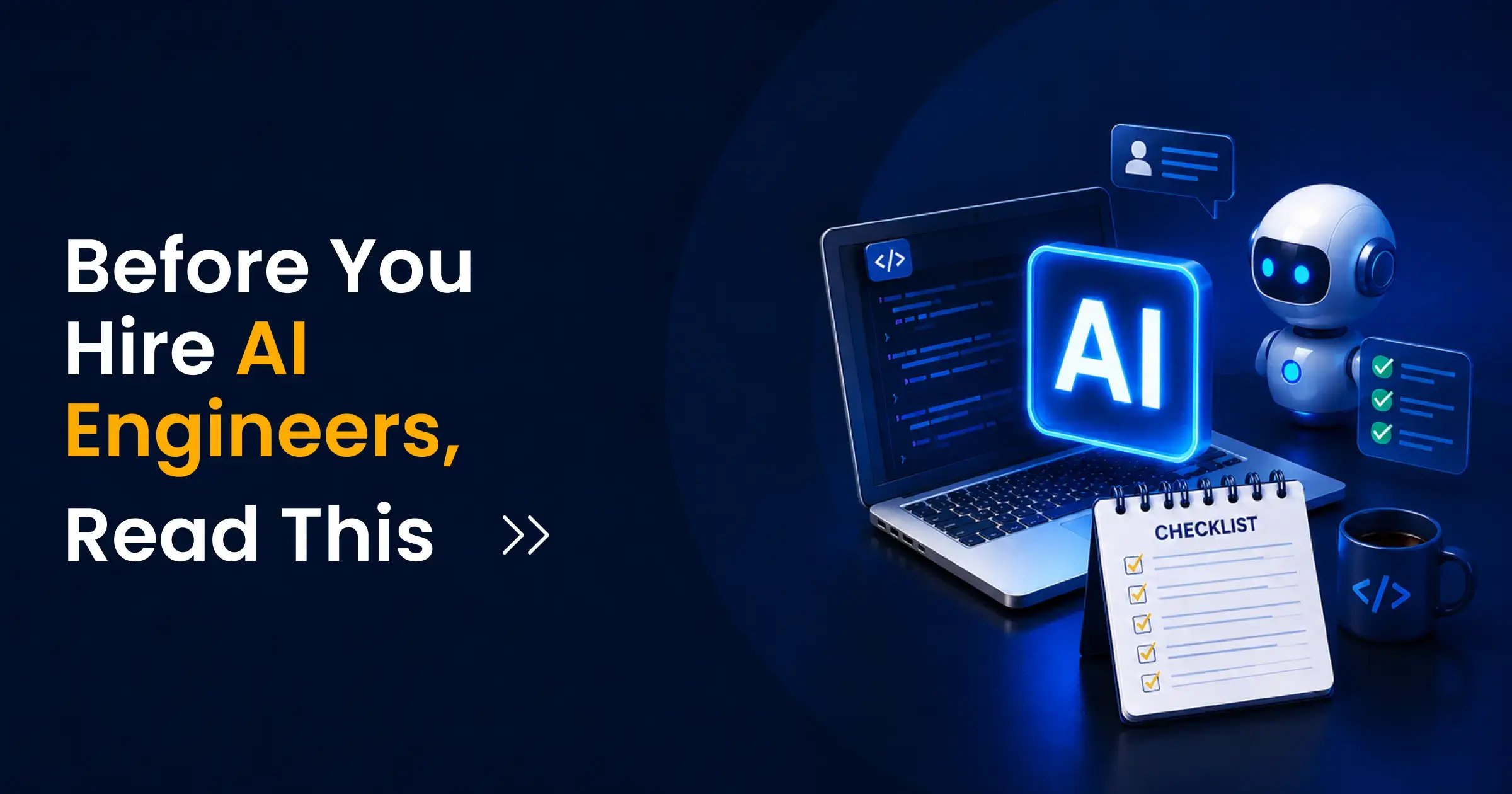
Before hiring AI engineers, make sure you know which business problem you're solving.
-
A successful AI project often creates more opportunities than the original plan anticipated.
-
Clear priorities will take you further than a bigger AI team.
-
AI engineers can build great solutions, but the business still needs to set the direction.
-
Not every AI initiative requires building a long-term internal capability.
-
Getting people to use AI is often harder than building the technology itself.
-
The best hiring decisions come from thinking years ahead, not quarters ahead.
-
Sometimes the smartest first step is validating AI opportunities before scaling a team.
Should Hiring an AI Team In-House Your First Decision?
Spend enough time in executive meetings today and you'll notice a pattern. Someone mentions AI. A few use cases get discussed. Budget conversations begin. Then, almost inevitably, somebody says:
"Should we start hiring AI engineers?"
It sounds logical. After all, if AI is becoming important, surely the next step is building a team. But that's not usually how things unfold inside a business.
When AI Requests Start Coming from Every Direction
The pressure rarely comes from one place.
Sales wants help generating proposals faster. Operations wants to automate repetitive processes. Customer support wants AI assistants. Product teams want AI-powered features. Leadership wants to know what the company is doing with AI.
Suddenly, every request feels important.
Why Prioritization Matters More than Hiring
This is where things get interesting. The challenge is often not a shortage of AI talent. It's a shortage of focus.
If five departments have five different AI ideas, hiring engineers doesn't solve the problem. It simply gives the organization more capacity to work on unclear priorities.
The companies making the most progress with AI are usually the ones that slow down long enough to answer a harder question first: Which problem is actually worth solving?
Because once that answer becomes clear, everything else becomes easier. Hiring. Budgeting. Team structure. Even deciding whether you need an internal team at all.
A Scenario Playing Out Inside Many Companies Right Now
Let's say a company decides to hire a small AI team.
A machine learning engineer comes in. Then another. Maybe an AI architect joins a few months later. The first project gets approved and everyone rallies around it. Meetings happen. Models get built. The solution goes live.
Eventually, the project is delivered. And that's where a different set of questions starts showing up.
The engineers are still there. The budget is still there. Leadership has seen what's possible with AI and naturally wants more.
So what comes next? Sometimes there's already a clear roadmap waiting. Sometimes there isn't.
One department has an idea. Another team wants something completely different. A third request sounds promising but may not deliver much business value at all.
This is often the moment when organizations realize they are no longer managing a project. They're managing an AI capability.
And that requires a different level of planning, ownership, and decision-making than simply hiring a few talented engineers.
Questions to Ask Before Hiring AI Engineers
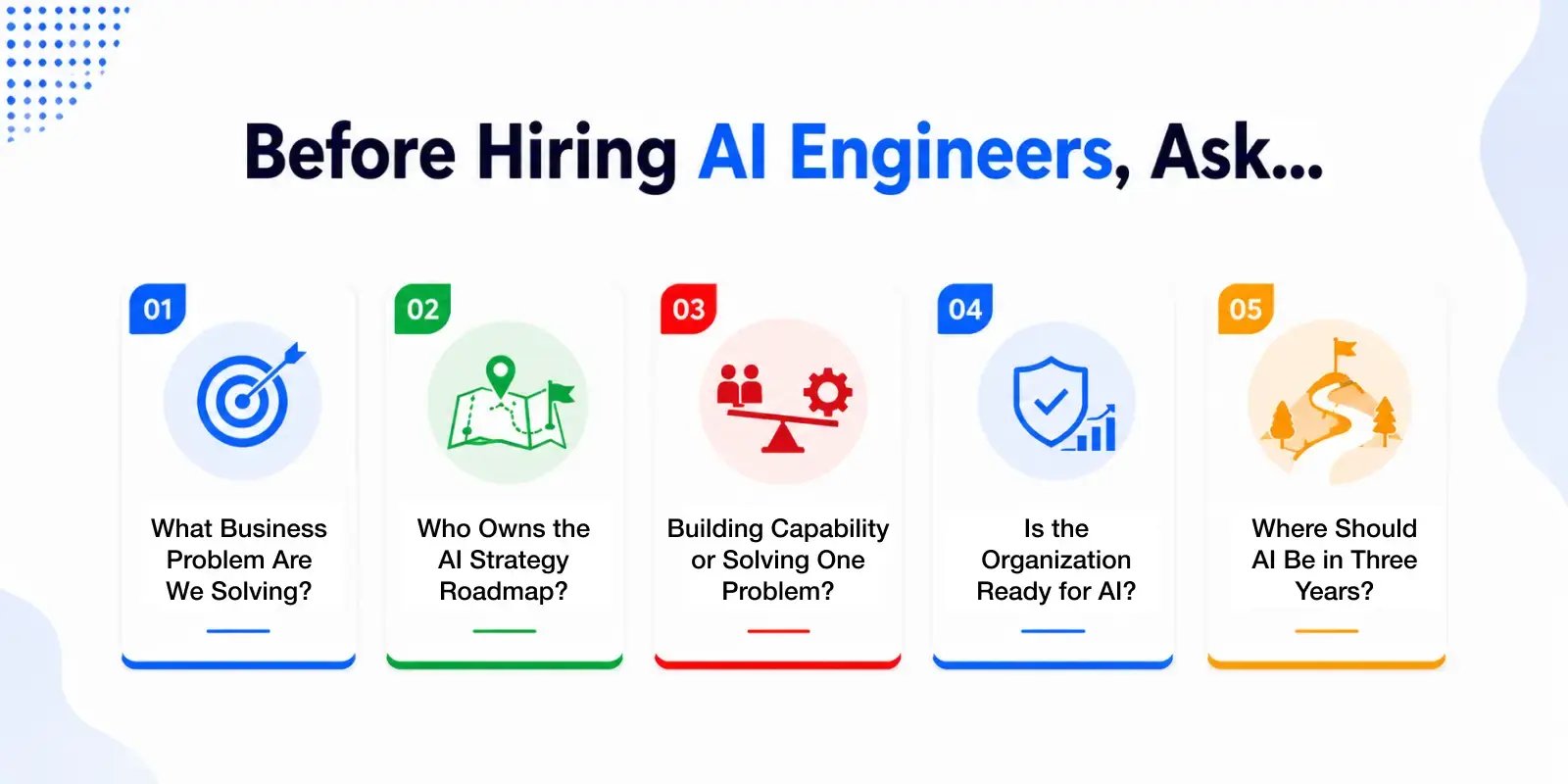
As common as it seems to hire AI engineers as the first step towards AI transformation, there are other important questions you need to ask before jumping on to that decision. Let’s discuss about each one of them.
Question #1: What Problem Are You Actually Trying To Solve?
One of the most common conversations happening in companies today goes something like this:
"We need an AI strategy."
It sounds reasonable. The problem is that it isn't actually a goal. AI is a technology. A business objective is something else entirely.
If you sit down with most leadership teams and keep asking "why?", the real objective usually starts to emerge. Maybe proposal creation is taking too long. Maybe support teams are buried in repetitive requests. Maybe employees waste hours searching for information spread across different systems.
Now we're talking about a problem worth solving. The distinction matters more than people realize.
When the objective is vague, everything becomes difficult. Teams struggle to prioritize. Different departments pull in different directions. Success becomes hard to measure because nobody agreed on what success looked like in the first place.
On the other hand, when the business problem is clear, decision-making becomes surprisingly straightforward.
For example:
- Reducing proposal turnaround time by 50%
- Cutting manual data entry work
- Improving employee productivity
- Speeding up customer response times
Those goals create focus. And once there's focus, other decisions become easier too.
Do you need AI engineers? Do you need external specialists? Do you need a six-month initiative or a multi-year roadmap?
Question #2: Who Owns the AI Roadmap?
This is where AI initiatives quietly get messy.
At the start, everyone is interested. Product has ideas. Operations has pain points. Engineering is expected to build. Leadership wants progress.
But who actually owns the roadmap? Not the meetings. Not the excitement. The roadmap.
Because without clear ownership, AI work turns into a collection of disconnected requests. One team wants automation. Another wants reporting. Someone else wants an internal chatbot. All useful, maybe. But not all equally important.
And this is the part companies need to be careful about: AI engineers should not be forced to decide business priorities.
Their job is to design, build, test, and improve systems. They can absolutely advise on feasibility. They can spot technical risks. But deciding which AI initiative deserves investment is a business decision.
Someone has to connect AI work to revenue, productivity, cost savings, customer experience, or operational speed. Without that owner, even a strong AI team can end up building in the wrong direction.
Question #3: Are You Building Capability or Solving a Specific Problem?
This question sounds simple, but it influences almost every decision that follows.
Let's say your goal is to automate proposal generation. Or improve knowledge search across the company. Or reduce manual work inside a specific process.
That's a project. It has a defined objective, a measurable outcome, and ideally, a finish line. Building an AI capability is different.
Now you're thinking beyond a single use case. You're investing in people, processes, governance, infrastructure, and long-term ownership because you expect AI to become part of how the business operates moving forward.
Neither approach is better. They're just different. This is also where building an internal AI team can make perfect sense.
If AI is becoming part of your product strategy, your competitive advantage, or a multi-year business initiative, having internal expertise is valuable. Knowledge stays within the company. Teams develop deeper context. Capabilities compound over time.
The mistake is assuming every AI opportunity requires that level of investment.
- Sometimes you're building a capability.
- Sometimes you're solving a problem.
Understanding which one you're doing can save a lot of time, money, and organizational confusion later.
Question #4: Is Your Organization Ready to Operationalize AI?
Many companies assume the hard part is building the AI solution. In reality, that's often the easiest part. The bigger challenge starts after launch.
According to IBM's Global AI Adoption Index, 42% of enterprise companies (>1,000 employees) have deployed AI, but 33% report limited AI skills and expertise as the primary barrier, with data complexity (25%) and integration challenges (22%) also ranking among top obstacles.
The model works. The assistant is live. The automation is ready. Yet adoption stalls. Employees continue using old processes. Teams find workarounds. Expected business impact never fully materializes.
Why? Because successful AI initiatives require more than technology. They require people changing how they work.
Think about it. If a new AI system affects sales workflows, support processes, or internal decision-making, someone needs to drive adoption, answer questions, measure outcomes, and ensure the solution becomes part of everyday operations.
This is where many projects lose momentum. Not because the technology failed. Because operational ownership was never clearly defined.
The companies seeing the strongest results from AI usually treat deployment as the halfway point, not the finish line. They understand that building the solution creates potential value. Getting people to consistently use it is what turns that potential into actual business results.
Question #5: How AI Looks Like Three Years from Now?
Most AI discussions focus on the next project. The better question is what happens after that.
Imagine your first few AI initiatives work. Teams start seeing results. More departments begin asking for AI support. Leadership allocates additional budget. Expectations grow.
Now you're operating in a very different environment. At that point, AI is no longer an experiment. It's becoming part of how the business functions. That's why it's worth looking three years ahead.
There are no right or wrong answers here. But companies that think about these questions early tend to make better decisions today. Because hiring is not really about filling roles. It's about preparing for the organization you're trying to build.
And sometimes the best hiring decision is not based on what you need this quarter. It's based on where the business is headed over the next few years.
When Working with an AI Development Company Make Sense
By now, you may have noticed something. Not every organization needs to build an AI capability from day one.
Sometimes the business needs outcomes before it needs an AI department. That's where working with a company offering AI development services can become a practical option.
When Speed Matters More Than Team Building
Hiring AI talent takes time.
Even after the hiring process is complete, teams still need onboarding, alignment, and time to become productive.
Many organizations simply cannot wait that long. They have clear business problems, executive support, and pressure to deliver results.
In those situations, an experienced AI partner can help accelerate execution while the business focuses on day-to-day operations.
When You Need Expertise That Doesn't Exist Internally
This is more common than many leaders admit.
A company may have strong software engineers but limited experience with AI architecture, retrieval systems, model evaluation, AI governance, or production deployments.
Building that expertise internally is possible. The question is whether it makes sense to build it before you've validated the opportunity.
When the Goal Is Learning Before Scaling
One of the smartest uses of an AI development company has nothing to do with outsourcing. It's about reducing uncertainty.
Before investing heavily in hiring, some organizations prefer to validate use cases, understand implementation challenges, and prove business value first.
That learning often shapes what an eventual internal AI team should look like. In other words, the decision is not always internal team versus AI partner.
Sometimes the fastest path to building the right AI capability is working with experienced specialists before scaling it internally.
In a Nutshell
The decision to hire AI engineers is rarely just a hiring decision.
It's often a signal that the business is entering a new phase. One where AI moves from an interesting idea to an operational capability.
That's why the smartest organizations spend less time asking, "How quickly can we build an AI team?" and more time asking, "What are we actually trying to achieve?"
Sometimes the answer leads to building a strong internal AI function. Sometimes it leads to working with experienced AI specialists first. Both can be the right path.
What matters is making sure your team structure follows your business strategy, not the other way around.
Because in the end, successful AI initiatives are rarely defined by who built them. They're defined by the business outcomes they create.
FAQs
Not necessarily. Many companies start by solving a specific business problem first and then decide what kind of AI capability they need over time.
Hiring before defining clear business objectives. Even the best AI talent will struggle if priorities and success metrics are unclear.
A good sign is when AI is becoming a long-term business capability rather than a one-off project. That's usually when internal expertise starts making more sense.
Not at all. Many organizations with strong engineering teams work with AI specialists to accelerate execution and gain expertise they don't have in-house.
The roadmap. A clear direction helps you make better decisions about hiring, budgeting, technology, and execution from the start.

Tech.us is an AI development company that builds custom AI solutions for businesses seeking measurable results. We partner with organizations to design, develop, and deploy scalable AI systems that solve complex challenges and unlock new opportunities for growth. Our team delivers practical AI applications that create tangible business impact across industries.

Continue reading the blog
with a Tech.us subscription
You’re now subscribed!