-
Hospitals don't have a bed shortage problem as often as they have a visibility problem.
-
A delayed discharge can create a chain reaction that affects patient flow across the hospital.
-
AI helps hospitals spot admission surges before they start overwhelming staff and capacity.
-
Better discharge forecasting gives teams a clearer picture of when beds will become available.
-
Bed demand forecasts are most useful when admissions, discharges, and occupancy data are viewed together.
-
The real value isn't predicting the future perfectly. It's giving teams enough time to prepare.
-
Hospitals that can anticipate capacity pressures spend less time firefighting and more time planning
-
Predictive AI helps turn hospital operations from reactive to proactive.
Overview
A hospital can have excellent clinicians, enough physical beds, and well-designed care pathways. Yet a sudden spike in admissions, a cluster of delayed discharges, or an unexpectedly busy emergency department can throw the entire operation off balance within hours.
This is why forecasting has become such a critical operational discipline.
Why Predicting Hospital Capacity is Difficult
Admissions Rarely Follow a Predictable Pattern
One of the biggest misconceptions outside healthcare is that patient demand follows a neat, consistent trend. But it doesn't.
Emergency departments are the clearest example. A hospital may see a manageable number of patients on a Tuesday afternoon, then suddenly experience a surge a few hours later because of a local accident, an infectious disease outbreak, extreme weather conditions, or a community event.
Surgeries, specialist referrals, transfers from other facilities, and post-operative recoveries all contribute to bed demand. Individually, these seem predictable. Together, they create a constantly shifting picture.
- How many patients are likely to arrive through the ED tonight?
- How many surgical patients will require inpatient beds tomorrow?
- Which units are most likely to experience capacity pressure?
Discharge Planning is Often the Bigger Challenge
Interestingly, many hospitals struggle more with discharges than admissions.
A patient may be medically ready to leave, but that does not always mean the discharge happens.
- Pending lab or imaging results
- Delayed physician sign-off
- Insurance authorization requirements
- Coordination with rehabilitation or long-term care facilities
- Transportation arrangements for patients and families
The Ripple Effect Across the Hospital
This is where capacity planning becomes an operational challenge rather than a bed management problem.
When admissions and discharges become difficult to anticipate, hospitals begin reacting instead of planning.
The consequences show up quickly:
- Emergency department patients wait longer for inpatient beds.
- Patients remain boarded in the ED.
- Care teams spend more time searching for available capacity.
- Elective procedures may need to be delayed.
- Staffing resources become harder to allocate efficiently.
How AI Predicts Patient Admissions Before Demand Peaks
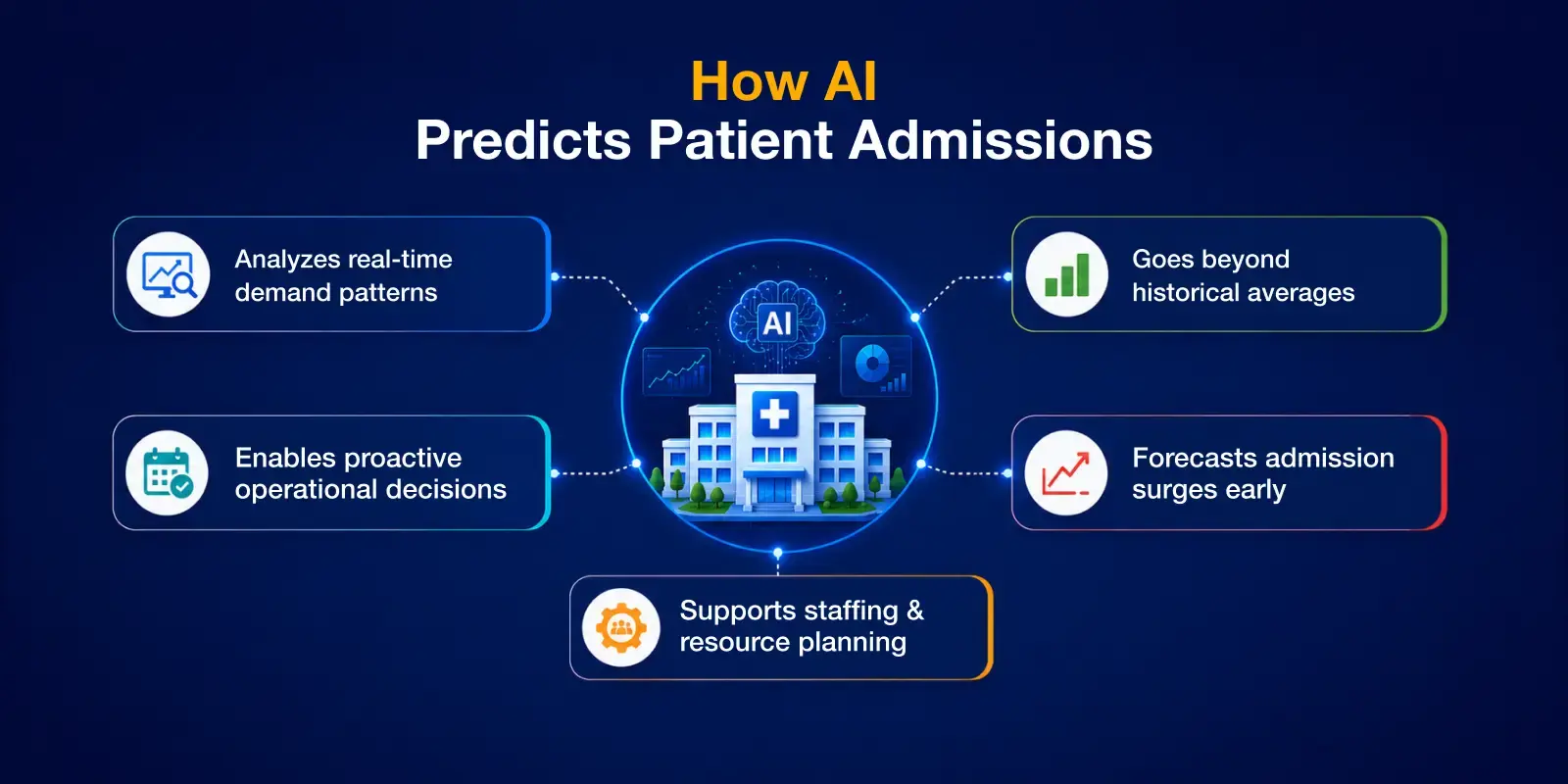
Most hospital leaders are not asking for perfect predictions. They are asking for a little more visibility.
If a hospital could know that admissions are likely to increase tomorrow afternoon, staffing decisions would look different. Bed allocation decisions would look different. Even discharge planning conversations would start earlier
That is where AI is proving valuable. Many of the leading AI healthcare solution providers are focusing heavily on predictive analytics because even small improvements in forecasting can create significant operational gains.
Not because it can predict the future with absolute certainty, but because it can spot patterns that humans simply cannot process fast enough.
Looking Beyond Historical Averages
Traditionally, hospitals have relied heavily on historical trends. The problem is that yesterday's numbers do not always explain tomorrow's demand.
Instead of analyzing a single data source, they continuously evaluate signals from across the organization and the surrounding environment.
- Historical admission patterns
- Emergency department arrival volumes
- Seasonal illness trends
- Public health surveillance data
- Scheduled surgeries and procedures
- Local weather conditions
- Population health trends within the service area
What Hospitals Actually See
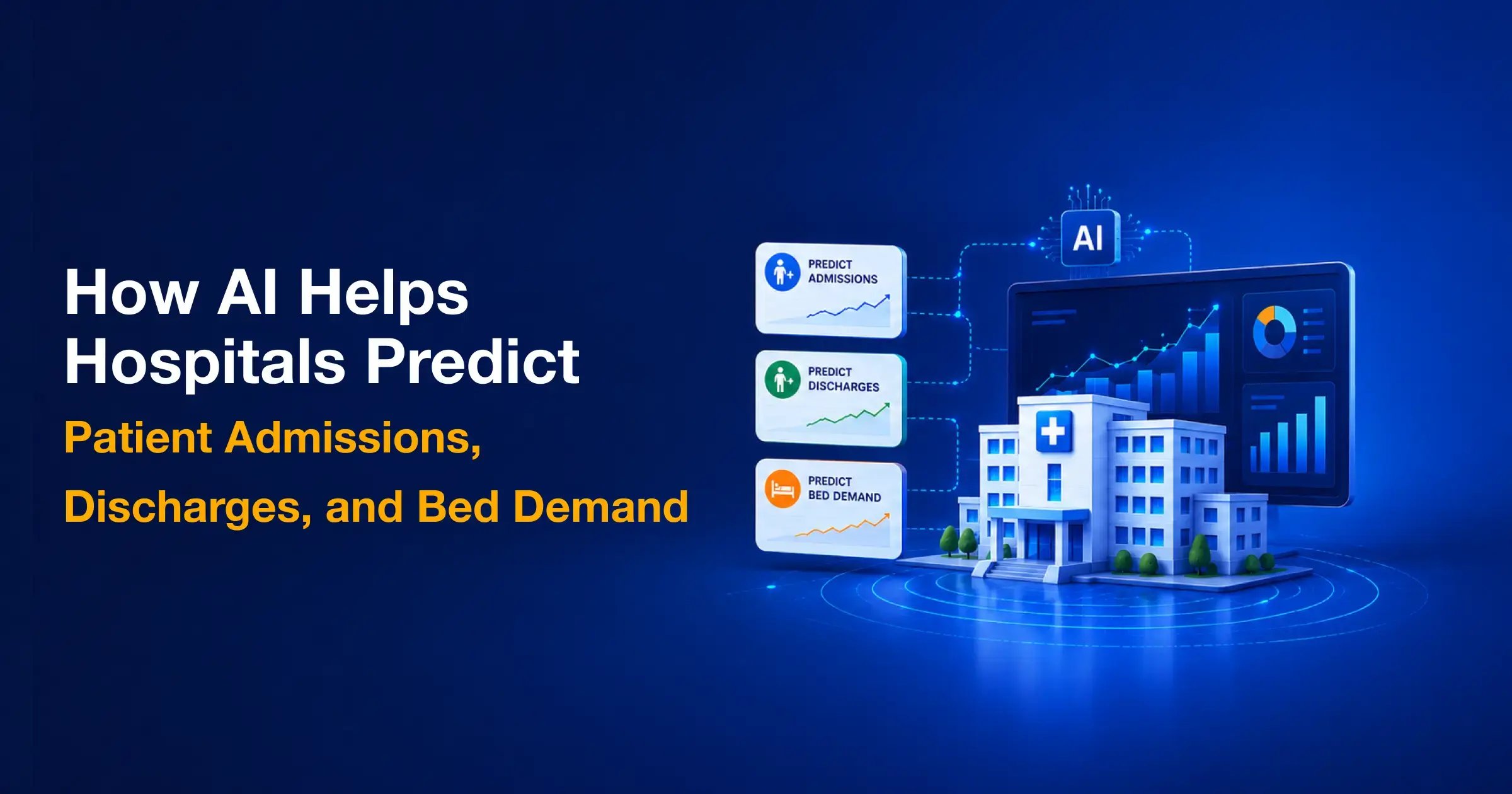
- Expected admissions over the next 24 hours
- Predicted admission volumes by department
- Occupancy projections by unit
- Areas likely to experience capacity constraints
Turning Predictions into Operational Decisions
This is where the real value emerges. A forecast by itself does nothing. What matters is what happens next.
According to the CDC, emergency department visits in the United States reached 155.4 million in 2022 (47.3 visits per 100 persons), creating significant pressure on hospital capacity and patient flow planning. When patient volumes fluctuate unexpectedly, even small forecasting errors can have operational consequences across the hospital.
How AI Predicts Patient Discharges More Accurately
Most hospitals pay close attention to admissions. Fewer pay the same attention to discharges.
Looking for Signals Humans Can Easily Miss
Discharge planning involves dozens of moving pieces. AI systems analyze a combination of factors that influence when a patient is likely to leave, including:
- Diagnosis complexity
- Length of stay patterns
- Treatment milestones
- Lab and imaging results
- Care plan progression
- Historical discharge trends
- Readmission risk indicators
Predicting Discharge Readiness Earlier
The goal is not simply to estimate a discharge date.
The more valuable insight is identifying which patients are likely to be discharged within the next 24 hours and which patients are at risk of delays.
Research published by the Agency for Healthcare Research and Quality (AHRQ) found that delayed discharges contribute to bed shortages, emergency department crowding, and reduced hospital efficiency.
Why This Improves Patient Flow
When discharge forecasting becomes more reliable, hospitals gain something extremely valuable: confidence in future bed availability.
That translates into faster patient transfers, reduced emergency department boarding, better bed utilization, and smoother throughput across the organization.
In other words, discharge prediction is not really about predicting who leaves. It is about knowing when capacity is coming back.
How AI Helps Hospitals Forecast Bed Availability
At this point, admissions and discharges stop being separate operational problems. They become part of a much bigger question.
“How many beds will actually be available tomorrow?” That is the number hospital leaders care about because it influences almost every major operational decision. Staffing plans, patient transfers, surgical scheduling, and emergency department flow all depend on having a realistic picture of future capacity.
Bringing Multiple Predictions Together
A bed forecast is not based on a single data point.
AI continuously combines information from different parts of the hospital, including:
- Predicted admissions
- Expected discharges
- Current occupancy levels
- Unit-specific capacity constraints
- Patient movement between departments
Supporting Better Operational Decisions
Once hospitals gain visibility into future bed availability, planning becomes much more proactive.
For example, an ICU forecast showing limited capacity may trigger earlier transfer planning. A projected surgical bed shortage may lead teams to adjust procedure schedules before bottlenecks develop. Emergency department leaders can prepare for expected boarding risks before patient volumes begin rising.
Why This Matters Beyond Bed Management
This is where many discussions about AI miss the point.
The goal is not simply to fill beds more efficiently but to help hospitals make better decisions before capacity becomes a problem. That typically requires purpose-built healthcare software systems capable of bringing operational, clinical, and capacity data together in one place.
In a Nutshell
Hospital operations have always involved a degree of uncertainty. The difference today is that hospitals no longer have to rely entirely on experience and instinct to navigate it.
When hospitals can predict admissions, discharges, and bed demand with more confidence, teams get more room to act. They can adjust staffing, move patients faster, prepare high-demand units, and avoid some of the last-minute scrambling that wears everyone down.
FAQs
Not exactly. But if it can tell you a surge is likely coming, that's usually enough time for operations teams to prepare instead of scramble.
Because a patient leaving on time often determines whether another patient gets a bed on time. Discharges have a bigger operational impact than most people realize.
Not really. Any hospital dealing with capacity constraints, ED crowding, or staffing pressure can benefit from better visibility into what's coming next.
No. It gives them a clearer picture. The decisions still belong to people. They just have better information to work with.
Less guesswork. Hospital teams can spend more time planning ahead and less time dealing with avoidable bottlenecks.

Tech.us is an AI development company that builds custom AI solutions for businesses seeking measurable results. We partner with organizations to design, develop, and deploy scalable AI systems that solve complex challenges and unlock new opportunities for growth. Our team delivers practical AI applications that create tangible business impact across industries.

Continue reading the blog
with a Tech.us subscription
You’re now subscribed!