

AI

How to Choose the Right AI Transformation Partner for Enterprise Initiatives

Discover how to choose the right AI transformation partner. Compare expertise, integration capabilities, security, delivery experience, and business value.

By Anand Selvadurai Published Oct 13, 2026 16 min read


Choosing the right AI transformation partner comes down to four things: whether they can work with the data and systems you already have, whether they have shipped AI into production before, whether they understand the constraints of your industry, and whether they can help people actually use what gets built. 
Most enterprise AI projects don't die because someone picked the wrong model. They fail because what was promised never makes it into production. A polished demonstration can still fall apart when it meets real data, legacy systems, security requirements, and teams with existing ways of working. 
Here's what nobody tells you during the sales pitch: choosing an AI transformation partner is less about their tech and more about whether they can survive contact with your messy data, your legacy systems, and your compliance team. That's the real test. 
This isn't a vendor checklist. It's a decision framework built from watching these engagements succeed and fail. By the end, you'll know what to ask, what to ignore, and what should make you walk away. 
how-to-choose-ai-transformation-partner

How to Choose the Right AI Development Partner for an Enterprise 

Start with evidence of delivery, not the capabilities listed on a website. 
A strong AI development partner should be able to show how they have taken an idea through data preparation, integration, deployment, adoption, and ongoing operation. That matters more than how many models, frameworks, or AI terms appear in the pitch. 
The best evaluation usually comes down to a few questions: 
  • Have they shipped AI into real production environments?
  • Can they work with imperfect data and existing systems?
  • Do they understand the regulations and operating constraints of your industry?
  • Will they stay involved after deployment?
  • Can they tie the work to a measurable business outcome?
Those questions expose much more than a capabilities deck ever will.

Why Most AI Partner Selections Fail 

The mistake usually happens long before anyone signs. 

Confusing Advisors with Builders

Some partners advise. Some build. Very few do both well. 
A consultancy hands you a strategy, a maturity score, a roadmap with confident arrows. Lovely work, none of it shippable. Pure engineering shops flip the problem: tell them what to build and they build it, but they won't tell you whether it's the right thing. 
Hire one expecting the other and you've lost a quarter before you notice. It's one of the quieter reasons enterprise AI initiatives fail to deliver results.

Trapped at the Pilot Stage 

A good AI partner should be able to explain how the pilot becomes a production system before the pilot begins. 
This is where the money goes. Certain partners are quietly built to win the proof-of-concept and nothing beyond it: 
  • A small team, hand-picked sample data, one narrow use case engineered to look magical
  • A demo that lands in the boardroom
  • Then real data shows up, real volume, systems nobody has documented since 2014, and suddenly there's "a new scope of work"

The pilot was never meant to grow up. It was meant to close the deal.

Buying on Price 

The lowest proposal is not necessarily the lowest-cost project. 
The cheapest bid wins the spreadsheet and loses on rework. Retrained models, abandoned pilots, integration that was somehow always out of scope. The invoice was never the real cost. 

What an AI Transformation Partner Actually Does 

An AI transformation partner can provide strategy, engineering, data and integration work, or own the full journey into production. The important part is knowing which of those jobs the business actually needs. 
Ask ten vendors what they do and all ten say "end-to-end AI transformation." The phrase is broad on purpose, because underneath it sit four genuinely different jobs. Knowing which one you need is half the decision. 

AI Strategy and Advisory 

The thinking work. Where AI fits, what it's worth, what to build first. 

A strong advisory partner gives you direction and a defensible business case, then points you toward the right delivery muscle to make it real.

AI and ML Engineering 

The teams who build and train the models. 
Give them a clear spec and they'll deliver something sharp. The better ones go further and pressure-test your assumptions before a line of code gets written. 

Data Infrastructure and Integration 

The unglamorous part nobody demos, and often the most valuable. 

Getting your data clean, connected, and reachable gives the model something useful to work with. This is also where most AI integration mistakes with existing systems quietly originate.

Full-Lifecycle Transformation 

One partner owns the whole arc, from the first use case to a system running in production with people using it every day. 
Typically, building an AI model is rather simple. For most enterprises the real win comes from data readiness and integration. Get that foundation right and a capable model has everything it needs to succeed. 

AI Consultant vs AI Development Partner: What's the Difference? 

An AI consultant primarily helps decide what should be done. An AI development partner is responsible for turning that direction into working software. 
That distinction sounds obvious until a project starts. 
A consulting-led engagement may be the better fit when the business still needs to identify use cases, assess readiness, or build an AI roadmap. A development-led engagement makes more sense when the use case is understood and the harder problem is engineering, integration, deployment, and scale. 
Some companies need both. 
If the project still has unanswered business questions, an engineering team alone may build the wrong thing efficiently. If the strategy is already clear, another round of advisory work can become expensive delay. 
The important question is not which type is better. It is which gap exists inside the business today. 

Key Capabilities to Look for in an AI Partner 
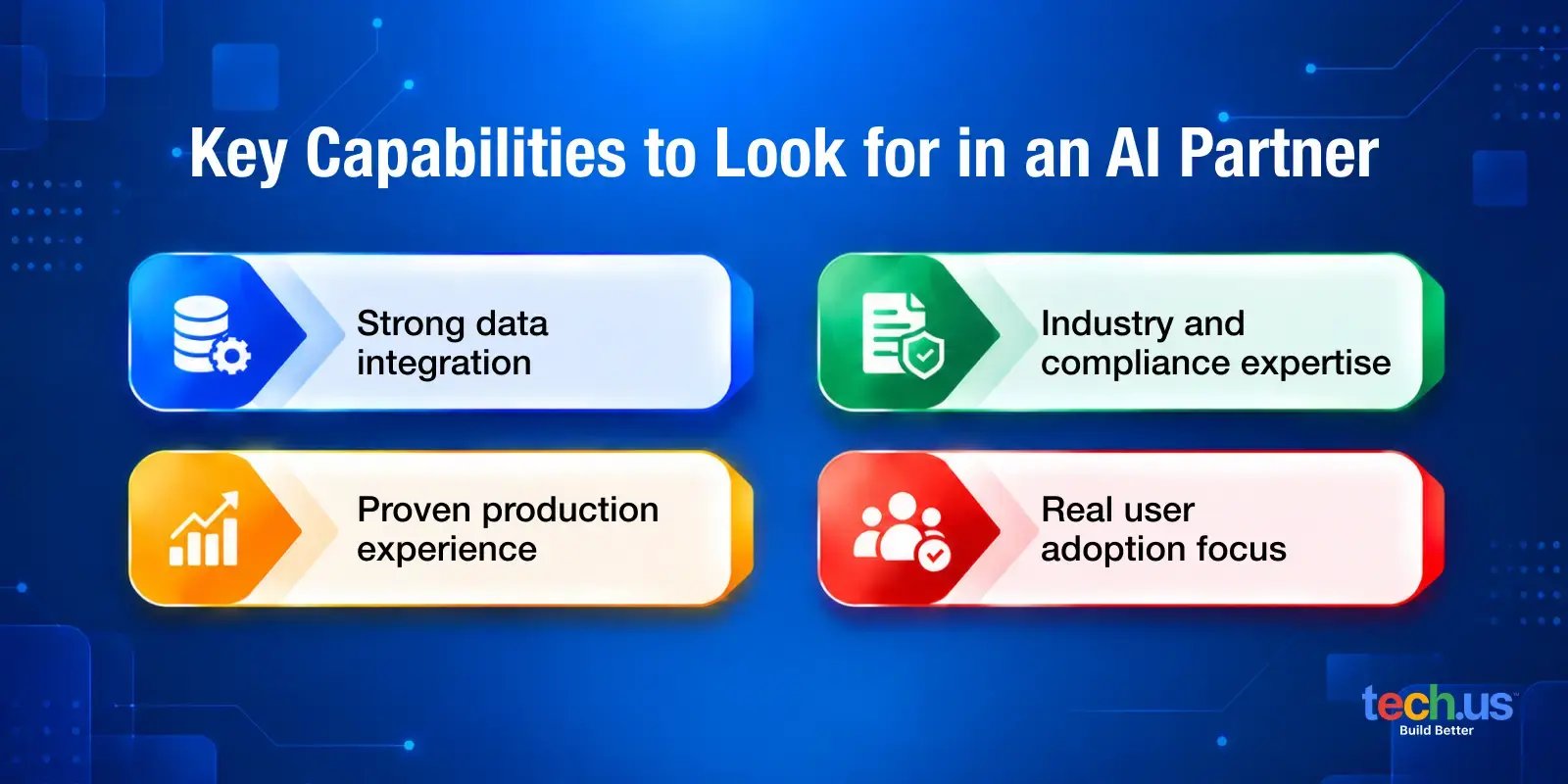
how-to-choose-ai-transformation-partner-Infographic
The strongest AI partners tend to stand out in four places: data integration, production delivery, industry knowledge, and adoption. 
The deck shows you the polished version. What you want is everything that happens after the applause, where those four capabilities either hold up or fall apart. 

Data Engineering and Integration 

A partner should be able to work with the data environment you have, not the clean one they wish you had. 
Building something clever on tidy, ready-made data is easy. Anyone can do that. The harder thing, the thing that actually matters, is whether a partner can work inside the mess you already live with. The old systems. The records scattered across departments that were never meant to connect. The rules your compliance team will not bend for anyone. 
So ask them about the mess. 
How have they dealt with data that was incomplete, duplicated, inconsistent, or locked away in some tool from a decade ago? 
A partner who only wants everything neat and handed to them has probably never delivered in a company like yours. 

How to Verify an AI Partner's Production Experience 

Ask for systems that are running now, not prototypes that worked once. 
A lot of partners can build something that works in a controlled test. Far fewer can build something that keeps working after it goes live, with real users, real volume, changing data, and all the operational problems nobody put in the demo. 
That gap is where projects quietly die. 
Get specific: 
  • How many of their projects are actually running today, months after launch?
  • What volume do those systems handle?
  • What happens when performance starts slipping?
  • Who owns monitoring and maintenance after deployment?
  • Simple FAQ bots sit at the lower end. Context-aware enterprise copilots with memory and multi-system integrations sit much higher.
  • Can they show what changed between pilot and production?
If those answers come out vague, you have your answer. 

Industry and Compliance Knowledge

General AI ability only takes you so far. 
The moment you are in healthcare, finance, insurance, or another regulated industry, the stakes change. A partner who already knows the regulations, who has sat across from an auditor before, saves you from explaining your own industry to the people you are paying to help you. 
Ask what regulated work they have genuinely done, not just talked about. 
That should include how they approach data access, privacy, security controls, deployment restrictions, auditability, and any requirements that shape where an AI system can run or what information it can use. 

Getting People to Actually Use It 

An AI system delivers nothing if the people it was built for quietly avoid it. 
Adoption is a people problem as much as a technology problem. 
Find out whether the partner stays involved through rollout, training, workflow changes, and early user feedback, or whether they hand over the keys and vanish. 
A system that technically works but sits outside the way people already work is usually not a successful deployment.

What Questions Should Be Asked Before Hiring an AI Development Company? 

The best questions force a partner to explain how they behave when conditions are less than perfect. 
A useful evaluation should cover five areas. 

Production 

What AI systems are still running in production today, and what changed after launch? 

Data and integration 

How have you handled fragmented, incomplete, duplicated, or legacy data in previous projects? 

Security and compliance 

What regulated environments have you worked in, and what security or governance requirements shaped the solution? 

Delivery 

Who stays involved after deployment, and how are monitoring, maintenance, and adoption handled? 

Commercials 

What work is outside the initial scope, and which costs usually appear after a pilot moves toward production? 
You learn more from those answers than from asking whether a company works with a particular model or framework. 

What Are the Biggest Red Flags When Choosing an AI Partner? 

The clearest red flags are guaranteed outcomes, vague production evidence, pilots with no path to scale, and important delivery work being pushed outside the scope. 
Watch for partners who: 
  • Promise a result before understanding the data
  • Talk endlessly about prototypes but cannot point to systems running in production
  • Treat integration as somebody else's problem
  • Need perfectly prepared data before they can begin
  • Cannot explain who supports the system after launch
  • Avoid specifics around security, compliance, or ownership
  • Quote aggressively low, then leave major production work for later
A strong partner does not need an answer to everything on day one. They should, however, know which questions need answering before anyone starts building. 

Engagement Models and What They Cost You 

There's no best engagement model. There is only the one that fits how clearly the work is defined and how much ownership the internal team can carry. 
Pick wrong and you either pay for hands you can't direct or buy a plan you can't execute. 

Fixed-Scope Projects 

This is the one most people reach for first, and for good reason. 
You know exactly what you want built, you agree on the price, and the partner delivers it. Clean. Predictable. Easy to get signed off by finance. 
But it only works when the scope is genuinely clear. AI work rarely is. 
  • Best when the use case is well defined and stable
  • You carry less day-to-day management
  • Changes mid-project get expensive, fast
  • Weak fit for anything still being figured out
If you're still exploring, this one boxes you in. 

Dedicated Team

Here the partner gives you a team that works only on your initiative, almost like an extension of your own staff.

They learn your systems, your quirks, your people. Over months, that context compounds into real speed. If you're weighing this against other arrangements, it's worth understanding how a dedicated team compares to outsourcing.
It costs more upfront, and it's worth it when the work is ongoing. 
  • Best for long-running, evolving programs
  • Deep knowledge of your environment builds over time
  • More flexible than fixed scope when priorities shift
  • Higher commitment, both in budget and involvement
This is usually the right call for serious enterprise transformation. 

Staff Augmentation 

Sometimes you don't need a strategy or a team to own things. You just need specific skills you're short on, plugged into a team you already trust to lead. 

That's what this is.

You direct the work; they bring the expertise. 
  • Best when you have strong internal leadership but a skills gap
  • You stay in full control of direction
  • Cheaper than a full dedicated team
  • Falls apart if your own people can't steer it
Lean on this only when the wheel is in capable hands already. 

How Much Does an AI Transformation Partner Cost? 

The cost depends less on "AI" itself and more on the amount of uncertainty, integration work, data preparation, and long-term ownership involved. 
A fixed-scope project is usually easier to price because the boundaries are agreed upfront. A dedicated team costs more over time but works better when priorities are expected to move. Staff augmentation can be cheaper when the internal team already has the leadership and architecture capability to direct the work. 
The expensive surprises usually come from somewhere else: 
  • Data that needs more preparation than expected
  • Legacy systems that are harder to integrate
  • Security or compliance requirements discovered late
  • A pilot that needs to be rebuilt for production
  • Ongoing monitoring and maintenance that were never included
  • Workflow or adoption work treated as an afterthought
So compare proposals on what is included, not just the number at the bottom. 

Do Enterprises Need an AI Partner or Can They Build In-House? 

Building in-house works when the organization already has strong AI, data, engineering, and product leadership with experience taking systems into production. 
If those capabilities are missing, a partner can shorten the learning curve and reduce the cost of discovering the hard parts through trial and error. 
The decision is rarely permanent. 
Some companies use a partner to get the first systems into production, build internal capability alongside them, and gradually bring more ownership in-house. Others keep external specialists around for areas where hiring permanent expertise makes little sense. 
The better question is not whether AI should eventually live in-house. It's whether the organization has the people and experience to get there without slowing down the work that matters now. 

How to Measure Whether an AI Partner Is Actually Delivering 

Measure business outcomes, not activity. 
Models shipped, hours saved, costs reduced, revenue affected, errors prevented, cycle time shortened, adoption increased. Those tell you whether the work is changing anything. 
Slides produced and meetings held do not. 
Agree on the outcome before the work begins, define how it will be measured, and make sure both sides know what evidence will count. 
A partner who cannot have that conversation before delivery starts will have an even harder time having it after the budget is spent. 

To Sum Up 

Strip all of it back and the decision comes down to one thing: can this partner actually deliver inside your reality, not the clean version in the demo? 

Look hard at how they handle messy data, whether their work survives in production, if they know your industry's rules, and whether they stay for the part where people have to adopt it.

Ask for evidence. Ask what happens after the pilot. Ask what is outside the scope. Ask who owns the problem when something breaks. 

The right partner is rarely the flashiest pitch in the room. It's the one whose answers still hold up when you press.

That standard is exactly what Tech.us's AI development services have been measured against across 1,500+ enterprise projects over more than two decades. Choose on delivery, not polish, and the rest tends to follow.

FAQs

A consultant advises on strategy and direction. A development partner builds and ships the actual systems. Some firms do both; many don't, so confirm which you're getting before signing. 

A focused first use case usually takes a few months to reach production. Full transformation runs longer, often a year or more, depending on data readiness and how many processes you're changing. 

It varies by engagement model, scope, data readiness, integration complexity, and the amount of ongoing support required. Fixed-scope projects are the most predictable; dedicated teams cost more but suit ongoing work. Tie cost to business value, not headcount. 

If you've got a strong data team and people who've actually shipped AI before, in-house can work. Most companies don't, at least not yet. A partner gets you moving faster and saves you the painful, expensive lessons they've already paid for. It's the classic in-house versus outsourced decision every CEO eventually faces. Plenty of firms start with a partner and bring it in-house once the muscle is built.

Guaranteed outcomes. Anyone promising a specific result before they've seen your data or your systems is selling, not delivering. Good partners get curious and ask hard questions early. There's more nuance to selecting the best AI development partner, but this red flag alone filters out a surprising number of them.

Tie it to business outcomes, not activity. Models shipped, hours saved, costs cut, revenue moved. Not slides produced or meetings held. Agree on what success looks like before you start, in plain numbers, and check against it often. If a partner dodges that conversation upfront, that tells you something on its own. 

Tech.us is an AI development company that builds custom AI solutions for businesses seeking measurable results. We partner with organizations to design, develop, and deploy scalable AI systems that solve complex challenges and unlock new opportunities for growth. Our team delivers practical AI applications that create tangible business impact across industries.
Anand Selvadurai

Anand Selvadurai

Director of AI/ML at Tech.us

Director of AI/ML 16+ years experience AI/ML Specialist

Written by Anand Selvadurai, Director of AI & ML at Tech.us — 16+ years experience designing enterprise ML pipelines and deploying production-grade AI systems across Construction, healthcare, fintech, and logistics. Certified Machine Learning Specialist and Research Scholar.


View all articles