There's a version of choosing the best company offering custom software development service decision that ends well. The product ships. The code is clean. The vendor feels like a genuine extension of your team, not a stranger you're managing across time zones.
And then there's the other version, which, unfortunately, is far more common. Projects stall. Scope creep quietly inflates the budget. The senior architects who sold you the deal are replaced by juniors three weeks in. By month four, you're not building software; you're managing a slow-motion crisis.
The difference between those two outcomes rarely comes down to budget or geography or even technical skill. It comes down to how you chose.
The software development outsourcing market now sits at an estimated $618.38 billion in 2026, on track to cross $977.04 billion by 2031, according to Mordor Intelligence.
This guide is not a vendor list. It's a thinking framework, built for 2026 realities, not 2018 assumptions.
Why 2026 is a Different Outsourcing Environment
The shift from cost arbitrage to capability arbitrage
For most of the last two decades, software development outsourcing ran on a single engine: labor cost differential. You paid $150/hour for a developer in San Francisco. You paid 35/hour for the same role in Kyiv. The math was obvious, and the strategy was simple.
That engine still exists. But it's no longer the point.
Where 70% of companies cited cost reduction as their primary outsourcing driver in 2020, only 34% do so today. In its place, 42% now cite access to specialized talent as their top driver, as per the Outsourceaccelerator.
Think about what that means in practice. Your competitor isn't outsourcing because their CFO demanded a 30% cost cut.
They're outsourcing because they need a team that's already shipped three LLM-integrated applications, already understands the security architecture for AI feature deployment, and can be operational in six weeks rather than six months of recruiting.
Cost is a pleasant side effect. Speed and depth are the actual purchase.
How AI-native vendors changed the competitive map
A year ago, every outsourcing vendor had "AI" somewhere on their homepage but that seldom told you about their capabilities fully.
What's changed in 2026 is that the gap between vendors who have genuinely internalized AI development services and those who merely talk about it has become visible and measurable.
EPAM projects that 80% of the development lifecycle will involve AI touchpoints by end of 2026, potentially raising individual developer productivity by as much as 75% Mordor Intelligence (Mordor Intelligence).
That productivity delta doesn't distribute evenly across the market. It concentrates in the vendors who have actually rebuilt their workflows around AI, and bypasses everyone who's still delivering the same way they did in 2021 but with a ChatGPT license.
When you evaluate vendors in 2026, you're not just assessing their developers but assessing whether their systems can keep up.
What this means for your business
Most companies walk into vendor selection with a shortlist built from LinkedIn ads, Clutch reviews, and whatever their network recommended three years ago. They evaluate on surface signals in situations where they should go deep.
The 2026 landscape rewards buyers who evaluate on depth in finding the best custom software development company. Not which vendor is the biggest. Not which one has the most impressive slide deck. But which one has genuinely rebuilt their capabilities for this moment, and which one is quietly coasting on a reputation built in a different era.
The Outsourcing Models that Matter in 2026
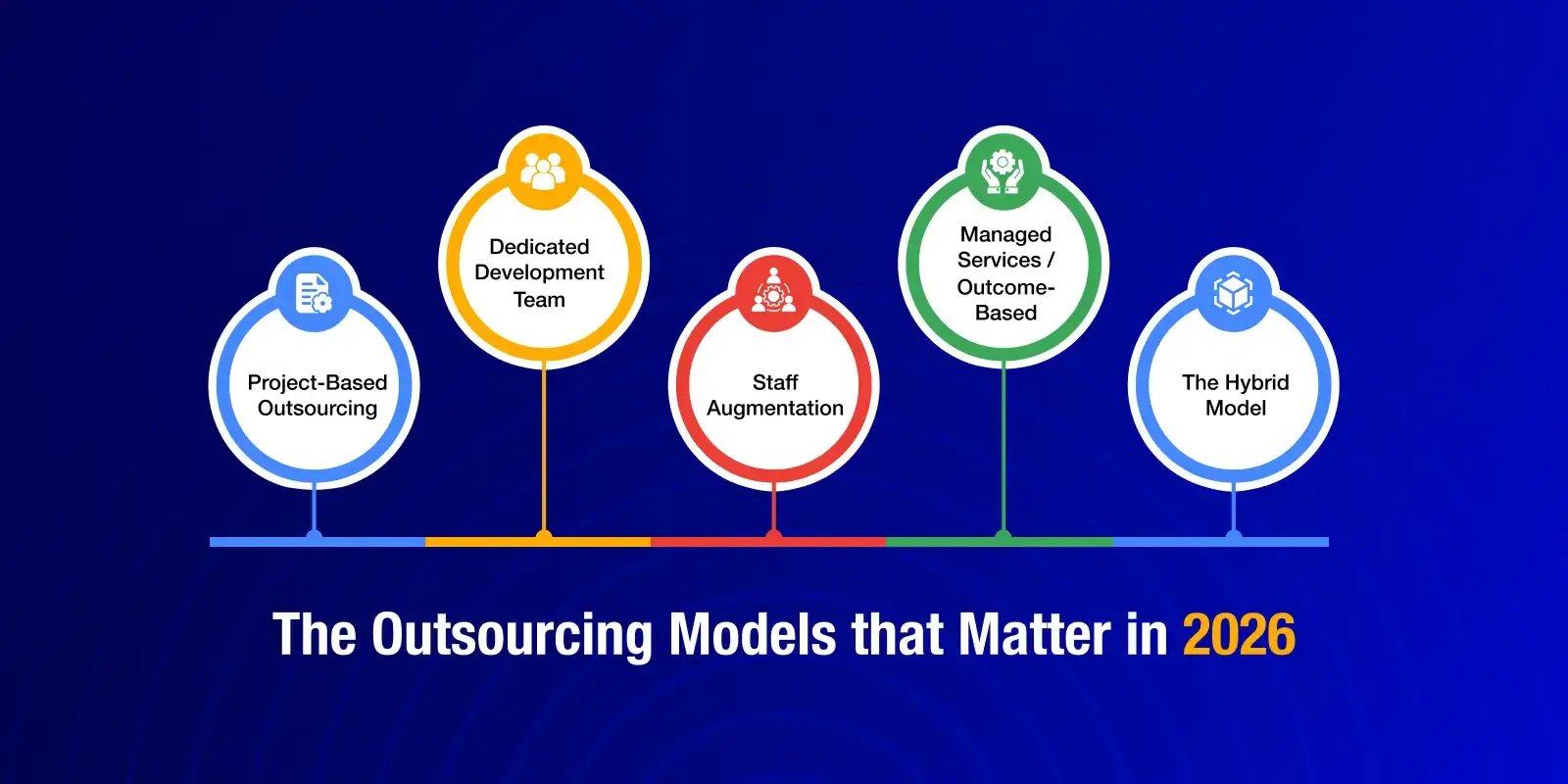
Before you evaluate a single vendor, you need to answer a more fundamental question: what kind of engagement are you actually looking for? Most outsourcing mistakes don't start with a bad vendor. They start with a buyer who chose the wrong model and then blamed the vendor for the friction that model naturally produces.
Here are the five models worth understanding.
1. Project-Based Outsourcing
You define the scope, agree on a price, and the vendor delivers. Simple in theory, messy in practice if your requirements have any ambiguity in them.
Best for: Well-defined, self-contained projects with stable requirements. Think a data migration, a specific API integration, or a compliance-driven feature update.
- Scope changes become expensive negotiation battles
- Vendors optimize for delivery, not quality, once the contract is signed
- You own the relationship risk entirely once the project closes
If your requirements are still evolving, this model will punish you for it.
2. Dedicated Development Team
You get a dedicated development team, typically a mix of developers, a QA engineer, and a project manager, that works exclusively on your product. They're employed by the vendor but operate like an extension of your company.
Best for: Long-running software product development where you need continuity, institutional knowledge, and a team that actually understands your codebase.
Why it works in 2026: As products become more AI-integrated and architecturally complex, institutional context matters enormously. A rotating cast of contractors doesn't cut it.
- Onboarding takes longer than most buyers expect (4 to 8 weeks realistically)
- You need in-house technical leadership to direct them effectively
- Costs are predictable but not cheap
3. Staff Augmentation
With staff augmentation, you hire individual engineers who sit inside your existing team, filling specific skill gaps. You manage them directly. The vendor handles HR, payroll, and compliance.
Best for: Teams that have strong internal leadership but need to scale headcount fast, or plug a niche skill (say, a machine learning engineer or a DevOps specialist) without a full-time hire.
Watch out for:
- Without cultural integration effort, augmented staff often feel like outsiders
- Knowledge walks out the door when the contract ends
- Works well when you already know exactly what you need built
4. Managed Services / Outcome-Based Engagement
The vendor doesn't just execute tasks. They own a functional area, say your entire QA process, your cloud infrastructure, or your data pipeline, and are accountable to specific performance metrics.
Best for: Mature companies that want to hand off operational responsibility, not just labor. Increasingly popular for AI-heavy workloads where the vendor brings domain expertise you don't have internally.
Why it's growing fast: Deloitte's 2024 Global Outsourcing Survey found that outcome-based delivery models have sharply increased in adoption, with 67% of organizations now prioritizing business outcomes over cost savings in vendor relationships. Buyers are no longer purchasing hours. They're purchasing results.
- Requires very clear KPIs upfront, or accountability becomes meaningless
- Governance overhead is higher than other models
5. The Hybrid Model
Part dedicated team, part staff augmentation, often layered with managed services for specific functions. This is the model gaining the most ground in 2026, though few vendors lead with it.
Best for: Companies scaling fast, with a mix of well-defined workloads and experimental new product streams running in parallel.
There is a growing debate on dedicated development team vs outsourcing, which is better for the long run, and so on. But hybrid model is often overlooked.
The honest appeal of this model is flexibility. You get deep continuity on your core product and on-demand capacity for everything else, without being locked into a single engagement structure that only fits half your needs.
A Quick 3-Question Diagnostic
Not sure which model fits? Answer these honestly:
Do you have in-house technical leadership? If no, dedicated team or managed services. If yes, staff augmentation becomes viable.
Are your requirements stable or still forming? Stable points to project-based. Forming points to dedicated team or hybrid.
Are you optimizing for speed, cost, or capability? Speed favors staff augmentation or hybrid. Capability favors dedicated or managed. Pure cost optimization is the wrong goal in 2026, and most vendors will sense it immediately.
What to Evaluate Before Choosing a Custom Software Development Vendor
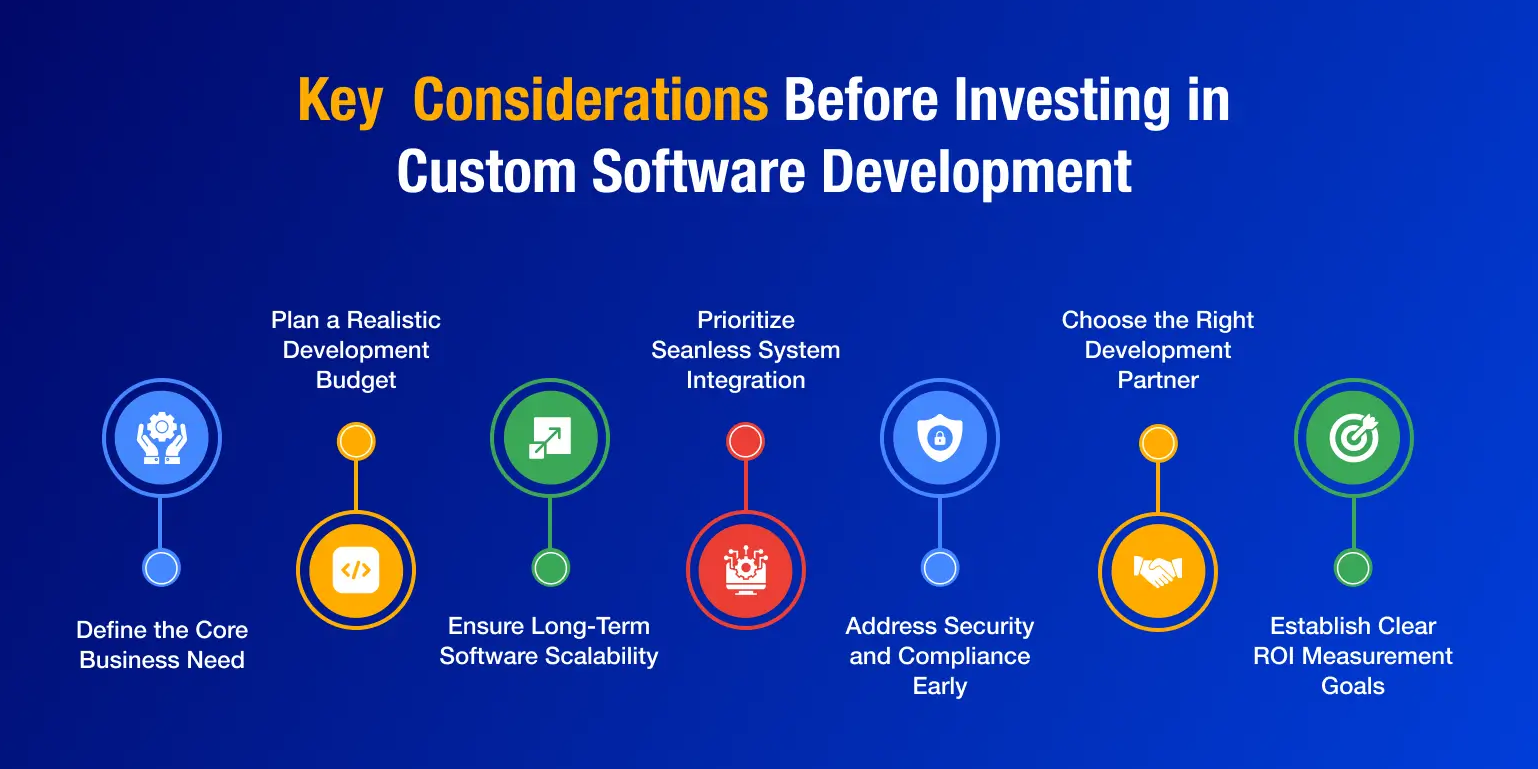
Portfolios are the first thing vendors show you. They should be the last thing you rely on. A polished case study tells you what a vendor wants you to believe. The seven signals below tell you what's actually true.
1. Technical Depth Signals
Don't just ask what technologies they use. Ask why they made specific architectural decisions on past projects. A vendor offering software development services with genuine technical depth will give you a considered answer. A vendor running on execution muscle will fumble it.
- Can they explain trade-offs between tech stack choices, not just list them?
- Do their developers contribute to open-source projects or publish technical writing?
- Ask to review a sanitized architecture document from a past project. The quality of that document reveals how they think.
2. Communication Infrastructure
English fluency is the entry bar, not the evaluation. The real question is how a vendor communicates when things go sideways, because they will.
- Do they maintain async documentation habits, or does knowledge live only in someone's head?
- How do they run sprint demos? Polished, structured demos signal process maturity.
- Ask them: "What's your escalation protocol when a deadline is at risk?" A vague answer is a red flag.
The vendors worth hiring treat communication as an engineering problem. They have systems for it.
3. IP Ownership and Contract Red Flags
This is where buyers get hurt most, and read the fine print least. In 2026, with AI-generated code, third-party model integrations, and complex data pipelines in the mix, IP clauses are more consequential than ever.
- Full IP assignment to you upon payment, with no carve-outs for "pre-existing tools"
- Source code escrow provisions for long-term engagements
- Clear data handling clauses, especially for GDPR, HIPAA, or SOC 2 environments
- Explicit language on who owns any AI-generated outputs produced during your project
If a vendor resists these clauses, that resistance itself is the answer.
4. Security Posture
Cybersecurity has quietly become one of the top reasons outsourcing relationships fail. Deloitte's 2024 Global Outsourcing Survey identified cybersecurity as the number one external challenge executives face in achieving their strategic objectives (Deloitte).
- Do they follow a documented secure SDLC (Software Development Lifecycle)?
- What compliance certifications do they hold?
- How do they handle access revocation when a developer leaves the team?
A vendor who treats security as a checklist item and not a cultural practice is a liability waiting to materialize.
5. Process Maturity
Good developers inside a broken process still deliver broken products. Process maturity is what separates vendors who happen to have talented people from vendors who reliably produce good outcomes.
- A documented definition of done, not a verbal one
- Clear sprint cadences with structured retrospectives
- Evidence of how they've handled scope changes on past projects, not hypothetically
Ask for a sample sprint report. The depth and honesty of that document tells you more than three reference calls.
6. Reference Check Questions Most Buyers Never Ask
Most buyers ask references: "Were you happy with the work?" That question gets you nothing useful. You need to ask some critical questions before hiring a software development partner. Ask these instead:
- "Describe a moment the project went off-track. How did the vendor respond?"
- "Did the team you were sold match the team that did the work?"
- "Would you rehire them for a project where requirements were still evolving?"
The third question is particularly revealing. Vendors who only perform well under stable conditions are a different product than vendors who thrive in ambiguity.
7. Scalability and Post-Launch Commitment
Building is one thing. What happens at month seven, when you need three more engineers, or a critical bug surfaces at 2am, matters just as much.
- What is their typical team expansion timeline when you need to scale?
- Do they offer post-launch SLAs, and are those SLAs actually enforceable?
- Is there a dedicated point of contact after handoff, or does support become a ticket queue?
The vendors who treat post-launch as an afterthought usually make that clear during sales. Pay attention.
Pricing Structures Decoded
Pricing is where vendor relationships quietly break down. Not because the numbers were wrong, but because the model was wrong for the engagement. Each structure creates a different set of incentives, and those incentives shape vendor behavior in ways that don't become visible until you're six months in.
Fixed Price
You agree on scope, timeline, and cost upfront. The vendor delivers. Clean on paper.
The problem is that software is not a construction project. Requirements evolve. Edge cases surface. What feels well-defined in week one looks completely different in week eight.
- Tightly scoped, short-duration projects with stable requirements
- Compliance updates, specific integrations, or clearly defined MVPs
When it doesn't:
- Any project where discovery is still happening
- Vendors will pad estimates to protect their margin, and under-deliver to protect their timeline
Fixed price doesn't eliminate risk. It just transfers it, and usually not in your favor.
Time and Materials (T&M)
You pay for actual hours worked at an agreed rate. Flexible, transparent, and honest about the nature of software development.
- Long-running engagements where scope legitimately shifts
- When you have strong internal oversight to monitor output quality
Watch out for:
- Without clear velocity benchmarks, hours can balloon invisibly
- Requires you to actively manage productivity, not just deliverables
T&M rewards good vendors and exposes weak ones. That is both its strength and its demand on you as a buyer.
Retainer Model
A fixed monthly fee for a defined set of resources or output capacity. Predictable budgeting, ongoing relationship continuity.
Best for: Product companies that need consistent development bandwidth month over month, without the overhead of renegotiating scope constantly.
The retainer works when trust is already established. Starting a new vendor relationship on a retainer, before you've validated their work quality, is a mistake most buyers only make once.
The Outcome-Based Model
This is the model gaining serious ground in 2026, and the one most buyers haven't encountered yet. Instead of paying for time or deliverables, you pay for results tied to specific business KPIs. Faster deployment cycles. Defect escape rates below a defined threshold. Uptime guarantees with financial consequences.
Deloitte's 2024 Global Outsourcing Survey found that 67% of organizations now prioritize business outcomes over cost savings in vendor relationships, a dramatic shift from just a few years ago.
Why it matters: A vendor willing to tie compensation to your outcomes is signaling something important about their confidence. It's rare. When you find it, weight it heavily.
The Hidden Costs Nobody Puts in the Proposal
Whatever model you choose, budget separately for these:
- Onboarding and knowledge transfer ramp (typically 4 to 6 weeks of reduced velocity)
- Documentation and handoff materials at project close
- Third-party licenses and infrastructure costs often absorbed quietly into T&M hours
- Post-launch support that falls outside the original contract scope
The vendors who surface these costs upfront are the ones worth trusting.
A quick look at pricing different outsourcing models
| Pricing Model | Best For | Billing Structure | Buyer Control | Risk Holder | 2026 Fit |
|---|---|---|---|---|---|
| Fixed Price | Scoped, short projects | One-time or milestone | Low | Vendor (padded estimates) | Narrow use cases only |
| Time & Materials | Evolving, long-term builds | Hourly/daily rate | High | Buyer (hours can balloon) | Strong, most common |
| Retainer | Ongoing product development | Monthly flat fee | Medium | Shared | Strong, for mature relationships |
| Outcome-Based | Strategic, KPI-driven engagements | Results tied to metrics | Very High | Vendor (performance-linked) | Emerging, highest upside |
| Hybrid | Complex, multi-stream projects | Mixed (T&M + retainer) | High | Shared | Fastest growing in 2026 |
Red Flags Checklist: 9 Signs You're About to Hire the Wrong Company
Every vendor looks good in the sales process. That's the point of a sales process. The tell is always in the details most buyers gloss over because they're excited about the portfolio or relieved to have found a team within budget. These are the signals worth slowing down for.
Red Flags: Walk Away If You See These
- The senior architects who sold you the deal disappear once the contract is signed
- They skip discovery and jump straight to estimates
- They agree with everything you say and never push back
- No named project manager assigned before work begins
- Any hesitation or resistance around IP ownership and source code clauses
- Their timeline estimate is dramatically faster than every other vendor's
- They have testimonials on their website but no reachable references
- Post-launch support is vague, unstructured, or completely absent
- Work is quietly handed to subcontractors without prior disclosure
Green Flags: Weight These Heavily
- They surface risks you didn't think to ask about, unprompted
- They share a documented definition of done without being asked
- They assign a named technical lead before the contract is signed
- Their proposal includes an onboarding timeline, not just a delivery timeline
- They ask hard questions about your internal processes, not just your product
How to Compare Custom Software Outsourcing Vendors
The scorecard below is designed to make the decision legible, not to replace judgment, but to make sure judgment is applied to the right things.
The 10 Weighted Criteria
Score each vendor from 1 to 5 on each criterion. The weights reflect what actually drives project outcomes in 2026.
| Criteria | Weight |
|---|---|
| Technical depth and AI-readiness | 20% |
| Process maturity and documentation habits | 15% |
| Communication infrastructure | 15% |
| Security posture and compliance certifications | 10% |
| IP protection and contract transparency | 10% |
| Pricing model alignment with your engagement type | 10% |
| Cultural fit and time zone overlap | 8% |
| Track record with similar-scale projects | 7% |
| Scalability and team expansion speed | 3% |
| Post-launch support structure | 2% |
Multiply each score by its weight, sum the totals, and you have a comparable number across every vendor you're evaluating. It won't make the decision for you. It will tell you where your instincts and the evidence agree, and more importantly, where they don't.
In a Nutshell
Every framework, checklist, and scorecard in this guide funnels into one final question: can this vendor tell you no?
A team that pushes back on unrealistic timelines, flags architectural risks before they become expensive, and protects your long-term product health over their short-term convenience, that's not a vendor. That's a partner.
Those partnerships exist. They're just harder to find than a good-looking proposal.
If you're navigating this decision and want a vetted starting point, Tech.us connects businesses with pre-screened custom software development partners matched to their specific needs, engagement model, and budget.
FAQs
Only for projects with locked requirements and a defined end date. If your scope has any moving parts, fixed price will cost you more than T&M ever would.
Ask them to walk you through exactly where AI tooling sits in their SDLC. If they can't name specific tools, workflows, and measurable productivity outcomes, it's marketing.
Misaligned engagement model, not bad developers. Hiring a dedicated team when you needed staff augmentation, or choosing fixed price for an evolving product, creates structural friction that talent alone can't fix.
Enough to review outputs critically and ask hard questions. You don't need to write code, but you need someone in-house who can tell the difference between technical debt and a clean architecture decision.
Not always. For well-scoped engagements with strong references, a pilot adds delay without proportional insight. Run one when requirements are ambiguous or when references weren't reachable.

Continue reading the blog
with a Tech.us subscription
You’re now subscribed!