-
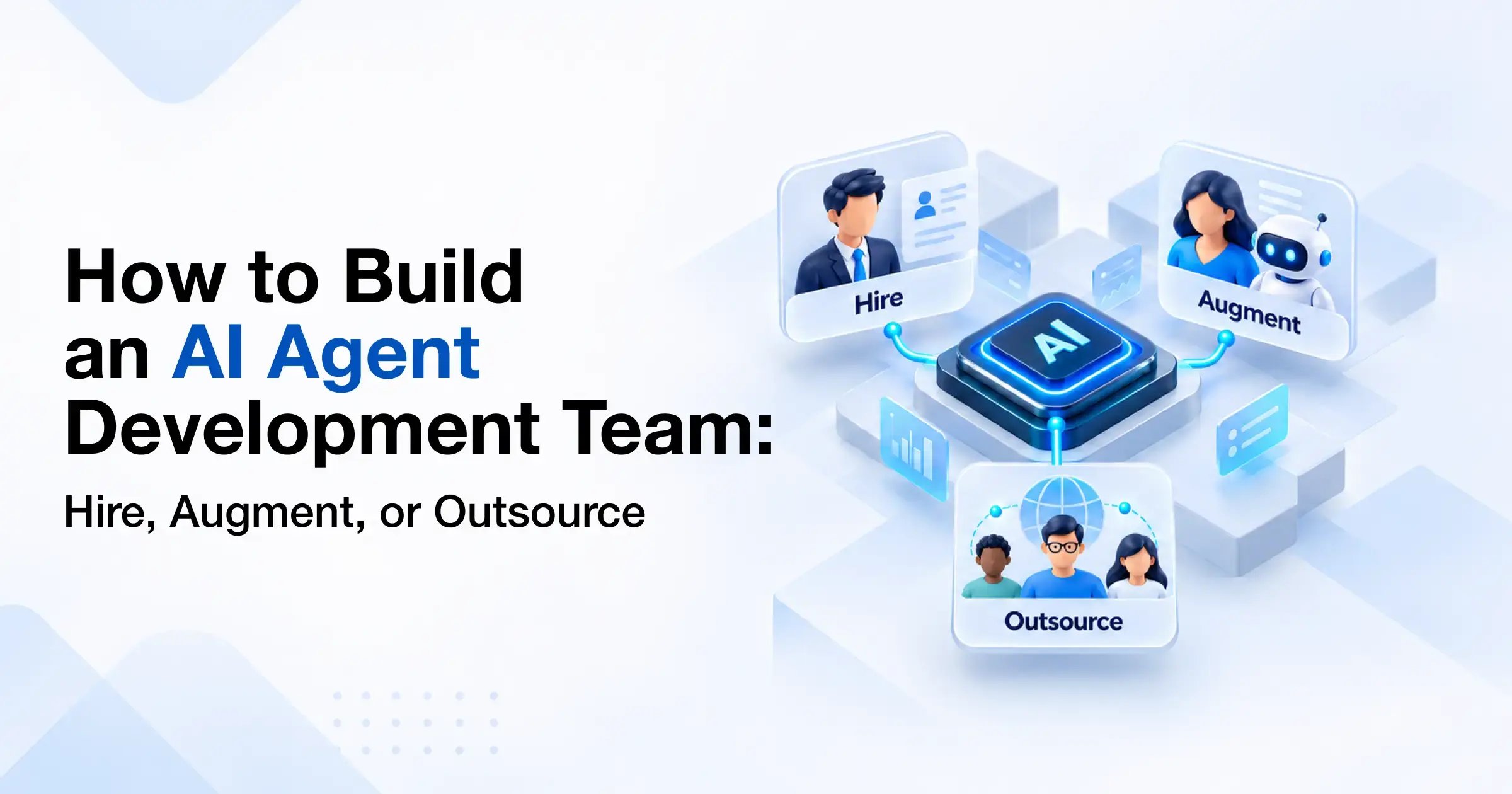
Three ways to build an AI agent team: hire, augment, or outsource.
-
Hiring builds lasting capability but is slow and costly.
-
Augmentation adds engineers fast, but you still direct the work.
-
Outsourcing is quickest and fits thin in-house expertise, but you trade control for outcomes.
-
Timeline, budget, and in-house AI expertise decide the fit.
-
Less internal expertise means outsourcing makes more sense.
-
Most teams end up mixing models over time.
Overview
Most teams arrive at this question from the same place: a working prototype, plenty of internal excitement, and nobody actually free to take the thing to production. That's when staffing stops being a someday problem.
And it's rarely as simple as "let's hire someone." Hiring takes months. Augmentation feels faster but brings its own headaches. Outsourcing can work beautifully or turn into a mess, depending on who gets picked and how closely the work is watched.
There's no single right answer. The best model depends on the timeline, the budget, and honestly, how much AI expertise already exists in the building.
What follows is a breakdown of all three: what each one actually involves, and when it makes sense to reach for it. If you're still mapping out what an agent project involves before staffing it, check out our AI agent development services for better understanding.
What an AI Agent Development Team Actually Needs
Before deciding how to build the team, it helps to be honest about what the team is for. Agent development is not the same as shipping a chatbot or wiring up an API call to a model.
Agents make decisions, take actions, call tools, and chain steps together, which means more can go wrong and more has to be watched. For a fuller picture of how these systems behave, it helps to understand what AI agents actually are and how they work.
The core roles
A capable agent team usually spans four kinds of work, and they rarely live in one person:
- AI/ML engineers who understand model behavior, evaluation, and where things drift or fail.
- Agent and LLM developers who handle orchestration, prompting, tool integration, and the logic that decides what the agent does next.
- Data engineers who build the pipelines and retrieval layers the agent depends on. Most agent failures trace back here, not to the model. It's worth seeing how far this reaches in practice, since AI agents are already reshaping core business processes.
- MLOps engineers who handle deployment, monitoring, cost control, and the unglamorous work of keeping it running once real traffic hits.
Smaller projects collapse a few of these into one or two senior people. That works until it doesn't.
Why hiring AI agent experts is challenging
The talent pool is thin, and the field moves faster than resumes can keep up. Someone strong in traditional ML may have never shipped an agent in production. Someone who has built impressive demos may have never dealt with reliability, evaluation, or cost at scale.
The gap between "made it work once" and "made it work reliably" is wide, and it is exactly the gap most hiring processes miss.
This is why the staffing model matters as much as the talent itself. There are three realistic ways to assemble this team: hiring in-house, augmenting with outside engineers, or outsourcing the build to a development partner. Each suits a different situation, and the rest of this guide walks through when each one earns its place.
Hiring an In-House Team
Hiring in-house means building permanent capability. The engineers are yours, they learn your systems deeply, and over time they become the people who know why every decision was made. For companies betting on AI as a long-term core function, this is the model that compounds.
How it works
You define the roles, run a hiring process, and bring engineers on as full-time employees. Sounds clean on paper. In practice, the hard part is evaluation. Screening agent talent well requires someone on your side who already understands the work, which is precisely what many teams lack at the start. Without that, it's easy to hire someone who interviews well and ships demos but stalls the moment production reliability is on the line.
When in-house makes sense
- AI agents are central to the product, not a side experiment.
- The work is ongoing, so there's enough to keep a team busy past the first launch.
- There's already at least one senior person who can judge technical depth and lead the hires.
- The data and domain knowledge are sensitive enough that you'd rather keep everything inside.
The trade-offs
- Time. Filling a single strong agent role often takes three to six months. Building a full team takes longer. If you're under pressure to ship this quarter, in-house alone won't get you there.
- Cost. Salaries for experienced AI engineers are high and still climbing. Add benefits, equipment, and recruiting fees, and the real number lands well above the headline figure.
- Retention. This is the quiet risk. The same scarcity that makes these engineers hard to hire makes them easy to poach. People you spent months recruiting and onboarding can be gone in a year, and the knowledge often walks out with them.
In-house is the strongest model for companies that have decided AI is a permanent part of who they are. It's the slowest and most expensive to stand up, but it's the only one that builds lasting capability rather than renting it. The catch is that you need some of that capability already in place to hire the rest well.
Staff Augmentation
Staff augmentation sits between hiring and outsourcing. You're not building a permanent team, and you're not handing the whole project to someone else. You're adding outside engineers to your existing team to fill a specific gap, and they work under your direction alongside your own people.
How it works
You bring in engineers through a staffing partner or vendor, usually on a contract basis. They join your standups, use your tools, and report into your leads, but they stay on the provider's payroll. The arrangement scales in both directions: add a single specialist for a hard problem, or spin up several engineers to push a launch, then wind down once the work is done. The provider handles sourcing and vetting, which is the part that saves the most time.
When augmentation makes sense
- A specific skill is missing and hiring for it permanently isn't worth it.
- There's a deadline that in-house hiring can't realistically hit.
- The internal team is solid but short-handed, and the work is well defined enough to direct.
- The need is real but temporary, like a first production push or a fixed-scope build.
The trade-offs
- Control. You keep it, which is the main advantage over outsourcing. But that control is also a demand. Augmented engineers need direction, and if your own leads are stretched thin, that direction slips and so does the work.
- Integration. Outside engineers don't know your codebase, your conventions, or your unwritten rules. The first few weeks are spent closing that gap, and how well it closes depends heavily on the people involved.
- Onboarding. Every ramp-up costs time, and with contract engineers you pay that cost knowing they may roll off in a few months. Short engagements can mean the onboarding investment never fully pays back.
Augmentation works best when there's a capable team that simply needs more hands or a specific skill, and someone with the bandwidth to steer the extra people. It's faster than hiring and cheaper than carrying permanent headcount you won't need later. What it doesn't do is supply the judgment to run the project. That still has to come from your side.
Outsourcing to an AI Agent Development Partner
Outsourcing means handing the build to an outside firm that brings its own team, process, and delivery structure. You're not directing individual engineers day to day. You're contracting for an outcome and trusting the partner to assemble the right people to reach it.
How it works
You select a development partner, agree on scope and milestones, and they staff the project from their bench. If you're at the stage of drawing up a shortlist, these roundups of the top AI agent development companies in the USA and the leading agentic AI development partners are a useful starting point.
A good partner already has agent engineers, data people, and MLOps under one roof, which is why they can start in weeks rather than the months in-house hiring takes.
Engagements range from a fixed-scope build to a longer managed relationship where the partner owns a whole workstream. The defining trait is that the team comes assembled and led, not handed to you piece by piece.
When outsourcing makes sense
- There's little or no in-house AI expertise yet, so judging and directing engineers internally isn't realistic.
- The project needs to move fast and a ready-made team is worth paying for.
- The build is well-bounded, with a clear outcome rather than open-ended experimentation.
- AI isn't meant to become a permanent internal function, at least not yet.
The trade-offs
- Oversight. You give up day-to-day control. That's the point, but it cuts both ways. Without clear milestones and regular check-ins, a project can drift a long way before anyone notices.
- IP and knowledge. The expertise lives with the partner, so when the engagement ends, much of the understanding can leave with them. Contracts need to be explicit about who owns the code, the data, and the models, and a knowledge transfer plan matters more than most teams realize at signing.
- Vendor selection. This is where outsourcing is won or lost. The market is crowded with firms that claim AI capability and have shipped very little. Ask for production work, talk to past clients, and look for partners who handled reliability and scale, not just demos. For enterprises in specific markets, location matters too, as seen in this look at agentic AI development for New York enterprises in 2026.
AI agent outsourcing is the fastest way to get a capable team working and the right call when AI expertise is thin internally and the goal is a defined result. The risk isn't the model itself. It's choosing the wrong partner, which is why vetting deserves real time before anything is signed.
How to Choose the Right Model
The three models aren't ranked. None is better than the others in the abstract. The right one falls out of your own situation, and three factors usually decide it.
Match the model to your timeline and budget
Timelines tend to settle the question fastest. If you need a team working in weeks, in-house hiring is off the table, and the real choice is between augmentation and outsourcing. If you have months and want lasting capability, hiring comes back into play.
- Tight deadline, no team yet: outsourcing gets people working fastest.
- Tight deadline, capable team short on hands: augmentation fills the gap.
- Long horizon, AI as a core bet: in-house is worth the wait and cost.
The budget rarely picks the model on its own, but it shapes how long you can sustain one. Permanent salaries are a standing cost; augmentation and outsourcing are easier to switch off when the work is done.
Match the model to your in-house AI maturity
This is the factor teams underweight most. Both hiring and augmentation assume you can judge and direct AI engineers. If that expertise doesn't exist internally yet, both get risky fast, because you can't screen well or steer the work.
- Little or no AI expertise: outsource, and let a led team carry the judgment.
- Some senior expertise, short on hands: augment around your existing leads.
- Strong internal expertise: hire and build on what you already have.
When to combine models
Most mature setups end up blended rather than pure. Common patterns:
- Outsource the first build, then hire in-house to take it over once the value is proven.
- Keep a small core team and augment for specific spikes or specialist skills.
- Run a long-term partner for one workstream while in-house owns another.
The honest rule: start with the model that fits today, and expect it to shift as your expertise and ambitions grow.
| Criteria | In-House Hiring | Staff Augmentation | Outsourcing |
|---|---|---|---|
| Speed to start | Months | Weeks | Weeks |
| Cost | Higher long-term | Pay as you use | Fixed per project |
| Scaling | Slow | Fast, both ways | Fast |
| Control | Full | High | Outcome-based |
| AI expertise needed internally | High | Moderate | Low |
| Ready AI talent | Limited | Broad | Full team ready |
| Builds in-house capability | Strongest | Partial | Via knowledge transfer |
FAQs
Staff augmentation adds engineers to your team and you direct them. Outsourcing hands the whole build to a partner who runs it and delivers the result. More hands versus a finished outcome.
Outsource if AI expertise is thin internally and you need speed. Hire in-house if AI is a long-term core function and you already have someone senior to lead it.
Three to six months for a strong hire, longer for a full team. The talent is scarce. If you need to ship sooner, augmentation or outsourcing is faster.
For hiring and augmentation, yes, since you have to screen and direct the work. Outsourcing is the one model that works when that expertise isn't there yet.
None is cheapest across the board. Hiring costs most long-term, augmentation lets you pay only while the work runs, and outsourcing is usually fixed per project.