Published Date: May 07, 2026 , Written by: Tech.us , Category: AI, Artificial Intelligence

POPULAR POSTS
01
How To Improve Document Processing Accuracy Using Document AI
02
Top 10 Companies Offering Software Modernization Consulting Services in 2026
03
11 Proven Benefits of AI Chatbots for Businesses in 2025
04
What Digital Transformation Means for Businesses in 2026
05
What is Data Mining
Published Date: May 07, 2026 , Written by: Tech.us , Category: AI, Artificial Intelligence
AI is no longer a side experiment. It is shaping how businesses operate, compete, and grow. From LLM-powered applications to RAG-based AI systems, companies are moving fast. The question is simple. Are you moving with the right partner?
Customers expect speed, personalization, and smarter experiences. Competitors are already investing in enterprise AI solutions and AI deployment services at scale. If your business delays, you risk falling behind. AI today drives real outcomes like faster decisions, better customer insights, and improved efficiency.
This is where things get expensive.
Have you seen projects that never move past the pilot stage? That is often a partner problem.
A strong AI development partner focuses on business-aligned AI solutions. They think beyond models. They look at outcomes, scalability, and long-term value. That is what drives ROI-driven AI implementation.
Jumping straight into vendor comparisons? That is where most teams go wrong. Before you even speak to an AI development company, you need clarity on your side. Otherwise, every pitch will sound good. But will it solve your problem?
Let’s break this down.
Start here. What do you really want from AI?
Is it faster operations? Better customer experience? New revenue streams?
Be specific. Vague goals lead to vague outcomes.
Ask yourself:
A good AI solutions provider will push you on this. Why? Because ROI-driven AI implementation starts with clear goals.
This is a tough one. Many teams explore AI because it feels urgent. But urgency without direction leads to wasted budgets.
So pause and ask:
If your use case is unclear, even the best AI consulting services will struggle to deliver impact.
Look for problems like:
These are strong entry points for business AI solutions.
Not every company needs the same kind of support.
Here is a simple way to think about it:
|
Need |
What You Should Look For |
|
Quick execution |
AI outsourcing company |
|
Strategy and planning |
AI consulting services |
|
End-to-end ownership |
Custom AI development company |
If your goal is end-to-end AI development and long-term scale, you need more than a vendor. You need a partner who understands AI lifecycle management and can support growth over time.
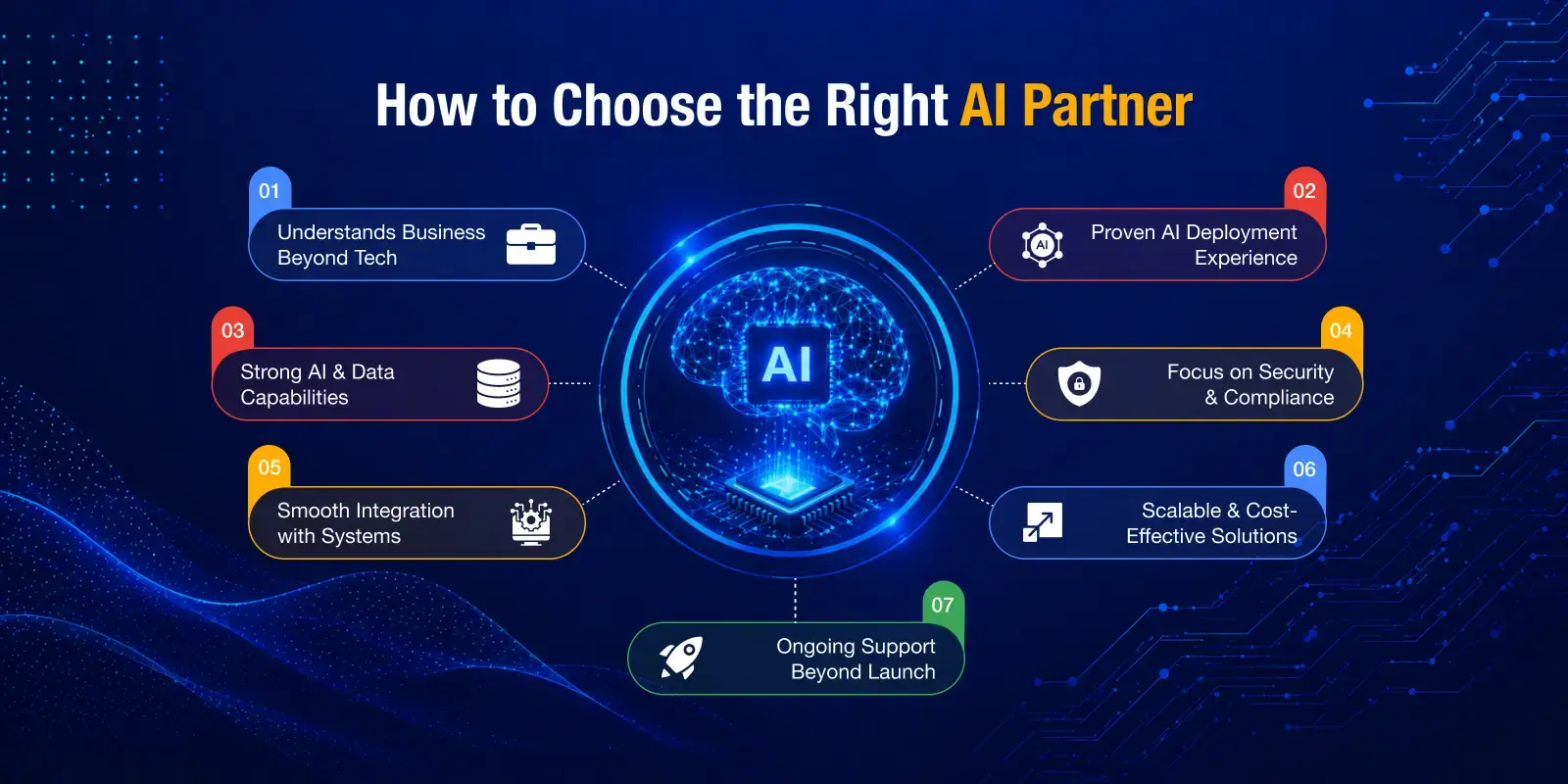
Here are seven key criteria you should consider while choosing the best AI development vendor who will help improve your business.
A lot of AI vendors sound impressive. They talk about models, frameworks, and tools. But here is the real question. Do they understand your business?
Can they take your problem and translate it into a working AI solution? Or are they just suggesting generic use cases?
A strong AI development partner starts with your goals. They ask about your workflows, customers, and data. They connect AI to real outcomes. That is how business-aligned AI solutions are built.
Ask yourself:
Key things to look for:
If your partner cannot explain how AI will impact your business in simple terms, they are not the right fit.
Anyone can build a demo. That is easy. The real test? Can they deploy AI in real business environments?
A reliable AI software development company will show proof. Not just concepts. Not just prototypes. Real deployments with measurable results.
Think about this. Have they helped companies reduce costs? Improve efficiency? Increase revenue?
Also, ask about scale. Have they handled AI deployment at scale? Or are they still experimenting?
Key things to look for:
Questions you should ask:
Execution matters more than ideas. A partner with real-world experience reduces your risk significantly.
AI is not just about models. It is about data, pipelines, infrastructure, and performance.
A capable AI solutions provider handles everything end-to-end. From data collection to deployment. From model training to AI model optimization and monitoring.
Do they work with modern technologies like LLM-powered applications or RAG-based AI systems? Can they build a scalable AI architecture that grows with your needs?
You do not want a partner who struggles once the project gets complex.
Key things to look for:
Questions to ask:
Strong engineering is what turns AI ideas into reliable systems.
AI runs on data. And data comes with risk.
So here is a critical question. Can you trust this partner with your data?
A responsible AI development company takes data security and AI compliance seriously. They follow standards. They build secure systems. They protect sensitive information.
This is even more important if you deal with customer data or regulated industries.
Key things to look for:
Questions to ask:
If a partner avoids talking about security, that is a red flag. Trust is non-negotiable in AI.
AI is not useful in isolation. It needs to fit into your current systems.
Can your partner handle AI integration with existing systems? Can they connect with your CRM, ERP, or internal tools?
If integration is weak, your AI solution will sit unused.
A good AI integration services provider ensures smooth adoption. They minimize disruption. They make AI part of your daily operations.
Key things to look for:
Questions to ask:
AI creates value only when it works within your ecosystem.
AI projects can get expensive. Fast.
So you need a partner who thinks about scale and cost from day one.
Can they build systems that grow with your business? Can they optimize infrastructure and model usage?
A smart AI outsourcing company focuses on ROI-driven AI implementation. They balance performance with cost.
Key things to look for:
Questions to ask:
AI should improve your margins, not hurt them.
AI is not a one-time project. It evolves.
Models degrade. Data changes. Business needs shift.
So ask this. Will your partner stay with you after deployment?
A strong custom AI development company offers continuous support. They focus on AI lifecycle management. They handle updates, monitoring, and improvements.
Key things to look for:
Questions to ask:
The real value of AI comes after deployment. Choose a partner who stays invested.
You have a shortlist. A few strong-looking vendors. Great presentations. Confident pitches.
Now what?
This is where most decisions go wrong. Teams rely on gut feeling. Or they pick the most popular AI development company. But AI is not a branding exercise. It is a long-term investment.
Use this as your go-to framework. It is simple, but powerful.
|
Criteria |
Questions to Ask |
Why It Matters |
|
Business Understanding |
Can they connect AI to your KPIs? |
Drives ROI-driven AI implementation |
|
Experience |
Do they have real case studies with results? |
Reduces execution risk |
|
Tech Capability |
Do they work with modern AI stacks like LLMs and RAG? |
Ensures future-ready solutions |
|
Security |
How do they handle data security and AI compliance? |
Protects sensitive data |
|
Integration |
Can they support AI integration with existing systems? |
Ensures real-world usability |
|
Scalability |
Can they build scalable AI architecture? |
Supports long-term growth |
|
Support |
Do they offer AI lifecycle management and optimization? |
Keeps systems relevant over time |
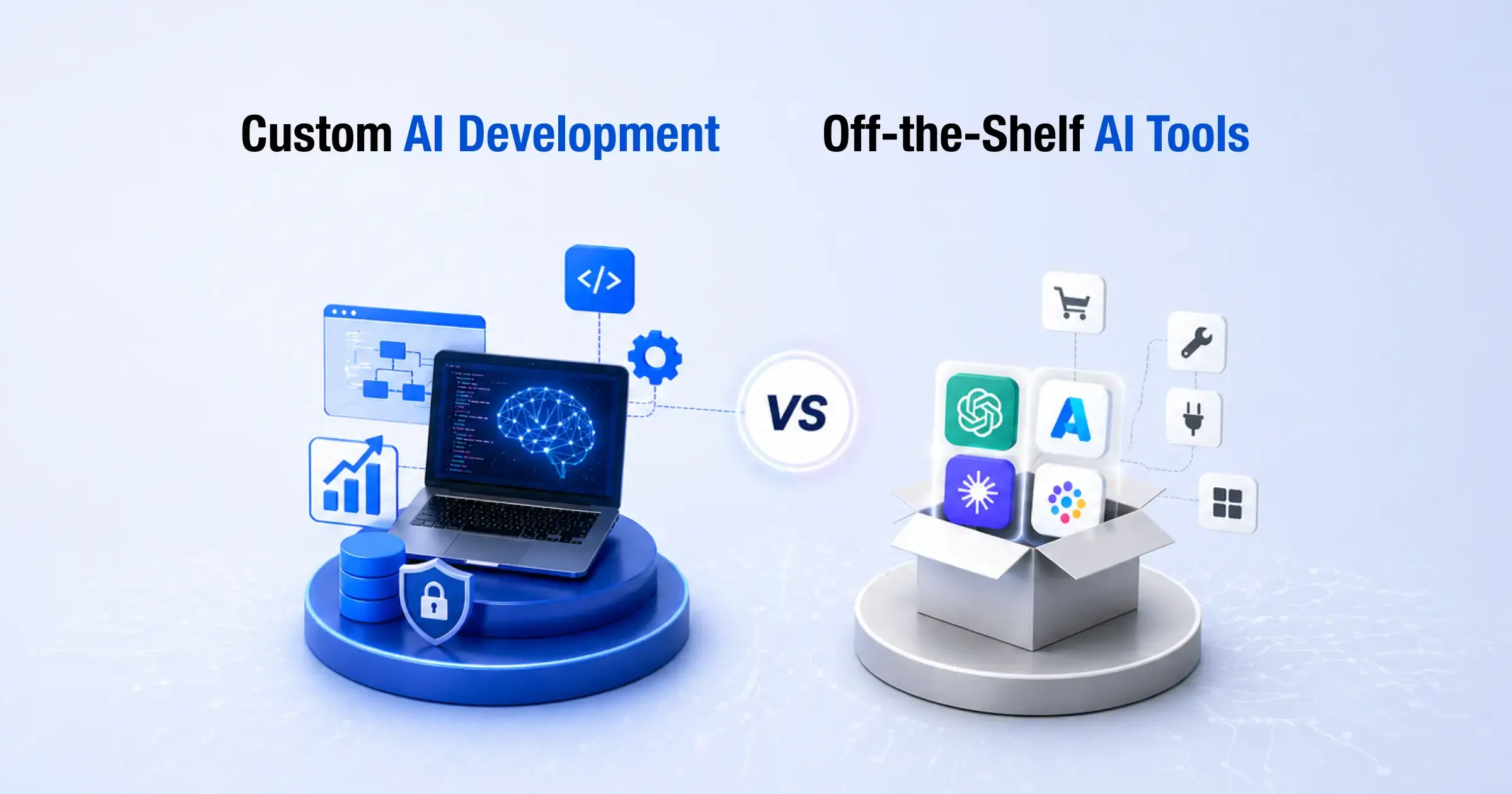
This is one of the biggest decisions you will make in your AI journey. Do you build everything in-house? Do you outsource? Or do you work with an AI development partner?
There is no one-size-fits-all answer. It depends on your goals, timelines, and internal capabilities. Let’s break it down.
Building internally gives you full control. Your team owns the data, models, and systems. Sounds ideal, right?
But here is the catch. AI talent is expensive and hard to hire. Infrastructure takes time to set up. And most teams underestimate the effort needed for AI lifecycle management.
Ask yourself:
In-house works best when AI is core to your business and you have the resources to support it.
If speed is a priority, outsourcing is often the smarter move. A reliable AI outsourcing company or AI solutions provider can bring ready expertise.
You skip hiring delays. You get access to proven frameworks. You move faster toward AI deployment at scale.
This approach works well when:
But choose carefully. The right AI development company will focus on outcomes, not just delivery.
This is where things get interesting. A hybrid approach combines internal teams with an external custom AI development company.
You keep control over strategy and data. Your partner handles complex development and scaling. This balance helps you build scalable AI architecture without slowing down.
Think of it as shared ownership:
So, what is the right choice for you? It comes down to one question. Are you trying to build capability, move fast, or do both?
Choose a partner that shows real results, understands your business goals, and can deliver scalable, ROI-driven AI solutions.
Costs vary widely based on complexity, but most AI projects range from a few thousand dollars for pilots to large investments for enterprise-grade AI systems.
Industries like healthcare, finance, retail, manufacturing, and logistics see major gains from automation, predictive insights, and improved customer experiences.
Outsource for speed and expertise. Build in-house if AI is core to your business and you have strong technical capabilities.
Get Free Tips
NEWSLETTER
Get Free Tips
Submit to our newsletter to receive exclusive stories delivered to vou inbox!
Thanks for submitting the form.
RECENT POSTS
How AI in Healthcare Optimizes Clinical Operations

Top 10 AI Healthcare Solution Providers in the USA for 2026
How to Choose the Best Custom Software Outsourcing Company in 2026
Top 10 Agentic AI Development Companies in the USA (2026)
The 1% Problem: Why Most Enterprise AI Initiatives Fail to Deliver Results.