Key Points Discussed
- Hospitals have the data. What's missing is systems that connect it in real time
- AI in healthcare operations fixes the architectural gap that produces all operational failures, not just individual symptoms
- ML models now forecast predictive patient flow 72 hours ahead, turning reactive hospital operations into proactive ones
- Dynamic AI hospital staffing eliminates the agency spend, overtime, and burnout that static scheduling quietly creates
- AI revenue cycle management intervenes at four points upstream, not just after a claim is denied
- Claim denial rates hit 11.8% in 2024, and 65% of those denials are never reworked — that's written-off revenue with a fixable cause
- AI supply chain healthcare is the most overlooked ROI opportunity in hospital operations right now
- Most healthcare AI deployments fail not because of the model, but because of drift, broken pipelines, and missing governance
- Sustainable AI healthcare efficiency requires MLOps monitoring and accountability structures built in before go-live, not after
Why Healthcare's Operational Crisis is a Data Problem in Disguise
Hospitals are not short on data. They never were. A mid-sized health system generates millions of data points every single day. Patient vitals, bed assignments, claim submissions, staff schedules, imaging queues. The data exists. The problem is that almost none of it talks to anything else in real time.
That's the crisis hiding in plain sight. The visible symptoms are familiar.
- Physicians spending over two hours daily on EHR documentation instead of patients.
- Thirty percent of hospital beds sitting idle while emergency departments overflow in the same building.
- Twenty-seven percent of readmissions happening not because medicine failed, but because care coordination broke down somewhere between discharge and follow-up.
These are not separate problems. They are five expressions of the same one. Every failure traces back to a system making decisions without a complete picture.
This is what AI in healthcare operations is actually solving. Not the symptoms individually, but the architectural gap that produces all of them. You can deploy the most sophisticated diagnostic AI on the market and still run an operationally broken hospital.
How AI in healthcare operations is different from clinical AI comes down to exactly this: clinical AI looks at one patient; AI hospital operations looks across an entire system simultaneously, finding friction before it becomes failure.
What's changed in 2026 is that health systems are finally asking the right question: where does the data already exist to make AI-powered healthcare software development work right now?
The answers are coming in from real deployments. The next sections get into exactly where.
Predictive Patient Flow: How AI Gives Hospitals a 72-Hour Window They've Never Had Before
For most of hospital history, patient demand has been a guess. Staffing decisions were made on yesterday's census. Bed allocation was reactive by design. And the cost of that gap, in overtime, in diverted ambulances, in cancelled electives, was simply accepted as the nature of the business.
That's no longer true.
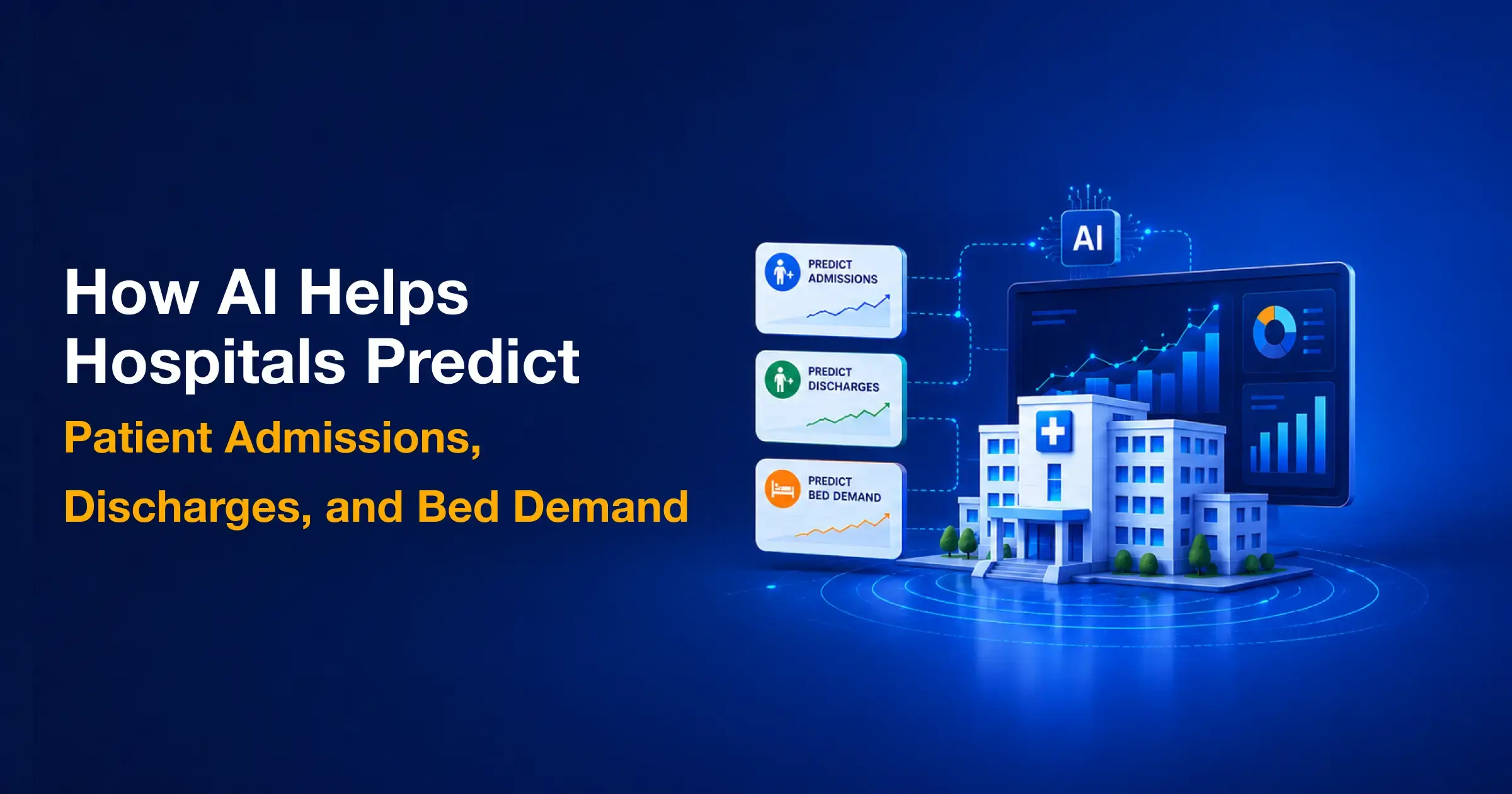
ML models trained on historical admission data, ER arrival patterns, seasonal disease cycles, and external signals can now forecast patient demand up to 72 hours ahead, dramatically improving AI healthcare efficiency across the board.
A 2025 study in the International Journal of Emergency Medicine demonstrated this in a clinical setting. Not a marginal improvement over guesswork. A fundamentally different operational posture. To understand what machine learning actually does inside these forecasting models, the mechanics are worth knowing before evaluating any vendor.
What is Predictive Patient Flow in Hospitals, Practically Speaking?
It's an ensemble approach, and the layers matter:
- Volume forecasting: Predicts aggregate arrivals by department across a 72-hour window
- Acuity mix estimation: Flags whether incoming load is high-complexity or routine
- Individual risk escalation: Identifies patients already in the system likely to deteriorate
Most health systems already have the data this requires. The step change isn't collecting new data. It's surfacing the patterns already buried inside what you have and converting them into AI hospital operations intelligence before the shift starts.
What the 72-Hour Window Changes Operationally
- Bed managers move ahead of demand, not behind it
- Nursing supervisors adjust shift ratios before call-outs start
- OR schedulers sequence elective cases around predicted constraints
- Supply teams stage inventory against projected need, not static par levels
The difference between managing a crisis and preventing one.
Where These Deployments Succeed and Where They Stall
The technology works. What breaks deployments isn't the model. It's the integration.
Hospitals seeing the clearest return have the forecast living inside tools staff already use daily. Inside the bed management platform. Inside the scheduling tool. Inside the capacity command center.
Remove that integration layer and you get a product nobody checks. This is also why AI integration with existing systems is one of the most consequential decisions a health system makes during deployment planning.
AI Healthcare Workforce Management: Beyond Scheduling Into Burnout Prevention
Healthcare has a staffing problem. But here's what rarely gets said plainly: a significant portion of it isn't a headcount problem. It's a time problem.
According to symplr's 2025 Compass Survey, clinicians lose nearly 90 minutes every single day to administrative tasks. Documentation, scheduling conflicts, credential checks. Work the right AI systems can absorb entirely.
AI healthcare workforce management isn't about replacing clinical staff. It's about giving them their time back.
Why Static Scheduling is Costing Hospitals More Than They Realize
Most hospitals still staff on fixed templates built weeks in advance. Think about what that assumes:
- That Monday's volume predicts next Monday's
- That a nurse scheduled on paper is actually available
- That acuity stays predictable across a 12-hour shift
When those assumptions break, hospitals pay in agency spend, overtime, and staff burnout. Dynamic AI hospital staffing adjusts recommendations in real time against live patient demand, not last week's census. It's one of the clearest examples of how AI is transforming business operations beyond the clinical layer.
How AI Detects Burnout Before a Staff Member Resigns
Burnout doesn't arrive suddenly. It builds. And the signals show up in data long before a resignation letter does:
- Longer documentation times per patient
- Rising after-hours EHR activity
- Increasing shift swap requests
- Dropping self-scheduled hours over time
AI healthcare workforce management surfaces these signals early enough for nurse managers to actually intervene. Not with a survey six months later. In the window where it still matters.
Replacing one experienced nurse costs between $40,000 and $60,000 when recruitment, onboarding, and productivity loss are factored in. Preventing a handful of departures per quarter changes the financial calculus of AI nurse scheduling and retention entirely.
Credentialing and Compliance: The Administrative Layer AI Eliminates
License verifications, certification renewals, DEA checks, payer enrollment updates. In most mid-sized health systems this lives across spreadsheets and email threads, creating compliance exposure nobody has time to manage properly.
AI doesn't just flag expiring credentials. It initiates renewal workflows, tracks completion, and surfaces exceptions before they become failures. This is clinical AI implementation doing the unglamorous work that keeps health systems audit-ready year-round.
Not glamorous. But exactly the kind of work that separates well-run health systems from ones constantly putting out fires.
AI in Revenue Cycle Management: Where the 20% Improvement Actually Comes From
Here's a number that should stop any hospital CFO mid-sentence.
Initial claim denial rates hit 11.8% in 2024, up from 10.2% just a few years prior. Per HFMA analysis, up to 65% of those denied claims are never reworked. That revenue is simply written off.
That's not a billing problem. That's a systemic failure with a very specific fix.
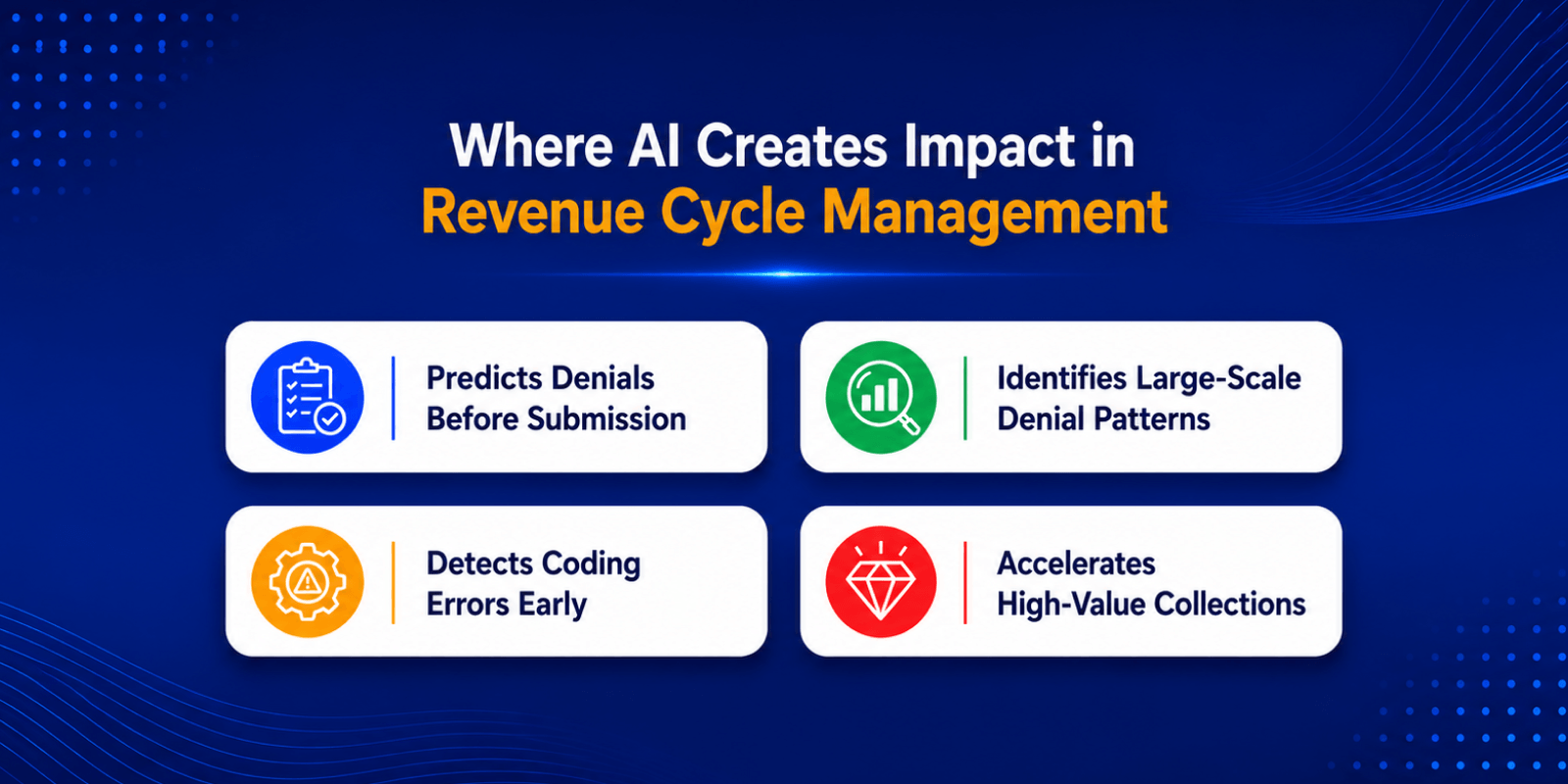
Oliver Wyman's research shows AI revenue cycle management can improve RCM performance by 20% or more. But that number means nothing without understanding where it actually comes from. Because it doesn't come from one place. It comes from four.
The Four RCM Intervention Points Where AI Actually Works
1. Prior authorization prediction — before the claim is ever submitted AI flags high-risk claims before submission using payer behavior patterns and historical denial data. Not after rejection. Before. That shift from reactive to preventive is where the largest share of the 20% originates.
2. Autonomous coding with clinical context — Coding-related denials rose 126% over three years per MDaudit. AI reads clinical notes, cross-references coding requirements, and surfaces discrepancies before the claim leaves the building.
3. Denial pattern analysis — fixing the root, not the symptom Most RCM teams fight denials one at a time. AI looks across thousands simultaneously, identifying structural patterns across payers, procedure families, and missing modifiers. Fix upstream, not downstream.
4. Payment velocity optimization — AI prioritizes follow-up queues by recovery value and payer response likelihood, moving highest-yield work to the front and accelerating cash flow.
The Adoption Gap Nobody Talks About
Experian Health's 2025 State of Claims survey found 67% of providers believe AI can improve claims. Only 14% have implemented it.
That gap isn't a technology problem. It's integration and change management. For hospital AI ROI conversations in the boardroom, revenue cycle is the fastest path to a defensible number. Measurable inputs, documented baseline, visible improvement within quarters.
AI in Healthcare Supply Chain: The Operational Layer Nobody is Talking About
Every conversation about AI in healthcare operations circles around clinical workflows, RCM, and staffing. Almost nobody mentions supply chain. That's a significant blind spot, because supply chain is where hospital AI ROI is often easiest to prove and fastest to realize.
According to a KPMG 2025 survey cited by GHX, 80% of U.S. healthcare executives face direct board-level pressure to show measurable ROI from AI investments. Supply chain is becoming the proving ground where that pressure gets answered.
Demand Forecasting That Connects to Patient Flow
Here's the connection most health systems haven't made yet.
The same ML models forecasting patient admissions 72 hours out? They can drive supply chain decisions with the same inputs. If Thursday is projected to run heavy on cardiac cases, the system flags consumable inventory levels for those procedures today, not Thursday morning when it's already too late.
- Procedure-specific supply staging based on live demand forecasts
- Automatic reorder triggers tied to predicted consumption, not static par levels
- Disruption alerts when vendor lead times threaten care continuity
This is AI healthcare supply chain management working as infrastructure, not as a standalone tool.
Where AI Eliminates Pure Operational Waste
Two areas where the impact is immediate and measurable:
PO exception handling — AI flags pricing mismatches, missing contract terms, and invoice discrepancies before they require manual resolution. What previously consumed hours of procurement staff time gets resolved or escalated automatically.
Inventory optimization — Overstocking ties up capital. Stockouts compromise care. AI holds that balance dynamically, adjusting across hundreds of SKUs simultaneously based on actual usage patterns and upcoming scheduled demand.
GHX's own 2026 prediction states it plainly: AI in healthcare supply chain is moving from proof of concept to proof of value. The organizations already treating it as a core operational layer, not an experiment, are the ones building a durable cost advantage.
Why Healthcare AI Fails After Go-Live and How to Prevent It
The model passed validation. The pilot looked promising. Then it went live, and six months later nobody was using it.
This is the most common story in clinical AI implementation right now. And the failure almost never starts with the algorithm.
Model Drift is Silent Until It's Costly
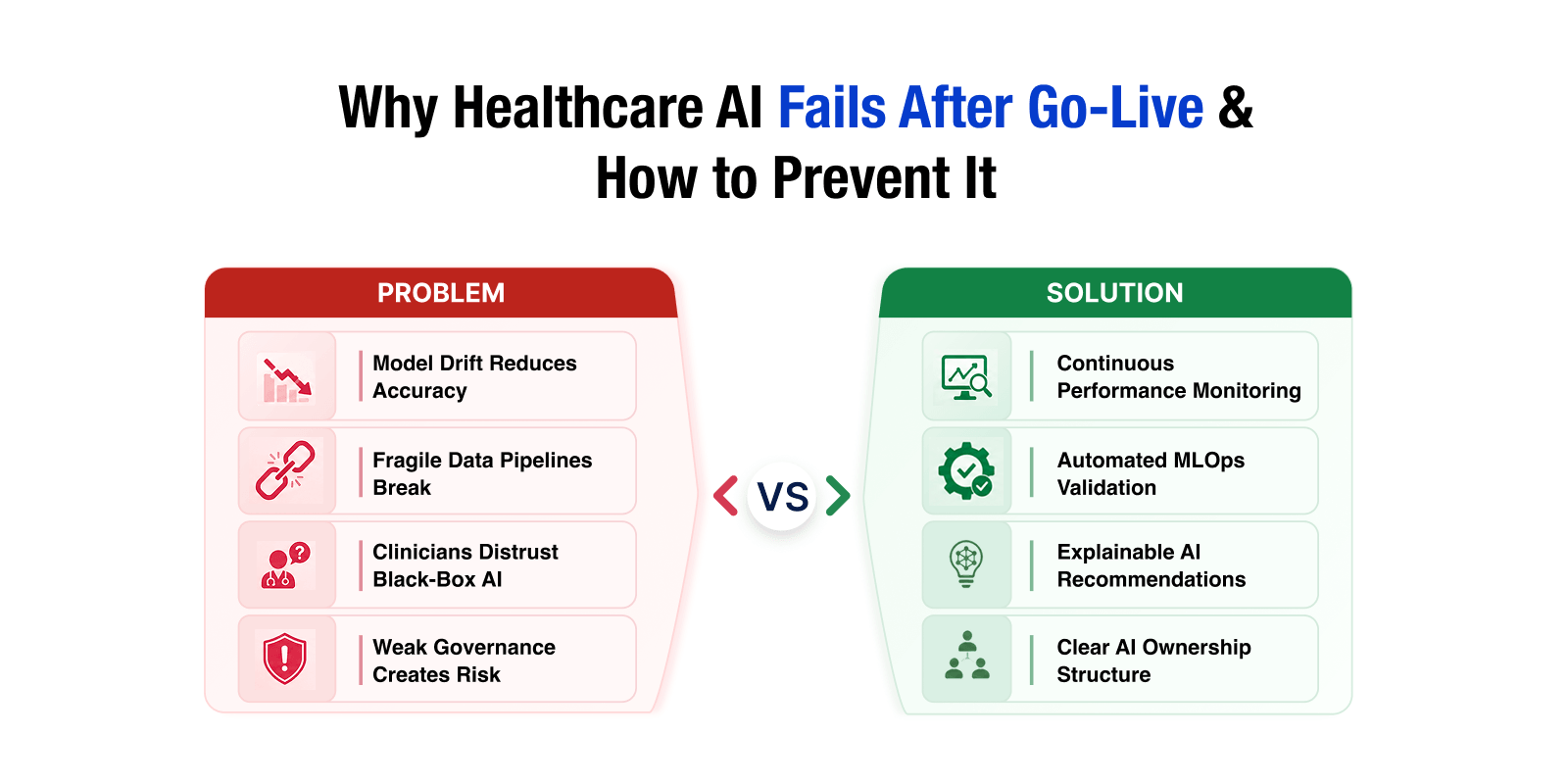
Patient populations shift. Payer rules change. Seasonal patterns evolve. A model trained on last year's data starts producing subtly wrong outputs, and nobody notices until it shows up in denial rates or staffing gaps. The fix is continuous performance monitoring baked into the deployment architecture itself, not a quarterly review someone schedules manually.
Your Data Pipeline is Probably Fragile
Most hospital AI runs on EHR integrations held together by assumptions. One upstream system updates and the feed breaks quietly. Active MLOps pipelines with automated anomaly detection catch breaks before they corrupt outputs, keeping the model honest without requiring constant human oversight.
Clinical Staff Don't Trust What They Can't Explain
An AI recommendation with no visible reasoning gets ignored. Every time. Adoption lives or dies on interpretability. When clinicians can see why a recommendation was made, not just what it says, trust builds fast and workflow integration follows.
Governance Gaps Turn Pilots Into Liabilities
Who owns the model after go-live? Who audits it quarterly? Without a named accountability structure, AI healthcare governance deteriorates into nobody's problem until it becomes a compliance problem. Define ownership, audit cadence, and escalation paths before the first production inference runs.
Getting AI healthcare efficiency gains that last means treating deployment as the beginning of the work, not the end of it. Choosing the right AI development partner for enterprise AI systems is often what determines whether governance gets built in from day one or bolted on after something breaks.
FAQs
What is AI in healthcare operations and how is it different from clinical AI?
Clinical AI looks at one patient and makes a recommendation. AI in healthcare operations looks across an entire health system simultaneously, finding where workflows break, where revenue leaks, and where demand is heading before it arrives.
How does predictive patient flow work in hospitals?
ML models trained on historical admissions, seasonal patterns, and real-time signals forecast patient demand up to 72 hours ahead, giving bed managers, staffing leads, and OR schedulers a window to act before pressure hits rather than after.
What is the ROI of AI in hospital revenue cycle management?
Oliver Wyman research puts it at 20% or more in RCM performance improvement, primarily through upstream denial prevention, autonomous coding accuracy, and payment velocity gains that compound across thousands of claims monthly.
How is AI being used in healthcare workforce management?
Beyond AI nurse scheduling and shift optimization, the most advanced deployments use EHR activity pattern analysis to detect early burnout signals and credential automation to eliminate the compliance paperwork that drains medical staff office hours daily.
What does it cost to implement AI in healthcare operations?
It varies significantly based on scope, existing data infrastructure, and integration complexity. A focused RCM or patient flow deployment costs far less than an enterprise-wide rollout, and most organizations see measurable hospital AI ROI within the first two to three quarters when the implementation is scoped correctly.
Why do healthcare AI projects fail after implementation?
Rarely the model. Almost always one of four things: model drift that goes unmonitored, fragile data pipelines that break silently, clinical staff who don't trust outputs they can't interpret, or governance structures that were never defined before go-live.
What should a hospital look for in an AI implementation partner?
Someone who builds for clinical reality, not general use. That means custom model training on your data, MLOps infrastructure that keeps performance honest post-deployment, and a team that stays accountable after the contract is signed, not just until go-live.