-
AI success today is an execution challenge, not a technology challenge.
-
Start with the business goal before deciding on a team structure.
-
Build in-house when AI is core to your product or competitive advantage.
-
Hire an AI development company when speed and expertise matter most.
-
The hidden costs of in-house AI go far beyond salaries.
-
AI partners help businesses avoid costly implementation mistakes.
-
Focus on time-to-value, not just ownership or cost.
-
Choose the model that best fits your business stage and goals.
Overview
Artificial intelligence is no longer a future initiative sitting on a roadmap. For most businesses, the conversation has already shifted to execution.
The challenge is that AI adoption and AI success are not the same thing.
Deloitte's State of Generative AI in the Enterprise study found that many organizations are progressing more slowly than expected, not because the technology is lacking, but because organizational change, governance, and execution are proving harder than the technology itself. As the report puts it, companies are often transforming at the speed of organizational change rather than the speed of AI innovation.
That observation will sound familiar to many CTOs.
Today, very few leadership teams are debating whether AI matters. Most have already invested in AI tools, pilots, or proof-of-concepts. The real question is much more practical:
What's the best way to build AI capabilities without creating delays, hiring bottlenecks, or operational headaches?
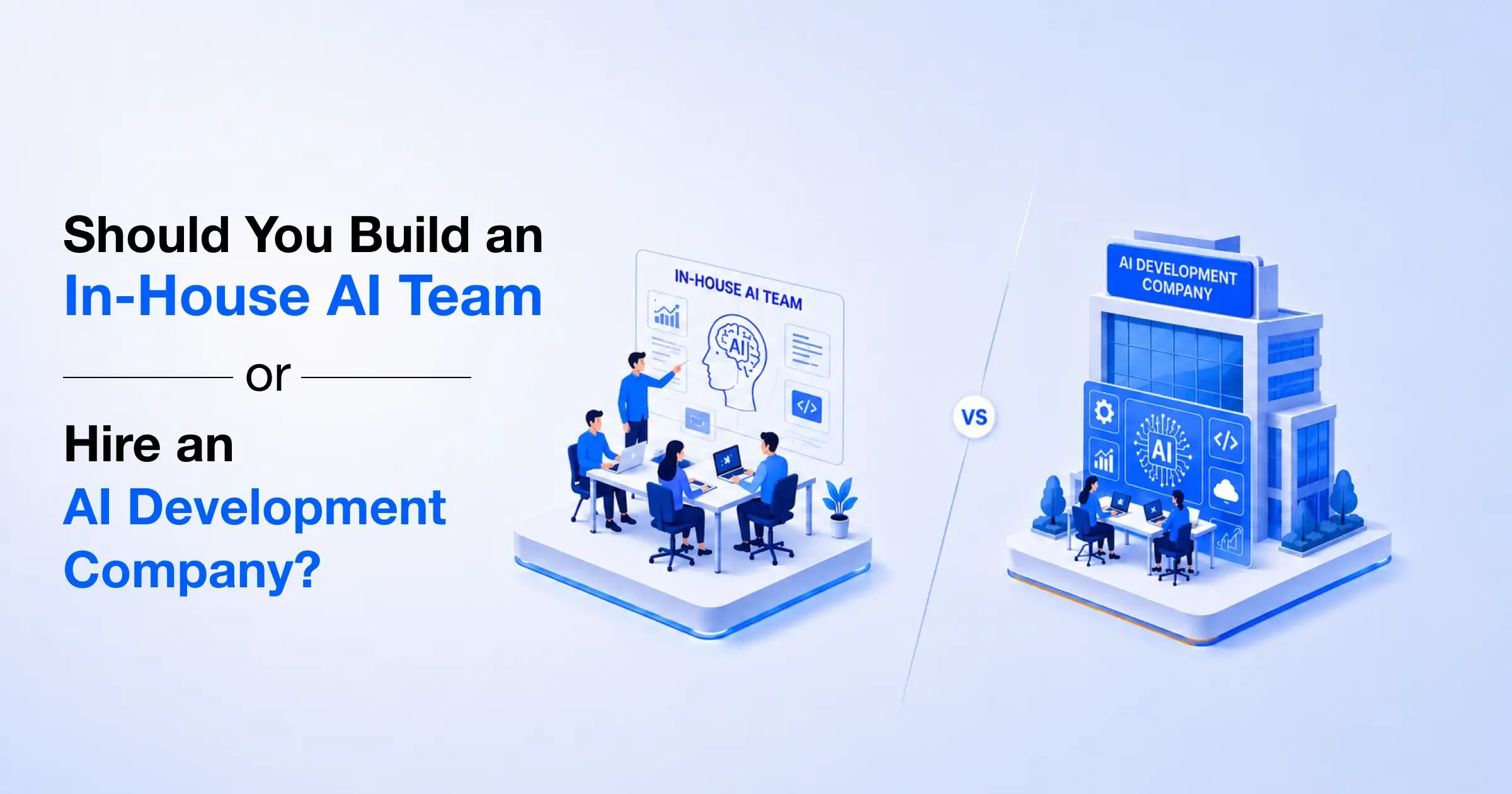
For some organizations, the answer is building an in-house AI team. For others, working with an AI development company is the faster path. Neither approach is universally right.
What matters is choosing the model that fits your business goals, internal capabilities, and timeline for results.
Why This Decision Looks Different in 2026
AI Talent is Still Expensive. But that's Not the Biggest Problem.
Let's start with the obvious.
Experienced AI engineers, machine learning specialists, and AI architects are still hard to hire. The demand remains high, especially for people who have actually deployed AI systems in production rather than simply experimented with models.
Many CTOs are competing against:
- AI-first startups offering attractive equity packages
- Big tech companies with deep hiring budgets
- Enterprises building internal AI initiatives at scale
Even when you find the right people, keeping them is another challenge altogether.
But here's what's interesting.
A few years ago, talent was the primary obstacle. Today, many organizations have realized that hiring AI experts does not automatically translate into AI success.
In fact, we've seen companies spend months building AI teams only to discover that progress remains frustratingly slow.
Why?
The New Bottleneck Is AI Execution
Most organizations no longer have an AI access problem.
They already have access to powerful models. They have cloud infrastructure. They have executive buy-in. In many cases, they even have skilled technical talent.
Yet projects still stall.
Not because the AI doesn't work.
Because the organization isn't ready for it.
Common roadblocks look something like this:
- Data spread across disconnected systems
- No clear ownership of AI initiatives
- Business and technical teams working toward different goals
- Governance and compliance concerns delaying deployment
- Pilot projects that never make it into production
And honestly, this is where many AI conversations become disconnected from reality.
That is why the in-house versus AI development company debate has become more nuanced in 2026. The decision is no longer just about acquiring talent. It's about choosing the execution model that can move your business from experimentation to measurable results.
Before Choosing a Team Structure, Decide What Kind of AI Company You Want To Be
This is the part many leadership teams skip.
They jump straight into the hiring conversation. Should we recruit AI engineers? Should we bring in an AI development company? Should we build a small internal team first?
Fair questions. But not the first question. The first question is simpler: what role should AI actually play in your business?
Are You Building AI as a Product?
If AI is part of what you sell, the equation changes.
Maybe you are building an AI-powered SaaS product. Maybe your platform depends on recommendation logic, predictive intelligence, natural language interfaces, or proprietary automation. In that case, AI is not just another technology layer. It is part of your product identity.
Here, internal capability matters a lot.
You need people who understand the product vision, customer behavior, roadmap decisions, and the technical trade-offs behind every AI feature. An outside partner can still help, especially in the early stages, but you probably do not want your entire AI brain sitting outside the company forever.
Are You Using AI to Improve Operations?
This is a different game.
Most businesses are not trying to become AI companies. They are trying to run better.
They want to reduce manual work, speed up decision-making, clean up messy workflows, improve reporting, automate repetitive tasks, or help teams get answers faster from internal data.
That might look like:
- Turning scattered business documents into searchable knowledge
- Automating repetitive back-office tasks
- Helping sales, support, finance, or operations teams work faster
- Connecting AI into existing CRMs, ERPs, dashboards, and internal systems
In this case, ownership still matters. But outcomes matter more.
You do not need to hire a full AI team just to prove that a workflow can be improved. You need the right people to identify the bottleneck, build the solution, integrate it properly, and make sure teams actually use it.
Why Companies Confuse These Two Goals
This is where budgets get wasted.
A company trying to improve operations may overbuild an internal AI team before it has clear use cases. Another company building an AI product may outsource too much and lose strategic control.
Same technology with very different decisions.
Building an In-House AI Team: Where It Makes Sense
Despite all the excitement around AI development partners, there are situations where building internally is absolutely the right move.
In fact, some companies have no realistic alternative.
The key is understanding whether you're building capability for a project or building capability for the business itself.
When AI Becomes Part of Your Competitive Advantage
Let's say your company is creating features, products, or customer experiences that competitors cannot easily replicate.
In that scenario, AI is not just supporting the business. It is becoming part of the business. Think about what happens over time.
Your team develops unique datasets. They learn from customer interactions. They discover what works, what fails, and why certain models perform better than others. That knowledge compounds year after year.
Many CTOs want that expertise to stay inside the organization. And honestly, that's a reasonable position when AI is expected to drive long-term differentiation.
When AI Is a Multi-Year Strategic Investment
A lot of companies underestimate this point.
If your roadmap includes a handful of AI projects over the next 12 months, building a large internal team may not make sense.
But if leadership has already committed to embedding AI across products, workflows, and decision-making over the next three to five years, the equation changes.
At that stage, you're not hiring for a project. You're building an internal capability that the business expects to rely on long term.
The Costs CTOs Often Discover Too Late
Most discussions focus on salaries.
The bigger costs usually appear after hiring.
For example:
- Building reliable MLOps processes
- Managing cloud infrastructure and model performance
- Retaining highly sought-after AI talent
- Preventing knowledge from becoming concentrated in one or two engineers
- Creating governance frameworks for security, compliance, and risk
Then there's leadership overhead.
Someone has to prioritize projects, align business stakeholders, evaluate technology choices, and ensure AI initiatives actually deliver outcomes.
This is why building an internal AI team is rarely just a hiring decision. It is an operating model decision. And for organizations betting heavily on AI over the long run, that investment can absolutely be worth it.
Working With an AI Development Company: Where It Makes Sense
There's a common misconception that companies work with AI development partners primarily to save money.
In reality, the strongest reason is usually something else. Time.
Most businesses are under pressure to show progress with AI now, not a year from now. They cannot afford to spend months building a team before a single project gets off the ground.
That's where an external partner often becomes a practical option.
When Speed Matters More Than Team Building
Many CTOs are dealing with a growing list of AI requests from across the business.
The operations team wants automation. Customer support wants AI assistants. Leadership wants productivity gains. Product teams want new AI-powered features.
Meanwhile, the hiring process moves at its own pace.
Working with an AI development company allows organizations to start solving business problems while they continue building internal capabilities in parallel. For many companies, that speed matters more than ownership in the early stages.
When You Need Expertise That Doesn't Exist Internally
This happens more often than people admit.
A company may have strong software engineers but little experience with AI architecture, model evaluation, retrieval systems, agent workflows, or production-grade AI deployments.
Those are very different skill sets. Hiring for all of them individually can take months. Sometimes longer.
An experienced AI partner brings those capabilities from day one, which reduces the amount of trial and error that often slows internal teams.
What a Good AI Development Partner Actually Brings
The real value isn't extra hands. It's access to a team that has already navigated common AI challenges across multiple projects.
That often includes:
- AI architects who can design scalable systems
- Data engineers who understand how to prepare and structure data
- Machine learning specialists with deployment experience
- Proven delivery processes that reduce project risk
- Lessons learned from previous AI implementations
Perhaps most importantly, they've usually seen what causes AI projects to stall. And sometimes, avoiding a mistake is just as valuable as building the solution itself.
In-House AI Team vs AI Development Company: A Practical Comparison
At this point, you might be thinking which option is better for your company at this stage. The honest answer is that neither is universally better. What matters is what problem you're trying to solve.
A company trying to launch AI initiatives within the next quarter will evaluate this decision very differently from a company building AI as a long-term strategic capability.
That's why the comparison below focuses on factors CTOs are actively dealing with today, not generic outsourcing talking points.
| Decision Factor | In-House AI Team | AI Development Company |
|---|---|---|
| Time to First Delivery | Often 6-12 months when hiring, onboarding, and infrastructure setup are included. | Can typically begin discovery and development within weeks. |
| Access to Specialized AI Skills | Depends entirely on who you can recruit and retain. Skill gaps are common in newer AI domains. | Immediate access to AI architects, ML engineers, data specialists, and implementation teams. |
| Execution Risk | Higher if the team lacks experience deploying AI systems in production. | Lower if the partner has delivered similar projects before. |
| Knowledge Retention | Institutional knowledge stays within the company. | Requires intentional documentation and knowledge transfer planning. |
| Control Over Priorities | Complete control over roadmap, priorities, and technical decisions. | Shared decision-making process with an external team. |
| Scaling AI Across Multiple Initiatives | Requires additional hiring as demand grows. | Teams can often scale resources up or down much faster. |
| Leadership Overhead | Significant. Internal leaders must manage hiring, mentoring, governance, and delivery. | Lower. Much of the execution management is handled by the partner. |
| Best Fit | Organizations building long-term AI capability as a strategic asset. | Organizations seeking faster execution, specialized expertise, or accelerated delivery. |
Choosing Between In-House and AI Development Firm
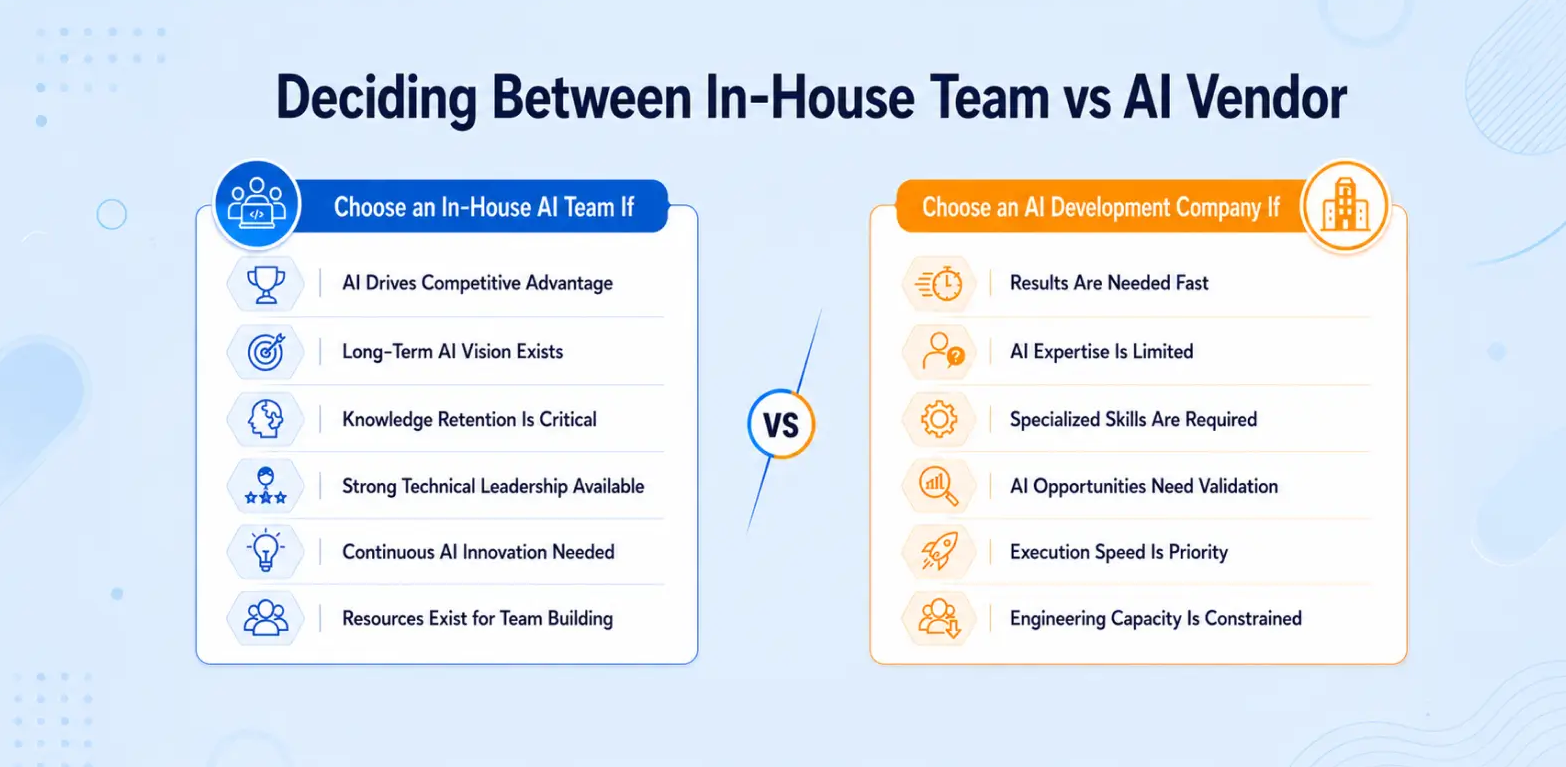
After all the comparisons, costs, and considerations, the decision often comes down to one question:
What does your business need most right now?
The right choice for a company trying to launch AI initiatives this quarter may be completely wrong for a company building AI capabilities as a long-term competitive advantage. So you need to be clear when to choose which model.
Building internally tends to make sense when AI is becoming a permanent part of your business strategy.
You should seriously consider an internal AI team if:
- AI capabilities are becoming a core differentiator for your products or services
- Leadership has committed to a multi-year AI roadmap, not just a handful of projects
- You want to retain technical knowledge, models, and intellectual property internally
- You already have experienced technical leadership capable of guiding AI initiatives
- The business expects continuous AI development rather than one-time implementations
- You are prepared to invest in hiring, retention, governance, infrastructure, and ongoing team development
Choose an AI Development Company If...
On the other hand, many organizations need results before they need a fully built AI department.
Working with an AI development company often makes more sense when:
- Business teams are asking for AI solutions now, not six to twelve months from now
- Internal teams lack hands-on experience with AI implementation at scale
- You need specialized expertise that would be difficult to recruit quickly
- The business wants to validate AI opportunities before making long-term hiring commitments
- Leadership is focused on accelerating execution and reducing implementation risk
- Existing engineering teams are already operating at full capacity
FAQs
There isn't a universal answer. If AI is going to be a long-term capability, building internally may make sense. But if you're trying to get projects moving quickly, an AI development company can often be the more practical investment.
Usually longer than most companies expect. Finding the right people is one thing. Getting them aligned, productive, and delivering business value is another. For many organizations, it's easily a six-month-plus journey.
When the business needs progress now. If you have clear AI goals but lack the time, expertise, or bandwidth to execute them internally, bringing in experienced specialists can help you move much faster.
The biggest mistake is choosing a partner based on promises instead of proven experience. Ask how they've handled real deployments, not just prototypes. That's where the differences start to show.
Yes, and many do. Internal teams provide business context and ownership. External partners bring specialized expertise and execution speed. It can be a very effective combination when managed well.
It's rarely just about AI engineers. Successful teams usually need a mix of data, engineering, architecture, and business expertise. The technical side matters, but so does understanding what problem you're actually trying to solve.

Tech.us is an AI development company that builds custom AI solutions for businesses seeking measurable results. We partner with organizations to design, develop, and deploy scalable AI systems that solve complex challenges and unlock new opportunities for growth. Our team delivers practical AI applications that create tangible business impact across industries.

Continue reading the blog
with a Tech.us subscription
You’re now subscribed!