blog-img

POPULAR POSTS

  • 01

    Top 10 Companies Offering Software Modernization Consulting Services in 2026

  • 02

    11 Proven Benefits of AI Chatbots for Businesses in 2025

  • 03

    Top 10 AI Development Companies Offering End-to-End AI Development Services

  • 04

    How To Improve Document Processing Accuracy Using Document AI

  • 05

    What Digital Transformation Means for Businesses in 2026

AI Transformation vs. Digital Transformation: Which One Does Your Business Actually Need?

Published Date: July 30, 2026 , Written by: Anand Selvadurai , Category: Digital Transformation, AI Transformation

tech.us-recognized-by-mobile-app-daily

Overview


Every few years, a new term takes over the boardroom. Digital transformation had its moment, and honestly, for most organizations, it never really ended.


Now AI transformation is the phrase everyone's using, often interchangeably with the last one, especially as businesses invest more heavily in artificial intelligence development services.
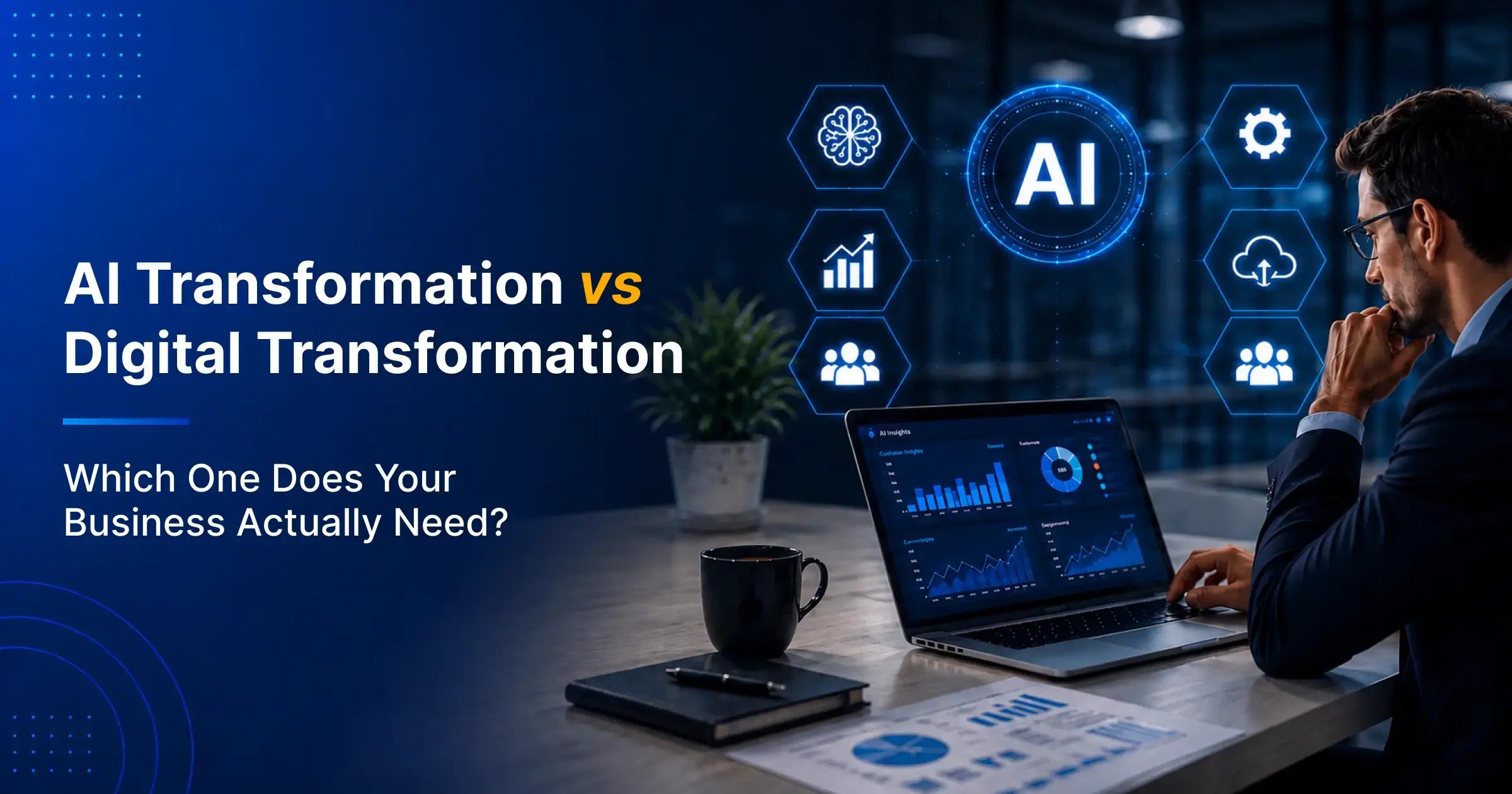

That's the problem. They're not the same initiative wearing different clothes. The goals are different, the risks are different, and, critically, the readiness requirements are different.


This post breaks down what each actually means, where they diverge, and how to figure out which one your business is genuinely positioned to pursue right now.


What Digital Transformation Was Actually About


Digital transformation meant different things to different organizations, but the underlying work was fairly consistent. Move infrastructure to the cloud. Replace legacy systems with platforms that could actually talk to each other. Get customer data out of spreadsheets and into CRMs. Build mobile-first experiences for users who had already given up on desktop portals. For the better part of a decade, that was the agenda.


And a lot of it worked. Companies that committed to it came out the other side with faster operations, cleaner data pipelines, and technology stacks that could at least be maintained without calling the one person who still understood the original codebase.


What It Got Right


The wins from digital transformation were real and measurable:


  • Centralized data replaced fragmented, siloed records across departments
  • Cloud infrastructure cut operational overhead and improved system reliability
  • SaaS platforms standardized workflows that had been running on tribal knowledge
  • Real-time reporting replaced the week-long wait for monthly dashboards

For organizations that executed it well, digital transformation built the operational backbone that everything else now depends on.


Where It Fell Short


Here's the part that didn't make it into the case studies. The technology was rarely the hard part. The hard part was getting people to actually use what was built. User adoption lagged. Middle managers kept their shadow spreadsheets. Teams worked around the new systems because nobody had invested in showing them why the change was worth the friction.


The other problem: digital transformation improved existing processes. It made slow things faster and manual things automated. What it didn't do was make businesses smarter. The systems did exactly what they were told, nothing more. That ceiling became obvious once the infrastructure was in place and companies started asking what came next.


Here’s How Digital Transformation Played Its Key Role


JPMorgan Chase spent years consolidating thousands of data systems across its global operations into unified cloud infrastructure.


Before that, different business units were running on incompatible platforms, that made something as basic as a complete view of a single customer nearly impossible.


This shift didn't just speed things up. It gave their teams a single source of truth to work from.


That's digital transformation at its core: not inventing new capabilities, but building the connective tissue that makes existing operations actually function as one coherent business.


What AI Transformation Actually Means (And What It Doesn't)


There's a version of "AI transformation" that's just digital transformation with a new label slapped on it. A company buys a few AI tools, adds a chatbot to the website, runs some prompts through an LLM, and calls it transformation. That's not what this is. Purchasing AI products is adoption. Transformation is something else entirely.


AI transformation is what happens when a business fundamentally changes how it generates intelligence, makes decisions, and creates value through artificial intelligence in business transformation. The systems don't just execute instructions faster. They learn from data, identify patterns humans would miss, and adapt over time without being manually reprogrammed. That's a different category of change.


The scale of that shift isn’t theoretical. According to McKinsey, generative AI features alone could add between $2.6 trillion and $4.4 trillion in annual economic value across the 63 business use cases they analyzed.


AI Adoption vs. AI Transformation: Not the Same Thing


The distinction matters because they require completely different organizational commitments:


  • AI adoption is tool-level: deploying AI products into existing workflows to improve speed or reduce manual effort
  • AI transformation is system-level: redesigning how the business operates around AI-native capabilities, including how data flows, how decisions get made, and who is accountable for outcomes

Most companies right now are somewhere in the adoption phase and calling it transformation, which helps explain why many enterprise AI initiatives fail to deliver results. That gap in expectations is where projects stall and budgets disappear.


What Changes at the System Level: From Deterministic to Probabilistic


Traditional software is deterministic. You put the same input in, you get the same output every time. If something breaks, you trace it, fix it, and it stays fixed.


AI systems don't work that way. They're probabilistic. The same prompt can return different outputs. A model update from a vendor can quietly shift behavior across your entire operation overnight. The system doesn't fail loudly. It fails by being confidently wrong, which is a harder problem to catch and a harder one to explain.


That shift alone changes how you govern, test, and manage these systems. The old playbook doesn't cover it, which is why organizations often need to revisit the key aspects of AI development for businesses before scaling AI initiatives.


Here’s How AI Transformation Changed the Game


Amazon's fulfillment network is a clear case. Their AI systems started doing things more than just automating warehouse tasks.


  • They predict demand before orders are placed
  • They dynamically reroute inventory across fulfillment centers based on real-time signals
  • They adjust staffing models accordingly

The decisions aren't being made by humans reviewing reports but the system is continuously learning from transaction data, seasonal patterns, and supply chain variables, then acting on that intelligence autonomously.


That's not a faster version of how Amazon used to operate. It's a fundamentally different operating model, one that wouldn't be possible by simply digitizing the old one.


The Real Differences Between Digital and AI Transformation

tech.us-recognized-by-mobile-app-daily

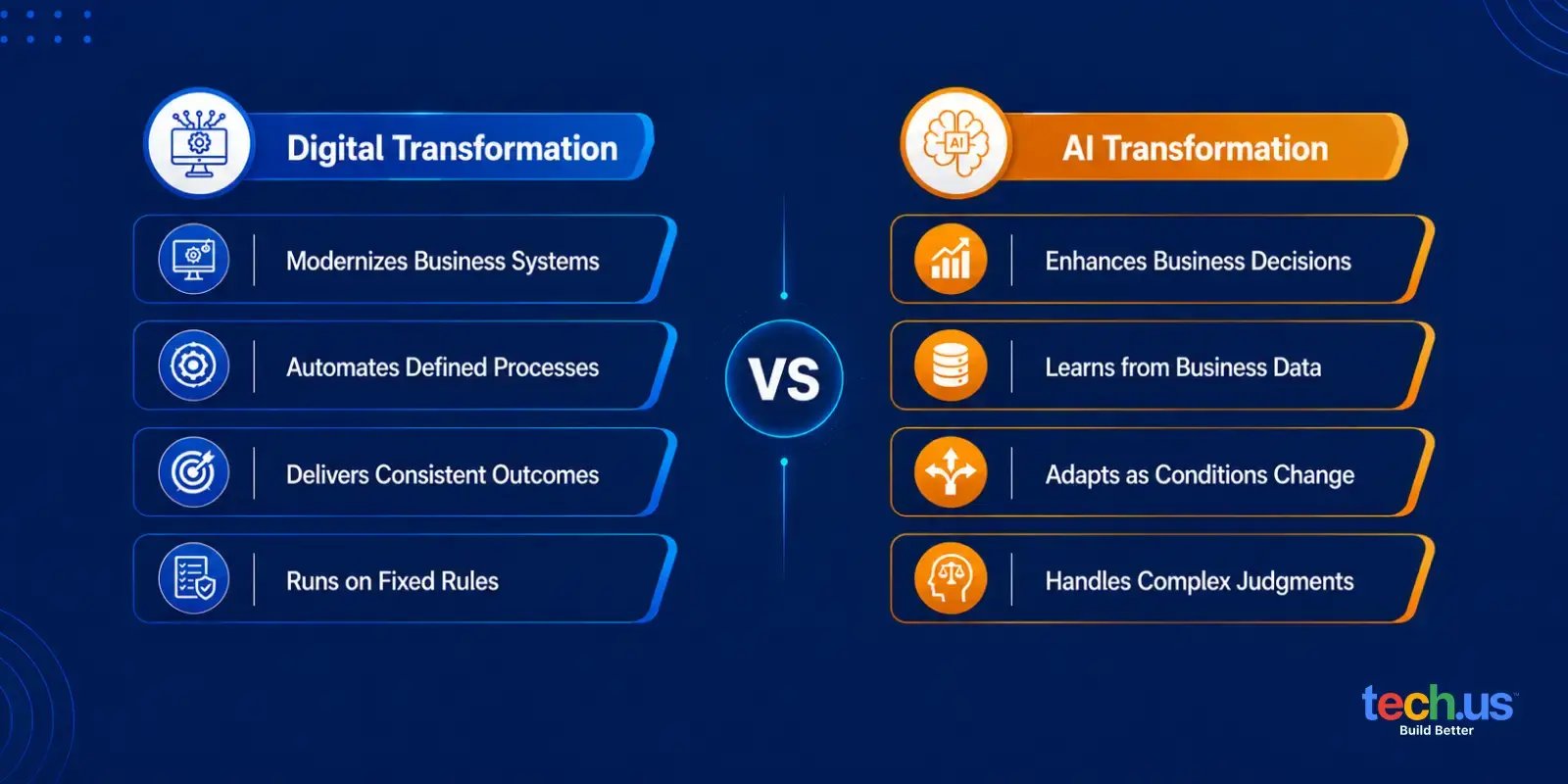
Digital and AI transformation are often treated as phases of the same journey. They're not. They differ at the level of how the technology works, what it does with data, who carries the decision-making load, and whether the work ever actually ends. Here's where those differences play out in practice.


How the Technology Works: Predictable Systems vs. Probabilistic Models


Digital systems are built on logic. A rule is a rule. The same input produces the same output, every single time. When something goes wrong, there's a traceable cause. A developer can find it, fix it, and the problem stays fixed.


AI models operate differently. They produce outputs based on probability, not hard logic. Ask the same question twice and you may get two different answers, both defensible, neither guaranteed to be correct. Worse, when a vendor updates the underlying model, your outputs can shift without you changing a single line of configuration. Digital systems fail loudly. AI systems fail quietly, often while sounding completely certain.


How Data Is Used: Reporting Asset vs. Living Intelligence


In digital transformation, data was something you organized and reported on. You built data warehouses, cleaned up records, and created dashboards so humans could review the numbers and make decisions.


In AI transformation, data doesn't sit in a warehouse waiting to be reviewed. It feeds models that learn from it continuously, identify patterns in real time, and act on those patterns without a human in the loop for every decision, which is fundamentally how machine learning systems create value.


Data stops being a record of what happened and becomes the engine driving what happens next.


What "Done" Looks Like: Finish Line vs. Moving Target


Digital transformation had a finish line, at least in theory. You migrated to the cloud. You shipped the new platform. You hit your adoption targets. The project closed.


AI transformation has no equivalent endpoint. Models need monitoring, evaluation, and retraining, which is why practices such as MLOps have become critical for long-term AI success.


New capabilities emerge that change what's possible every few months. The strategy you wrote in January is partially obsolete by April. This isn't a project with a completion date. It's an operational capability that has to be continuously managed.


Where the Cognitive Load Lives: Offloaded vs. Redistributed


Digital systems absorbed work that humans used to do manually. The system processed it, stored it, and surfaced it. Human effort went down.


AI systems do something different. They generate outputs that humans then have to evaluate, verify, and act on. Did the AI recommend the right pricing strategy? Is this generated contract clause legally sound? The decision-making burden doesn't disappear. It moves, and in many cases it becomes harder because the output looks authoritative even when it shouldn't be trusted without review.


Who Owns the Outcome: IT Projects vs. Business-Wide Accountability


Digital transformation was largely owned by IT. Business units were stakeholders, but the program lived in technology. Success was measured in system uptime, migration completion, and adoption rates.


AI transformation can't live in IT alone, which is why many organizations are investing in broader enterprise AI services for business operations.


When an AI system influences a pricing decision, a hiring shortlist, or a customer communication, the accountability for that output belongs to the business function using it. Legal, compliance, operations, and leadership all have skin in the game in ways they simply didn't during digital transformation.


Digital Transformation vs. AI Transformation: At a Glance


Dimension

Digital Transformation

AI Transformation

Core objective

Modernize systems and digitize operations

Build intelligent, adaptive, decision-making capability

How technology works

Deterministic: same input, same output

Probabilistic: outputs vary, models evolve

Role of data

Reporting and analytics asset

Continuous learning engine

Failure mode

Breaks visibly, traceable cause

Fails silently, confidently wrong

Project timeline

Defined phases, completion point

Ongoing, no fixed endpoint

Cognitive load

Moves work into systems

Redistributes decision weight to humans

Ownership

Primarily IT-led

Cross-functional business accountability

Success metric

Adoption rate, system uptime

Decision quality, model accuracy, business outcomes


What Carries Over, and What Doesn't


If you led a digital transformation, you're not starting from zero. Some of what you learned transfers directly. But parts of that strategy, if you carry them into an AI transformation without examining them, will quietly sink the program. Knowing the difference matters before you start.


What Still Works


The organizational disciplines that made digital transformation succeed are just as relevant here:


  • Change management: Whether you're rolling out a new ERP or an AI-powered decision system, human adoption is still what determines success, which is one of the key benefits of working with an AI software development company.
  • Executive sponsorship: If leadership isn't visibly using and championing the initiative, the organization won't follow. That hasn't changed.
  • Governance frameworks: Access control, data classification, audit trails, and accountability structures still matter. They just need to expand to cover new territory like model evaluation and prompt oversight.
  • Stage-gate scoping: Starting with a constrained use case, proving value, then expanding is still the right approach. Broad rollouts without validated pilots fail in AI just as they did in digital.
  • Cross-functional program structure: Steering committees, named owners, and working groups keep large programs from drifting. That discipline carries over cleanly.

What Will Get You in Trouble


This is where leaders who've done this before tend to make avoidable mistakes:


  • Waterfall planning: A 36-month AI roadmap planned in detail is obsolete before it's approved, especially given how quickly generative AI capabilities continue to evolve.
  • Pass-fail acceptance testing: You cannot verify a probabilistic system the way you verified a CRM migration. You need ongoing evaluation, not a sign-off checklist.
  • One-and-done training: AI tools change constantly. Training your team once at rollout and moving on guarantees drift between how people use the tools and what the tools are actually capable of.
  • Measuring ROI only in hours saved: The real value from AI often shows up in decision quality, new revenue models, and capabilities that didn't exist before. If your CFO is only looking for productivity savings, you'll undervalue what's actually working.

How to Move Forward Without Getting It Wrong


The companies that struggle with AI transformation aren't typically short on tools or budget but mostly on clarity.


That shows up clearly in the data. BCG’s 2024 global survey of 1,000 executives found that only 22% of companies have moved beyond AI proofs of concept to generate real value, and just 4% are seeing substantial impact at scale.


The technology is the easy part to procure. Choosing the right implementation strategy and AI development partner is often much harder.


What's harder is getting your executive team aligned on what you're actually attempting, building the infrastructure to evaluate whether it's working, and treating adoption as an ongoing organizational challenge rather than a launch event.


AI transformation rewards shorter planning cycles, honest assessment of your digital foundation, and investment in the human layer of the program, not just the technical one.


FAQs


Is AI transformation just the next phase of digital transformation?


Not exactly. Digital transformation modernized your systems. AI transformation changes how those systems think and decide. One builds the foundation; the other changes what you build on top of it.


Can a business skip digital transformation and go straight to AI transformation?


In most cases, no. AI systems need clean, connected, well-governed data to function reliably. If your digital foundation is shaky, your AI initiative will be too.


How do we know if we're ready for AI transformation?


Start by asking whether your data is centralized, accessible, and trustworthy. If your teams are still reconciling numbers across spreadsheets, you have foundational work to finish first.


Why do so many AI transformation initiatives fail?


Mostly because organizations treat it like a technology project when it's really an organizational change problem. The tools are the easy part. Getting people to use them well, consistently, is where most programs break down.


What's the first thing a business should do before starting AI transformation?


Align your leadership team on what AI transformation actually means for your business specifically, not the industry definition, but the operational and strategic changes you're committing to. Without that clarity at the top, everything downstream gets harder.


Tech.us

Tech.us is an AI development company that builds custom AI solutions for businesses seeking measurable results. We partner with organizations to design, develop, and deploy scalable AI systems that solve complex challenges and unlock new opportunities for growth. Our team delivers practical AI applications that create tangible business impact across industries.

1,500+ Projects
Delivered
25+ Years in
Business
30+ Industries
Served
100% Commitment
to Success

WRITTEN BY

Anand Selvadurai

Anand Selvadurai

Director of AI/ML at Tech.us

Director of AI/ML 16+ years experience AI/ML Specialist

Written by Anand Selvadurai, Director of AI & ML at Tech.us — 16+ years experience designing enterprise ML pipelines and deploying production-grade AI systems across Construction, healthcare, fintech, and logistics. Certified Machine Learning Specialist and Research Scholar.


View all articles
How Multi-Agent Systems Work in Enterprise Environments

How Multi-Agent Systems Work in Enterprise Environments

NEWSLETTER


RECENT POSTS


blog-img

AI Transformation vs. Digital Transformation: Which One Does Your Business...

blog-img

How Multi-Agent Systems Work in Enterprise Environments

blog-img

Multi-Agent Systems in Enterprise: Benefits, Use Cases, Risks, and...

blog-img

How to Identify High-Impact AI Transformation Opportunities

blog-img

When Should Businesses Build AI Into Custom Software?