-
AI access grew 50%, but readiness has not kept pace.
-
84% of companies still haven't redesigned work around AI.
-
AI adoption does not automatically lead to AI transformation.
-
Only 34% of organizations are using AI to deeply transform their business.
-
Workflow, governance, data, talent, and infrastructure gaps slow AI success.
-
Only 25% of companies have scaled 40% or more of their AI experiments into production.
-
The biggest AI challenge today is organizational readiness, not technology access.
Overview
If you've spent any time reading about artificial intelligence over the past year, you've probably noticed a pattern.
Every company seems to be "doing AI."
There are announcements about new AI initiatives. Employees are getting access to AI tools. Budgets are increasing. Leaders are talking about transformation. From the outside, it looks like businesses have finally moved beyond experimentation and are racing toward an AI-powered future.
But there is a problem hiding beneath all that momentum.
Many organizations are adopting AI without truly preparing for what AI transformation actually requires.
A recent Deloitte survey of more than 3,200 business and technology leaders found that workforce access to AI tools grew by 50% in just one year. At the same time, 84% of organizations increased their AI investments, and 78% of leaders reported growing confidence in the technology. Those numbers suggest AI adoption is accelerating across industries.
Despite all this activity, 84% of companies have not redesigned jobs and work around AI capabilities. In other words, they are introducing AI into existing ways of working rather than rethinking how work should happen in an AI-enabled business.
Successful AI transformation is rarely about deploying another tool. Many organizations pursuing AI development services underestimate how much organizational change is required alongside the technology itself. Technology is only one piece of the equation.
What the 84% Statistic Actually Means
At first glance, the finding is surprising.
How can 84% of companies be unprepared for AI transformation when AI adoption is accelerating across industries?
Organizations are increasing AI investments, giving employees access to AI tools, and launching new initiatives across the business. On the surface, that sounds like progress.
AI Adoption Does Not Equal AI Transformation
A company can deploy AI tools across its workforce and still operate exactly as it did before.
The same workflows exist. The same approval processes remain in place. Teams continue working in the same structure. AI simply becomes another layer on top of existing processes.
While this can improve productivity and automate repetitive work, it rarely changes how the business fundamentally operates.
That is where many organizations get stuck.
The Companies Seeing the Greatest Impact Are Thinking Differently
According to Deloitte's research, only 34% of organizations are using AI to deeply transform products, processes, or business models. Another 30% are redesigning key processes around AI, while 37% are using AI with little or no change to underlying workflows.
This distinction also helps explain why many enterprise AI initiatives fail to deliver results. Leaders often focus on acquiring AI capabilities while underestimating the organizational changes required to unlock their value.
The organizations creating the most value from AI are not necessarily deploying more tools. They are rethinking how work gets done.
Real AI Readiness Starts with the Foundation
Real AI readiness goes far beyond technology adoption.
Organizations need to rethink:
- How decisions are made
- How workflows are structured
- How teams collaborate
- How data moves across the business
- How governance and accountability are managed
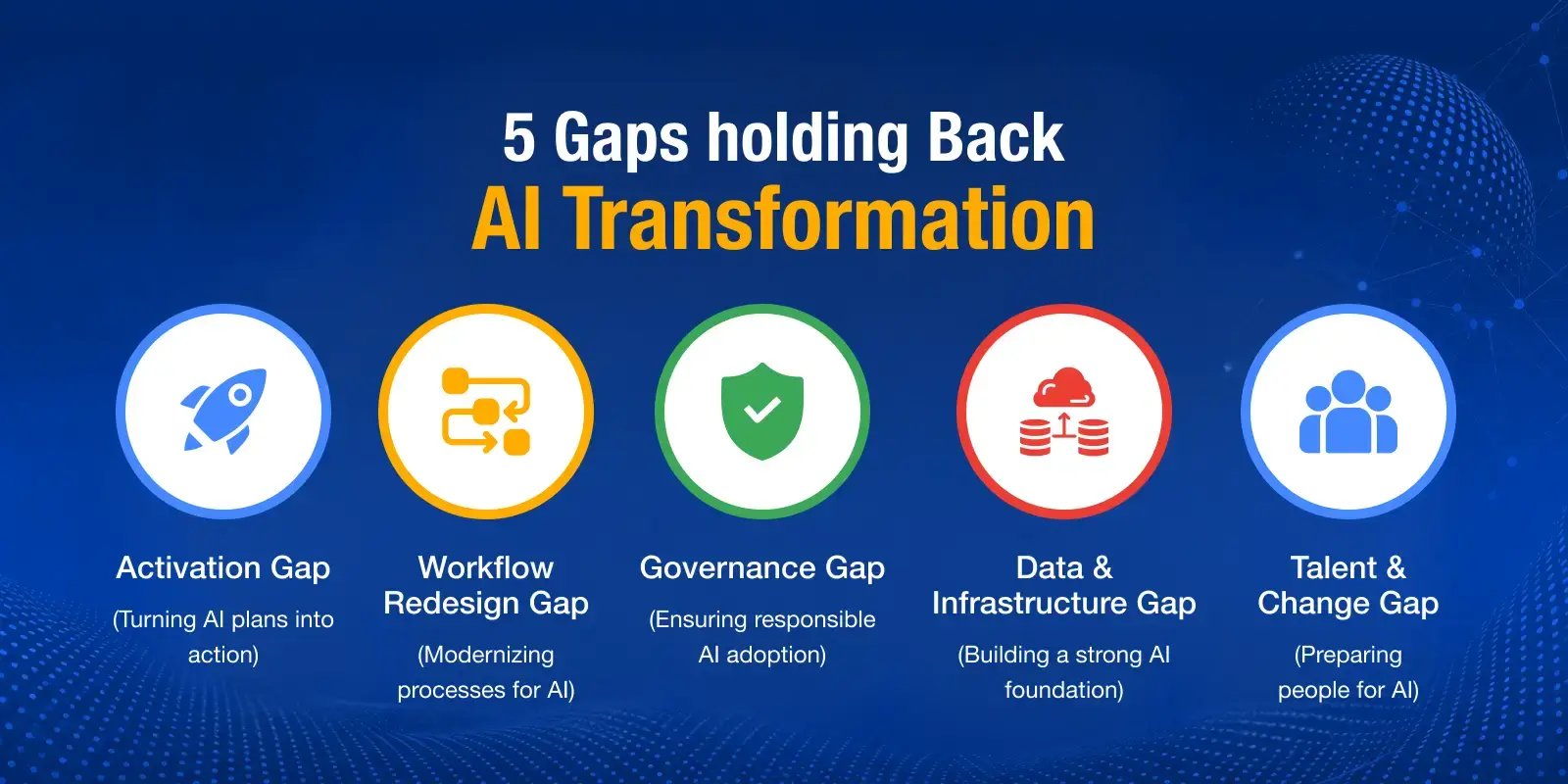
The 5 Gaps Holding Companies Back from AI Transformation
Most companies do not fail at AI because they lack ambition. They fail because the organization around the technology is not ready.
That is the uncomfortable part. AI can be available, funded, and even widely discussed inside a business, but still fail to produce meaningful transformation. The gap is usually not the model. It is not always the tool either.
It is the operating environment around it.
Here are the five gaps that keep companies stuck between AI experimentation and real AI transformation.
1. The Activation Gap
Many organizations have already solved the access problem. Employees have AI tools. Teams are experimenting. Leaders are encouraging adoption.
That is not transformation. That is casual adoption.
That includes sales follow-ups, claims processing, customer support, reporting, forecasting, quality checks, compliance reviews, documentation, software development, and operational decision-making. These are also some of the top business processes being transformed through AI automation today.
2. The Workflow Redesign Gap
This is one of the biggest issues hiding behind failed AI initiatives. Companies often introduce AI into old workflows and expect new outcomes.
But if the process itself is outdated, AI only makes the outdated process faster.
For example, if a company has a slow approval process, AI may help summarize documents faster. That helps. But the larger bottleneck may still remain. The same handoffs, the same dependencies, the same review cycles, the same manual checks.
- Which steps no longer need to exist?
- Which decisions can be supported by AI?
- Which tasks should stay human-led?
- Where do we need human review?
- What should the new workflow look like if we designed it today?
That last question matters.
Too many companies are trying to fit AI into systems that were never designed for intelligent automation, real-time insights, or autonomous action. In fact, some of the most common challenges arise from AI integration mistakes within existing enterprise systems.
3. The Governance Gap
Governance is not the most exciting part of AI transformation. But it may be the part that decides whether AI can scale.
In early pilots, governance can feel manageable. A small team tests a use case. The risk is contained. The data is limited. The business impact is controlled. Production is different.
These questions become even more important with agentic AI systems, where systems do not just generate responses but can take actions.
A chatbot that suggests an answer is one thing. An AI agent that sends an email, updates a record, triggers a workflow, or makes a recommendation that affects a customer is something else entirely. This is one reason many organizations are exploring how AI agents are disrupting traditional business processes.
4. The Data and Infrastructure Gap
AI transformation depends heavily on the quality of the systems beneath it.
The same applies to infrastructure.
As AI use cases become more advanced, companies need systems that can support security, monitoring, integration, scalability, and real-time data movement. This is where practices such as MLOps for AI deployment and governance become increasingly important.
Pilots take longer. Integrations become expensive. Teams struggle to trust outputs. Scaling becomes harder than expected.
5. The Talent and Change Management Gap
This is where many companies take a narrow approach. They offer AI training, encourage employees to experiment, and assume that adoption will follow.
They need to know how AI fits into their specific role. They need examples from their daily work. They need clarity on what they are accountable for. They need confidence that using AI will not create confusion, risk, or extra review cycles.
Because AI transformation does change work. It changes how tasks are completed, how decisions are made, how teams collaborate, and how value is measured. This broader shift is a core theme in artificial intelligence-driven business transformation.
Real change management makes AI practical. It connects the strategy to the employee experience. It turns abstract ambition into daily behavior.
That is when AI stops being a leadership priority on paper and starts becoming part of how the business actually runs.
Why AI Pilots Don't Become Business Value
One of the biggest misconceptions about AI transformation is that successful pilots automatically lead to successful implementation.
In reality, this is where many organizations get stuck.
According to Deloitte's research, only 25% of companies have moved 40% or more of their AI experiments into production. Yet more than half expect to reach that level soon. That gap highlights a challenge many leaders know all too well: proving value in a controlled pilot is much easier than delivering value across an entire organization.
Pilots Operate in Ideal Conditions
Under those conditions, success is often achievable.
Scaling AI Introduces New Challenges
AI systems must integrate with existing platforms, comply with governance requirements, handle edge cases, support larger user groups, and deliver reliable outcomes consistently.
Avoiding the Proof-of-Concept Trap
Before investing in another AI initiative, leaders should ask:
- Do we have a clear path from pilot to production?
- Who will own this solution after deployment?
- Can our existing systems support it at scale?
- How will we measure business impact beyond technical performance?
- What governance and oversight mechanisms are required?
- Have we identified the workflows that need to change alongside the technology?
Closing the Gap Starts with a Different Mindset
They are struggling with AI transformation. The difference matters.
- Are we redesigning workflows or simply adding AI to existing processes?
- Do we have a clear path from pilots to production?
- Is our data infrastructure capable of supporting AI at scale?
- Have we established governance before expanding adoption?
- Do employees understand how AI fits into their day-to-day responsibilities?
- Are our AI initiatives connected to measurable business outcomes?
The answers to those questions often reveal more about AI readiness than the number of tools deployed across the organization.
Here's What Stood Out to Us
One insight stood out to us throughout the research.
Based on our experience working with organizations on AI initiatives at Tech.us, the biggest challenge is rarely selecting the right model, platform, or vendor. More often, it is aligning workflows, governance, data, and people around AI in a way that creates lasting business value.
The organizations seeing the greatest impact are not simply deploying AI tools. They are redesigning how work gets done, how decisions are made, and how business processes operate. This is also why many businesses increasingly partner with an AI software development company to align technology initiatives with broader operational goals.
That is an important distinction.
The companies that recognize this shift early will likely be the ones that capture the greatest value from AI over the next few years.
FAQs
AI readiness goes beyond having access to AI tools. It refers to an organization's ability to integrate AI into its workflows, data infrastructure, governance processes, and day-to-day operations. A business may be using AI today but still not be fully prepared to scale it across the organization.
AI adoption is the act of introducing AI tools into the business. AI transformation happens when organizations redesign processes, decision-making, and operating models around AI capabilities. In simple terms, adoption changes how tasks are performed, while transformation changes how the business operates.
Many pilots succeed in controlled environments but struggle when deployed at scale. Production environments require system integration, governance, security, data quality, and ongoing management. Without a clear roadmap from pilot to production, organizations often find themselves running experiments without creating lasting business value.
While technology is often viewed as the primary challenge, organizations typically face broader obstacles. Common barriers include fragmented data, lack of governance, outdated workflows, insufficient change management, and difficulty aligning AI initiatives with business goals. These factors often limit transformation more than the technology itself.
Businesses evaluating these areas often begin by assessing whether they are truly ready for artificial intelligence development before committing to large-scale implementation.
Here are things business leaders should prioritize:
- Align AI initiatives with measurable business outcomes
- Assess whether existing workflows need to be redesigned
- Establish governance and accountability frameworks
- Ensure data quality and infrastructure readiness
- Prepare employees for new ways of working with AI
Organizations that address these areas early are generally better positioned to move from experimentation to sustainable AI-driven growth.

Tech.us is an AI development company that builds custom AI solutions for businesses seeking measurable results. We partner with organizations to design, develop, and deploy scalable AI systems that solve complex challenges and unlock new opportunities for growth. Our team delivers practical AI applications that create tangible business impact across industries.

Continue reading the blog
with a Tech.us subscription
You’re now subscribed!