
Key Aspects Discussed
- AI adoption is near-universal. Bottom-line impact is not.
- Using AI and benefiting from AI are two very different things.
- Speed in one team does not equal profit for the whole company.
- Most companies automated their old problems instead of fixing them.
- Only 1 in 5 organizations have actually redesigned how their work gets done.
- Without a CEO owning AI governance, it stays a mid-level priority.
- If you are not tracking AI KPIs, you have no idea if it is working.
- No measurement means no improvement, and no improvement means no results.
- The winning companies changed their operating model, not just their toolset.
- Running ten pilots at once is not a strategy. It just looks like one.
- Pick one workflow, redesign it properly, and build from there.
- Going wide and thin is how companies end up with activity but no impact.
- Getting results from AI is a decision, not a coincidence.
Overview
There is something strange about enterprise AI at work right now. Almost every company is using it, but at the same time almost nobody can point to where it shows up on the bottom line. And why businesses aren't seeing ROI from AI is a question that deserves a straight answer.
The numbers from McKinsey's latest global survey make the AI adoption value gap hard to ignore:
- 88% of organizations now use AI in at least one business function.
- 79% have adopted generative AI (up from 33% in 2023, which nearly tripled in 2 years).
- Adoption is essentially everywhere. And yet, more than 60% of those same organizations say they are seeing no tangible enterprise AI bottom line impact from generative AI (only 39% report EBIT impact).
- Only 1% of executives describe their rollouts as mature.
So what is actually going on here?
The easy explanation is that the technology isn't ready. That also happens to be the wrong one. The tools work. People are using them every single day. The problem sits somewhere else, in how companies have bolted AI onto the way they already operate. This is an execution gap, not a technology gap, and that difference matters far more than it first sounds.
The gap between using AI and getting value from it
The value from AI is real. It's just stuck in small places.
Go team by team inside most organizations and the story sounds promising. The support desk is closing tickets faster. Marketing trimmed its content spend. Most teams that have put generative AI to work say it lowered their costs, and a growing number say it lifted revenue too. The wins are sitting right there.
Then step back and look at the company as a whole. Where did they all go?
A team win is not a business win
This is the part most leaders quietly miss. Making one department faster does not automatically make the whole business more profitable. And the profit line proves it: Only 6% of organizations are AI high performers, which means they attribute 5% or more of their company-wide EBIT to gen AI use. For everyone else the generative AI ROI story is too small, too scattered, or too buried under other costs to ever surface where the board is actually looking.
There's also a cost side that tends to get overlooked:
Using AI is not consequence-free. Organizations are dealing with inaccurate outputs that slip through unchecked. Security vulnerabilities that nobody planned for.
Intellectual property risks that the legal team is still trying to untangle. These aren't edge cases. They're showing up across industries, and every one of them quietly offsets whatever value the tools were supposed to create.
Why adoption alone doesn't change the numbers
Companies typically approached AI the same way. They found a tool, ran a pilot, got some positive feedback, and rolled it out. The process underneath stayed exactly the same. The meetings still happen the same way. The approvals still go through the same chain. The reports still get built the same way, just a little faster now.
That's the problem.
Dropping a capable tool into a broken or outdated workflow doesn't fix the workflow. It just automates the same steps that weren't creating enough value to begin with. And somewhere between the pilot results and the quarterly numbers, the expected transformation quietly fails to show up. It is precisely why AI projects fail to move the needle at the enterprise level.
The hard part nobody wants to do
Of all the things researchers measured to understand what actually drives bottom-line impact from AI, one factor stood above everything else: whether organizations carried out a genuine AI workflow redesign around the technology. Not tweaked them. Not added a new step. Actually, rethought how the work gets done.
Only 21% of organizations have done that.
Which means the other 79% are essentially using a more powerful engine to drive the same old car on the same old road. More speed in isolated moments, but the destination hasn't changed.
Buying software is the easy part. It has a price tag, a demo, and a contract. But changing how an organization actually operates is rather slower, messier, and touches things people are protective of, like roles, habits, and existing processes. That's exactly why most companies skip it.
What the companies seeing returns do differently
There is something that gets lost in most AI conversations. The organizations pulling ahead aren't winning because they found a better model or spent more on licenses. They changed their AI operating model.
That's the actual gap between the 6% seeing real results and the 94% that aren't. So what specifically are they doing?
Someone at the top owns it
In companies where AI is moving the bottom line, the CEO is directly involved in overseeing how AI is governed. Not just aware of it. Not just sent the quarterly update. Actually, responsible for the policies, the decisions, and the accountability around it. This is what a working AI governance structure looks like in practice.
That level of ownership changes how seriously the rest of the organization takes implementation. When AI governance sits with a mid-level committee, it stays a mid-level priority.
They measure it like they mean it
Most organizations using AI have no defined AI KPIs for it. No clear metrics. No consistent way of knowing whether a deployment is working or just running. Fewer than one in five organizations are actually tracking well-defined AI KPIs for their gen AI solutions.
That's a significant problem because:
- Without measurement, there's no feedback loop.
- Without a feedback loop, there's no improvement.
- Without improvement, the early gains plateau and stay there.
The companies getting results treat AI deployments the way they treat any other business initiative. They define success before they start, and they track it after. Measuring AI success is not an afterthought. It's baked into the plan from the beginning.
They have a roadmap, not just a rollout
There's a difference between launching AI and scaling AI across the enterprise. Most companies do the former and hope the latter follows. The organizations seeing enterprise-wide impact have a structured AI deployment strategy for how AI moves across teams and business units, phased, sequenced, and tied to specific outcomes.
Fewer than a third of organizations are following most of the practices that research consistently links to meaningful returns from AI. The larger companies are ahead here, not because they have better technology access, but because they built the structure around it.
Technology was never the differentiator. The AI operating model was.
Where the majority of organizations need to start
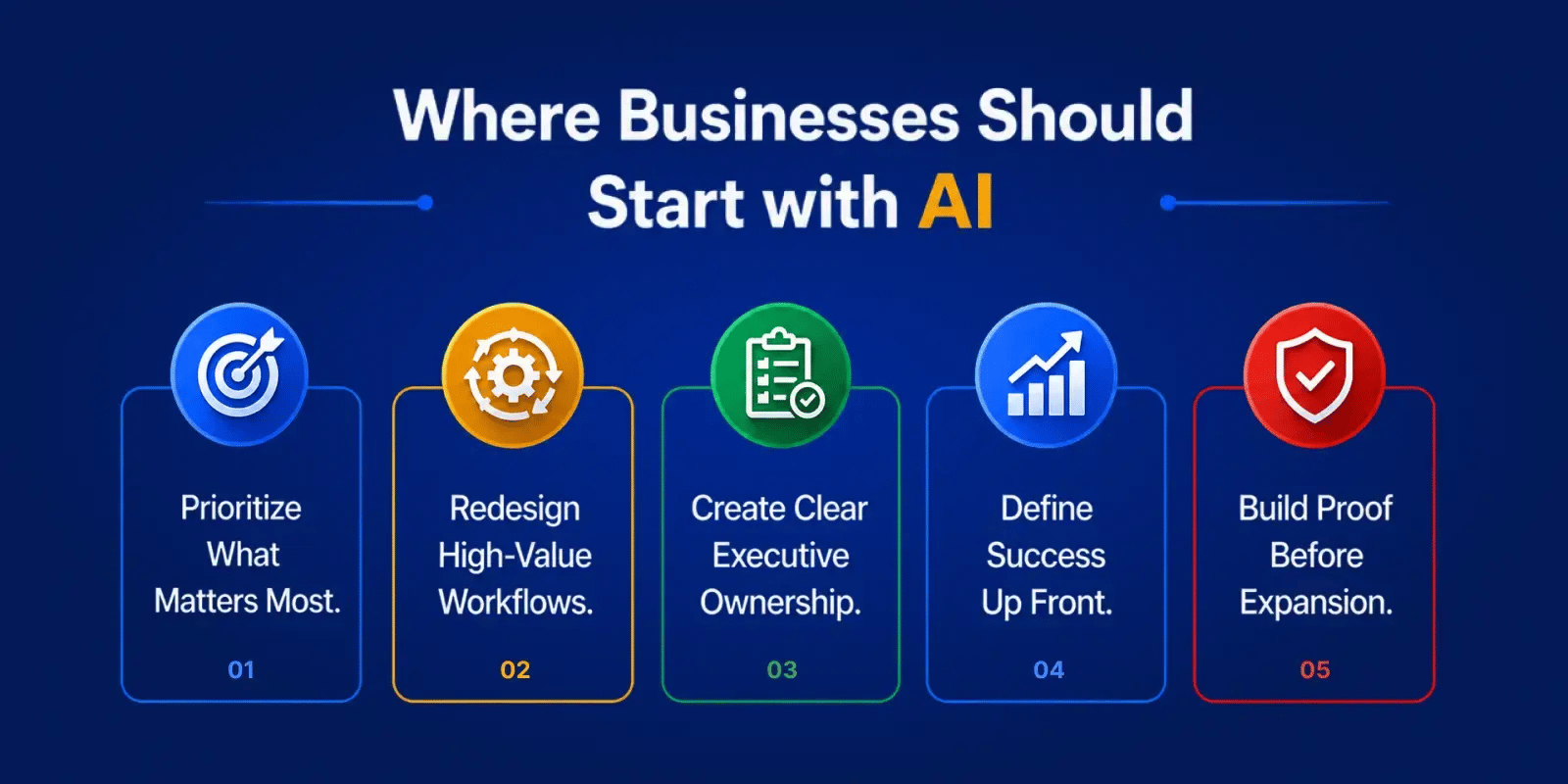
Most organizations don't have an AI problem. They have a priorities problem. The technology is accessible, the use cases are obvious, and the budget is usually there. What's missing is a clear AI implementation strategy and the discipline to go deep on that one thing before spreading thin across ten others.
Scattered AI pilots feel productive. They rarely are.
Pick one workflow and actually change it
Not automate it. Change it. There's a difference between putting an AI tool inside an existing process and rethinking how that process should work given what AI can now do. The first gives you marginal speed. The second gives you structural value.
The question to start with isn't "where can we use AI?" It's "which part of how we operate is most worth rethinking?" That's a harder question and it takes longer to answer, but it's the one that leads somewhere.
Put a senior owner on it
If nobody senior owns the outcome, the initiative will drift. It will live in a working group, produce a report, and quietly lose momentum by Q3. Organizations that are seeing real returns have someone at the leadership level who is accountable for both the deployment and the results, not just the rollout.
Define what success looks like before starting
This sounds basic. Most companies skip it anyway. Before deploying anything at scale, it's worth being specific about:
- What does this need to deliver to be considered working?
- How will that be measured?
- Over what timeframe?
Without those answers upfront, every result becomes open to interpretation and nothing ever gets meaningfully evaluated.
Build before you spread
Once one workflow is genuinely producing results, that becomes the internal proof of concept. It's far easier to scale AI across an organization when there's a real example inside the business that people can point to. Starting broad and thin is how companies end up with lots of AI activity and very little AI impact.
The path forward for most organizations isn't complicated. It just requires doing fewer things with far more intention.
Adoption was never the hard part
AI isn't going to get easier to ignore. The organizations that figure out implementation now are building a lead that compounds over time. The ones still running disconnected pilots are not falling behind slowly. They are falling behind quickly, and the gap between those two groups is already visible.
More tools aren't the answer
The honest truth is that most companies don't need more AI tools. They need a clearer approach to the ones they already have. There's a meaningful difference between an organization that has AI running in twelve places and one that has AI genuinely embedded into how the business operates. The first looks busy. The second produces results.
What disciplined implementation actually looks like
Getting from one to the other requires a few things working together:
- A senior owner who is accountable for outcomes, not just rollout
- Workflows that have been genuinely redesigned, not just patched with new software
- Clear metrics defined before deployment, not after
- A plan for scaling what works rather than endlessly expanding what's untested
None of that is technically complicated. All of it requires organizational will and a clear head about where to focus first.
Where outside perspective helps
This is also where having the right partner matters. Not to hand the problem off, but to work with someone who has seen enough implementations across enough industries to know what the common failure points are before they show up.
That's the kind of work Tech.us is built around. Helping businesses think through the structural changes that produce real returns, not just deploying technology and stepping back.
The decision most companies haven't made yet
The organizations seeing results from AI didn't get lucky with their tool choices. They got serious about how their businesses run. That decision is available to every organization. Most just haven't made it yet.

Continue reading the blog
with a Tech.us subscription
You’re now subscribed!