Overview
A growing retail company once spent months building custom business software for inventory management. The idea looked great on paper with every team member excited and leadership expected faster operations and fewer manual tasks.
Six months later, employees were still using spreadsheets.
According to McKinsey, 70% of large-scale transformation efforts fail to achieve their intended objectives.
Why? The software solved the wrong problem. It looked modern, but it did not fit the company’s actual workflows. Integrations were incomplete. Reporting was slow. Teams avoided using it because everyday tasks suddenly became harder.
Stories like this are more common than most businesses think.
Custom software development can absolutely transform operations. It can improve productivity, automate repetitive work, reduce workflow inefficiencies, and support long-term scalability. For many companies, it becomes the foundation for digital transformation initiatives and future growth.
But investing in custom software development is a serious business decision. It is not just about building features or launching an app. Businesses should evaluate how the software fits their processes, growth plans, teams, customers, and existing systems.
Ask yourself this. Are your current tools actually limiting growth? Or are processes themselves broken?
That distinction matters a lot.
This guide breaks down the key factors businesses should consider before investing in custom software development services so they can avoid expensive mistakes, reduce technical debt, and build scalable software solutions that truly support business growth.
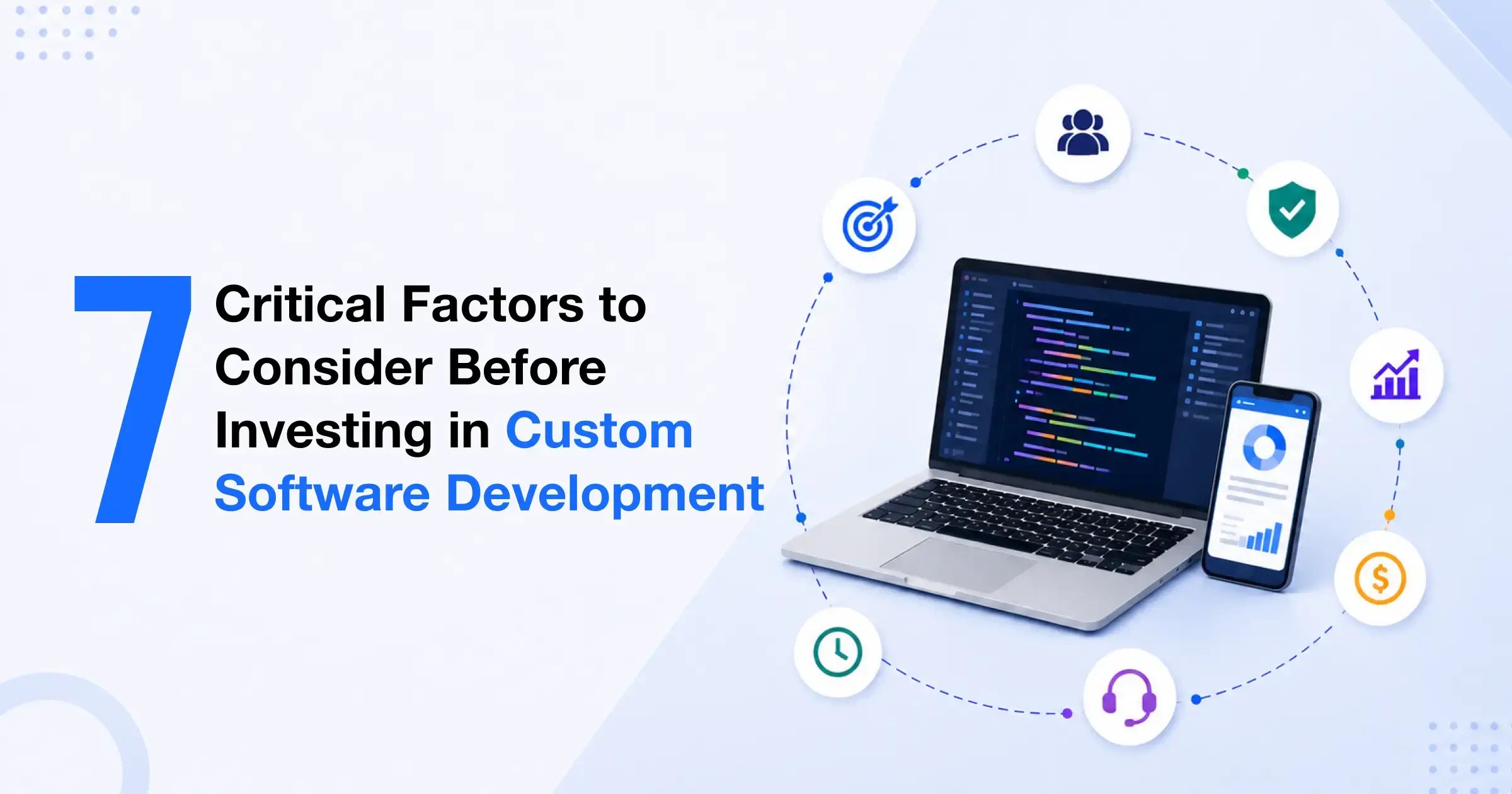
7 Factors to Consider Before You Invest in Custom Software Development
The following 7 factors make up what we call the Custom Software Readiness Framework, which is a decision model Tech.us developed to help businesses evaluate software investments before committing to development. Each factor maps to a common failure point in custom software development projects.
1. Problem definition: Is the business trying to solve a real workflow problem, or building software around a process that is itself broken?
2. Full-lifecycle budget: Does the budget account for build, integration, QA, and the 15–25% annual maintenance cost?
3. Scalability architecture: Is the software architectured to handle 3–5x current load without a full rebuild? 78% of fast-growing companies hit architecture limits.
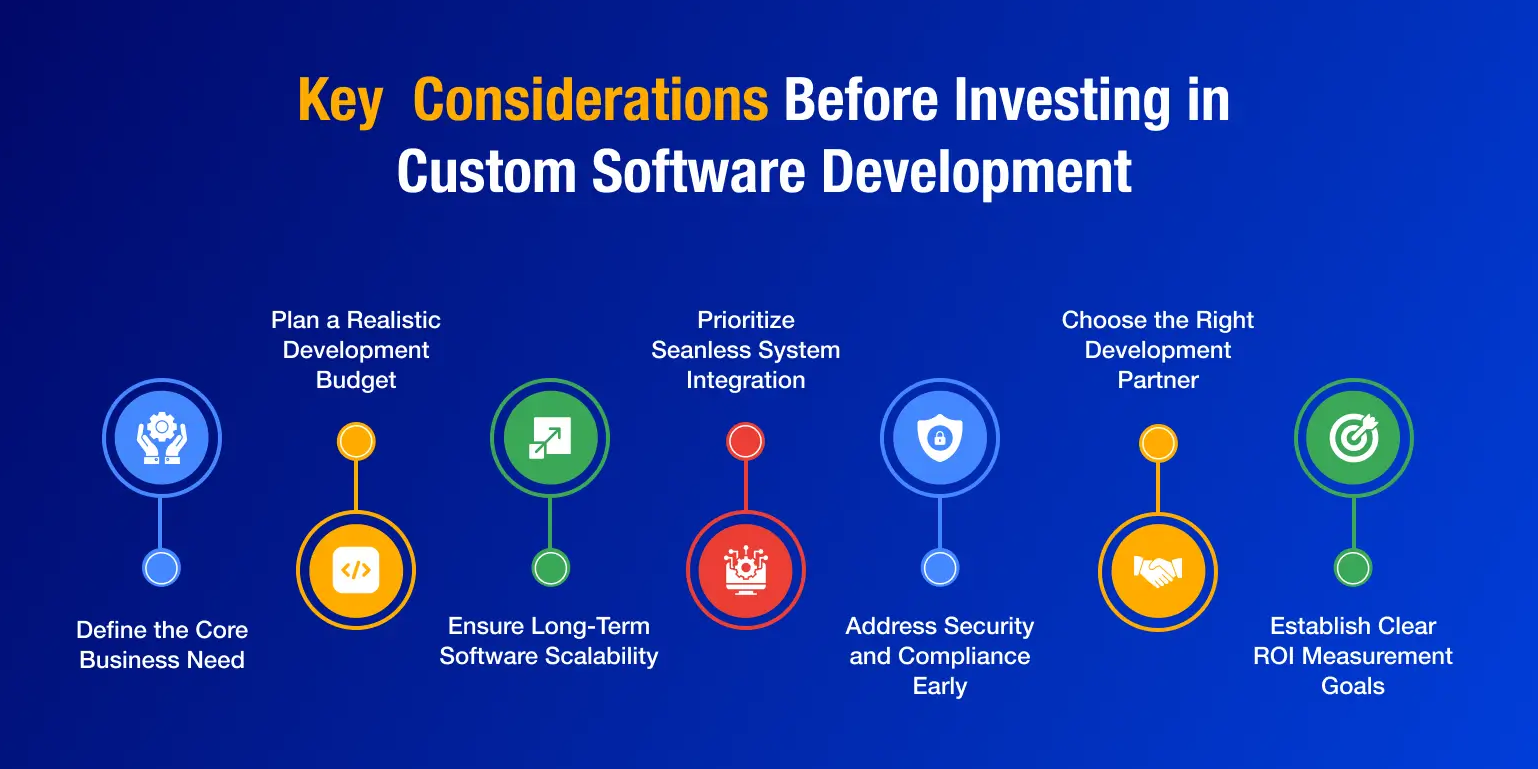
4. Integration readiness: Has the existing software ecosystem been mapped? 84% of integration projects fail or partially fail when this step is skipped.
5. Security & compliance design: Are GDPR, HIPAA, SOC 2, or PCI DSS requirements scoped in from day one, and not retrofitted after launch?
6. Partner qualification: Does the vendor ask hard questions before proposing solutions? Projects with clear pre-development requirements are 97% more likely to succeed.
7. ROI measurement plan: Are success metrics defined before development starts such as time saved, adoption rate, error reduction, efficiency gains?
Let us look into each aspect in detail.

1. What Business Problem are you Trying to Solve?
This sounds simple, but this is exactly where many custom software development projects fail.
A business decides it needs new software. Teams start discussing features. Budgets get approved. Development begins.
But what exact problem is the software supposed to solve?
If that answer is unclear, even the best custom software solutions can turn into expensive operational headaches.
Are Your Current Systems Slowing Down Work?
Most businesses start exploring bespoke software development because their existing tools create daily friction.
Maybe teams still depend on spreadsheets. Maybe customer data sits across multiple platforms. Maybe employees waste hours moving information manually between systems.
These are common operational bottlenecks that quietly slow business growth.
Some warning signs are easy to spot:
- Teams constantly switch between tools
- Reporting takes too long
- Workflows rely heavily on manual approvals
- Existing software cannot support new processes
- Departments work in disconnected systems
At first, these issues seem manageable. Over time, they create bigger workflow inefficiencies, scaling problems, and rising software maintenance costs.
Is Software Actually the Problem?
This is something businesses rarely stop to ask.
Sometimes the issue is not outdated software. The real problem could be broken internal processes or unclear workflows. Building custom business software without fixing those gaps usually creates more confusion later.
Before investing in software development services, businesses should clearly define:
- What process needs improvement
- Which teams will use the system
- What tasks should become faster
- What outcome the business expects
Without that clarity, development becomes guesswork.
And honestly, that is where technical debt often begins.
2. How Much Should Businesses Budget for Custom Software Development?
One of the biggest mistakes businesses make while investing in custom software development is underestimating the actual cost. Many leaders assume the budget only covers development. In reality, development is just one part of the equation.
The total custom software implementation cost depends on several moving parts. A simple internal workflow automation software will cost far less than a scalable enterprise application connected to multiple systems.
What Actually Impacts Custom Software Development Cost?
A lot depends on what the business is trying to build.
For example, costs usually increase when the project involves:
- Complex business-specific workflows
- Third-party integrations
- Cloud-native applications
- AI-powered automation
- Advanced security and compliance needs
- Custom ERP development
- Scalable software architecture planning
Even user experience matters more than businesses expect. Poor UI creates adoption problems later. Fixing that after launch often becomes expensive.
And then comes integrations.
Many companies already use CRMs, payment platforms, analytics tools, or inventory systems. Connecting everything inside an API-driven ecosystem takes time, testing, and long-term planning.
Development Is Just the Beginning
According to a study, ongoing maintenance and support typically accounts for 15–25% of the initial development cost each year, which means the original build budget represents only a fraction of the true lifetime investment in custom software.
This is where many businesses get surprised. Custom software solutions need continuous support after launch. That includes:
- Security updates
- Infrastructure scaling
- Performance monitoring
- Bug fixes
- Feature improvements
- Ongoing software maintenance costs
Think about it this way. Software is not a one-time purchase. It is a long-term software investment.
How Can Businesses Avoid Budget Overruns?
A McKinsey and University of Oxford study of over 5,400 IT projects found that large IT projects, especially those with budgets over $15 million, run an average of 45% over budget while delivering 56% less value than originally predicted.
A clear software development strategy helps more than people realize. Budget overruns usually happen because:
- Requirements keep changing midway
- Teams skip the discovery phase
- Timelines are unrealistic
- Businesses try building everything at once
A smarter approach is starting with an MVP development strategy. Solve the core problem first. Expand later based on user feedback and business growth.
Estimated Cost Breakdown
|
Component
|
Cost Impact
|
|
UI/UX Design
|
Medium
|
|
Backend Architecture
|
High
|
|
Third-party Integrations
|
Medium-High
|
|
AI Features
|
High
|
|
Security & Compliance
|
High
|
|
Testing & QA
|
Medium
|
|
Ongoing Maintenance
|
Recurring
|
3. Will the Software Scale as Your Business Grows?
A lot of businesses build software for today’s problems. That works for a while. Then growth happens.
More customers come in. Teams expand. Data increases. Suddenly, the software that once felt fast starts slowing everyone down.
This is why software scalability should never be treated as an afterthought.
What Happens When Demand Increases?
Here’s a situation many businesses face.
The software works perfectly during the first few months. Then traffic increases. Reports take longer to load. Systems crash during peak hours. Teams start complaining about delays.
At that stage, fixing software scalability issues becomes expensive and disruptive.
Scalable software solutions are designed to handle growth from the beginning. That includes database performance, infrastructure scaling, cloud-native applications, and future-ready architecture.
A good enterprise software development company usually plans for:
- Higher user traffic
- Growing customer data
- Multiple business locations
- New integrations
- Expanding workflows
Without that planning, businesses often end up rebuilding systems much earlier than expected.
Can the Software Adapt Later?
This is another important question businesses should evaluate before investing in software.
Business needs change constantly. New services get added. Teams evolve. Customer expectations shift. Sometimes AI and automation requirements enter the picture unexpectedly.
If the software lacks flexibility, every small change turns into a complicated development project.
That is why experienced enterprise software development teams focus heavily on modular systems and API-first development. It gives businesses room to grow without breaking existing workflows.
Are You Building for the Next Five Years?
Think beyond current operations.
Will the software still support the business after expansion? Can it handle international operations later? What happens when customer volume doubles?
These questions matter because long-term software scalability directly affects the ROI of custom software. One common mistake businesses make is over-customizing systems too early. Another is ignoring software architecture planning entirely.
Good custom software solutions should grow with the business, not slow it down every time growth happens.
4. How Will the New Software Integrate with Existing Systems?
For many businesses, the real challenge in customized software development does not begin during development. It begins after launch, when teams try fitting the new system into their existing workflows.
A logistics company learned this the hard way during its digital transformation initiative. The company invested heavily in custom software solutions to streamline operations across departments.
On paper, everything looked promising. The platform had advanced dashboards, automation capabilities, and reporting tools.
But daily operations became slower instead of faster. The problem was never the software itself. It was the lack of integration planning.
Why Integration Planning Matters Early
Experienced enterprise software development teams usually spend a lot of time understanding the company’s existing software ecosystem before writing a single line of code.
That process often uncovers:
- Hidden workflow inefficiencies
- Dependency on legacy systems
- Data silos across departments
- Integration challenges businesses face during scaling
Without that visibility, businesses risk creating another disconnected platform instead of improving operations.
The Bigger Picture Businesses Often Miss
Most companies do not operate with a single tool anymore. Sales, finance, operations, customer support, and analytics teams often rely on different platforms every day.
That is why API-first development has become so important in modern business software development. It helps systems communicate smoothly inside an API-driven ecosystem and gives businesses more flexibility as operations grow.
Good custom software should feel connected to the business from day one. Employees should not have to fight the system just to complete basic tasks.
The best software integrations are usually the ones employees barely notice because everything simply works together in the background.
5. Is Security and Compliance Being Considered Early Enough?
A healthcare company once invested in healthcare software development to improve patient scheduling and internal coordination. The platform worked well during testing. Teams loved the faster workflows. Operations became smoother within weeks.
Then the compliance review happened.
The company discovered that sensitive patient data could be accessed too easily across departments. Audit logs were incomplete.
Some third-party integrations lacked proper security validation. Fixing those gaps after development delayed the launch by months and significantly increased costs.
Situations like this are more common than businesses think.
Security Problems Usually Start Small
Many companies treat software security and cybersecurity best practices as something to handle later. That approach creates serious risks over time.
IBM's 2024 Cost of a Data Breach Report, based on analysis of 604 organizations globally, found that the average cost of a data breach reached $4.88 million, a 10% increase from the prior year and the largest spike since the pandemic.
In custom business software, small security gaps can quietly expose critical business and customer data.
Experienced enterprise software development teams usually pay close attention to:
- Weak authentication systems
- Poor access control
- Insecure APIs
- Third-party vulnerabilities
- Unprotected customer data
The challenge becomes bigger during digital transformation initiatives where multiple systems, users, and integrations are involved.
Compliance is not Just a Legal Requirement
A lot of businesses assume compliance applies only to large enterprises. That is rarely true anymore.
Depending on the industry, companies may need to follow standards like GDPR, HIPAA, SOC 2, or PCI DSS. Ignoring those requirements early can create expensive rework later in the software development lifecycle.
More importantly, customers notice when businesses take security seriously. Strong security practices improve trust. Weak security damages reputation quickly.
Why Security Should Be Planned from Day One
Security works best when it becomes part of the software architecture planning process from the beginning.
That usually includes:
- Data encryption
- Role-based access controls
- Audit logs
- Backup and recovery planning
- Compliance reviews
- Regular penetration testing
Good custom software solutions should protect the business quietly in the background without slowing operations down. Because honestly, rebuilding customer trust after a security failure is far harder than preventing the issue early.
6. How Do You Choose the Right Custom Software Development Partner?
A fast-growing retail brand once went on to hire a custom software development company purely because the pricing looked attractive. The proposal promised quick delivery, low costs, and “complete digital transformation” within a few months.
The project started smoothly. Then problems slowly surfaced.
Requirements were misunderstood. Timelines kept shifting. The development team changed frequently. After launch, the software struggled with scalability and integrations. Within a year, the business had to bring in another vendor to rebuild major parts of the platform.
The cheaper option eventually became the more expensive one.
Technical Skills Matter. But So Does Business Understanding.
Experienced businesses usually look beyond coding expertise while choosing a custom software development company.
A 2024 study by researcher Junade Ali and J.L. Partners, surveying 600 software engineers in the US and UK, found that projects with clear, documented requirements before development started were 97% more likely to succeed than those without them.
A strong development partner should understand:
- Business-specific workflows
- Long-term scalability goals
- Operational bottlenecks
- Integration requirements
- User adoption challenges
Good enterprise software development is rarely just about writing code. It involves product thinking, software architecture planning, and understanding how teams actually work inside the business.
Communication matters too.
If the development team struggles to explain technical decisions clearly during early discussions, that problem usually becomes worse later.
Why Cheap Development Often Creates Bigger Costs
This is where many businesses make risky decisions.
Low-cost vendors may skip critical steps in the software development lifecycle. The software may launch faster initially, but technical debt builds quietly in the background.
And honestly, fixing poorly built custom software solutions later is far more expensive than building them properly from the beginning.
Questions Businesses Should Ask Early
Before signing any agreement, decision-makers should ask:
- Who owns the source code?
- How will post-launch support work?
- How are change requests handled?
- What happens if project timelines shift?
- How will the system scale later?
The best software partners usually do not rush businesses into development. They ask difficult questions early because they understand that long-term custom software development investment decisions affect operations for years.
7. How Will You Measure ROI From Custom Software Development?
For one manufacturing company, investing in custom software development was never just about replacing old systems. The leadership team wanted faster operations, fewer manual errors, and better visibility across departments. On the surface, the new platform delivered all the right features.
But the real turning point came months later.
Managers noticed that teams were completing operational tasks much faster than before. Reporting cycles that once took days were now finished within hours.
Customer response times improved quietly in the background. Employees stopped relying on spreadsheets because the system finally matched their actual workflows.
That is when the company started seeing the real ROI of custom software.
ROI Looks Different Across Businesses
Experienced leaders rarely measure software success only through revenue growth. Good custom software solutions usually create value in smaller operational improvements first.
That often includes:
- Faster decision-making
- Reduced manual work
- Better business process automation
- Lower error rates
- Improved customer experiences
Over time, these improvements directly impact operational efficiency and long-term scalability.
Adoption Matters More Than Features
A lot of businesses focus heavily on development and launch timelines. But software only creates value when employees and customers actually use it comfortably.
One retail company discovered this during its software modernization initiative. The platform was technically powerful, but employees avoided using it because the workflows felt complicated.
The company eventually invested more time into user training and UX improvements than actual development fixes.
That changed adoption completely.
Experienced enterprise software development teams understand this well. Strong user experience, onboarding, and change management often influence software success more than advanced features.
The most successful custom business software projects usually share one thing in common. The technology feels natural to the people using it every day.
ROI metrics you should track
|
ROI Metric
|
Why It Matters
|
|
Time Saved
|
Shows improvement in operational efficiency and daily workflows
|
|
Reduction in Manual Work
|
Indicates successful business process automation
|
|
Employee Productivity
|
Measures how effectively teams use the software
|
|
Customer Experience
|
Reflects faster support and smoother user journeys
|
|
System Scalability
|
Shows how well the software supports business growth
|
|
User Adoption
|
Indicates if the software fits real business-specific workflows
|
The Custom Software Readiness Framework by Tech.us distills these seven factors into a repeatable evaluation model. Businesses that work through all seven before starting development are significantly less likely to face the cost overruns, adoption failures, and technical debt that derail most custom software projects.
Custom Software vs Off-the-Shelf Software: Which One Makes More Sense?
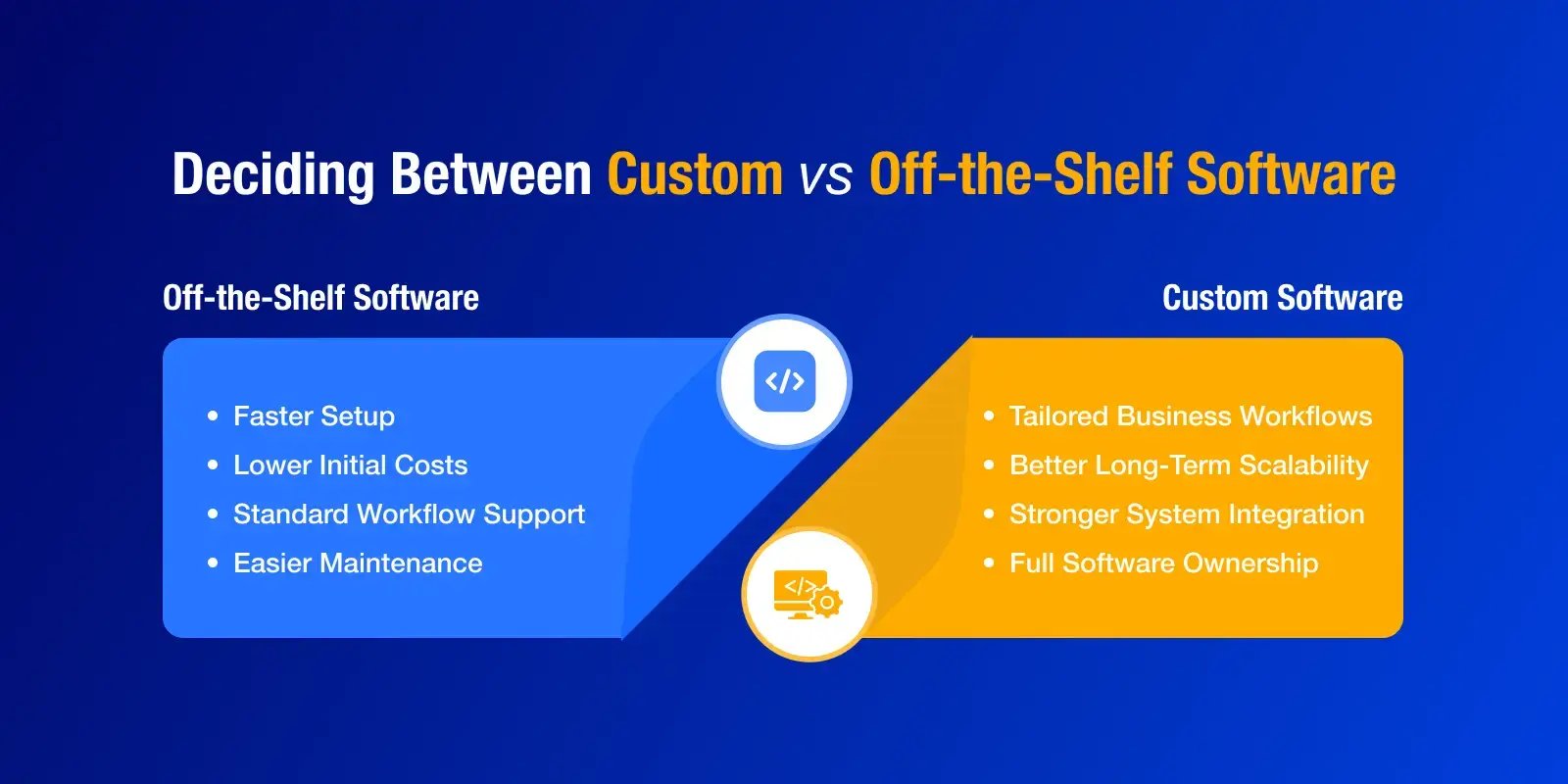
Custom software vs off-the-shelf software is one of the most common questions businesses ask before investing in custom software development. And honestly, there is no single right answer.
Some companies genuinely benefit from off-the-shelf SaaS solutions. Others quickly outgrow them and start looking for custom software solutions built around their workflows.
The real decision usually comes down to how the business operates today and where it plans to go next.
When Does Off-the-Shelf Software Work Better?
For smaller teams or businesses with standard workflows, SaaS development can work well initially. They are faster to deploy, easier to maintain, and usually cost less upfront. And, in some cases custom SaaS development even give competitive edge to many businesses.
Many businesses choose them for:
- CRM management
- Accounting
- HR operations
- Project management
But problems start appearing when teams need deeper customization or better integrations. Over time, businesses may end up changing their processes just to fit the software limitations.
That creates workflow inefficiencies many leaders do not expect initially.
When is Custom Software the Better Choice?
Custom business software makes more sense when operations become more complex. And you need to know when your business has actually outgrown SaaS.
A growing business may need:
- Business-specific workflows
- Better software scalability
- Stronger business process automation
- Secure custom software solutions
- Integration across multiple departments
This is where enterprise software development becomes valuable. The software gets built around how the business actually works instead of forcing teams into rigid workflows.
Long-term software ownership also becomes a major advantage for businesses focused on digital transformation initiatives and future growth.
Custom Software vs Off-the-Shelf Software
|
Factor
|
Custom Software
|
Off-the-Shelf Software
|
|
Flexibility
|
Built around business needs
|
Limited customization
|
|
Initial Cost
|
Higher upfront investment
|
Lower starting cost
|
|
Scalability
|
Easier to scale long-term
|
Depends on vendor limitations
|
|
Ownership
|
Full software ownership
|
Vendor-controlled
|
|
Integrations
|
Easier API-first development
|
Integration limitations possible
|
|
Competitive Advantage
|
Supports unique workflows
|
Similar tools used by competitors
|
For many businesses, the smartest approach is not choosing one over the other completely. It is understanding when existing tools are enough and when custom software development services for businesses become necessary for long-term growth.
FAQs
What is custom software development?
Custom software development means building software around a company’s actual workflows instead of forcing teams to adjust to generic tools. In other terms, it is software built for specific needs of a business.
How do businesses know if they need custom software?
Businesses usually start considering custom software development when existing systems slow operations down or teams keep creating workarounds to get basic tasks done.
How much does custom software development cost?
The cost of custom software development depends on how complex the system is, how many integrations it needs, and how scalable the software must be over time.
How long does custom software development take?
Some custom software solutions take a few months, while larger enterprise software development projects can take much longer depending on features and integrations.
Is custom software more secure than off-the-shelf software?
Custom software can offer stronger security because businesses have more control over access, data handling, and software security best practices.
What industries benefit most from custom software?
Industries with complex operations or business-specific workflows usually benefit the most from custom business software and scalable software solutions.
Can custom software integrate with existing business tools?
Yes. Most modern custom software solutions are built to integrate with CRMs, ERPs, payment systems, and other tools through API-first development.
What are the biggest risks in custom software development?
Poor planning, unclear business goals, and weak scalability planning are some of the biggest reasons custom software projects struggle later.
How do businesses calculate ROI from custom software?
The ROI of custom software usually becomes visible through faster workflows, lower manual effort, and smoother day-to-day operations.
Should startups invest in custom software development?
Startups usually invest in custom software development when existing SaaS tools stop supporting their product vision or long-term growth plans.