-
Stop looking for AI use cases and start looking for business bottlenecks.
-
The best AI opportunities usually hide inside everyday operational friction.
-
Review queues, information search, repetitive decisions, and knowledge silos are strong AI signals.
-
Measure AI ROI through business impact, not just hours saved.
-
Prioritize processes where growth currently requires adding more people.
-
Focus on solving important constraints first, and AI ROI becomes much easier to achieve.
Overview
This is an important distinction that matters more than ever. According to PwC's 2025 AI Jobs Barometer, industries with greater AI adoption are seeing revenue growth nearly three times higher than industries with lower AI adoption levels.
They launch pilots, experiment with new tools, automate a few tasks, and six months later they're still asking a difficult question: "Why aren't we seeing meaningful business impact?" This is one of the main reasons enterprise AI initiatives fail to deliver results.

Why Most Businesses Look for AI Opportunities in the Wrong Places
The Common Mistake: Starting with AI Instead of Business Problems
Why AI-First Thinking Creates Random Pilots
The highest-value opportunities rarely appear when you're looking for AI use cases. They appear when you're looking at operational problems.
Think about the processes that people complain about most often. Not because they're annoying, but because they consume time, delay decisions, create rework, or require constant human involvement.
For example:
- Work waiting days for approvals
- Teams manually reviewing the same types of documents every week
- Employees switching between multiple systems just to answer a simple question
- Managers becoming bottlenecks as the business grows
What High-Performing Organizations Do Differently
The companies that see meaningful returns from AI tend to approach the problem from the opposite direction.
Instead of asking: Where can we use AI? They ask: Where is work slowing down, becoming expensive, inconsistent, or difficult to scale?
That small shift changes everything. It forces attention toward outcomes rather than technology, which is one of the most important key aspects of AI development for businesses.
In practice, the most valuable AI opportunities are often hiding inside everyday operational friction that people have accepted as normal. A process takes three days because it always has. A specialist spends hours reviewing documents because that's how the team works. Information is scattered across systems, so employees spend part of every day searching for answers.
The Four Signals That Usually Indicate a High-ROI AI Automation Opportunity
Not every manual process deserves automation.
One of the biggest mistakes companies make is assuming that anything repetitive is automatically a good AI candidate. In reality, the best opportunities usually reveal themselves through certain patterns. Once you know what to look for, they become surprisingly easy to spot.
Signal #1: Work Constantly Waits for Human Review
Look for places where work spends more time waiting than moving.
Signal #2: Employees Spend More Time Finding Information Than Using It
This is one of the most common bottlenecks in modern organizations.
Think about how much time people spend searching. They jump between emails, CRM records, spreadsheets, PDFs, internal systems, chat messages, and knowledge bases just to gather enough context to do their job.
Then the actual work begins.
When you look closely, many employees are acting as information retrievers before they can act as problem solvers.
If a process requires people to repeatedly collect, organize, summarize, and connect information from multiple sources, there is often an automation opportunity hiding underneath it. This is where technologies such as natural language processing often create measurable value.
Signal #3: The Same Decisions Are Made Over and Over Again
Signal #4: Critical Knowledge Lives Inside a Few People's Heads
When expertise can be captured through documents, past decisions, workflows, and historical data, AI can make that knowledge more accessible across the organization. Many businesses achieve this through enterprise AI services for business operations.
How to Calculate Whether an AI Opportunity Is Actually Worth Pursuing
Look Beyond Hours Saved
Measure the Cost of Slow Decisions
In many cases, reducing wait times creates more value than reducing labor. This is one of the most practical benefits of enterprise AI initiatives.
Understand the Cost of Errors
Consider What Happens as the Business Grows
Five Business Processes That Often Deliver Faster AI ROI Than Companies Expect
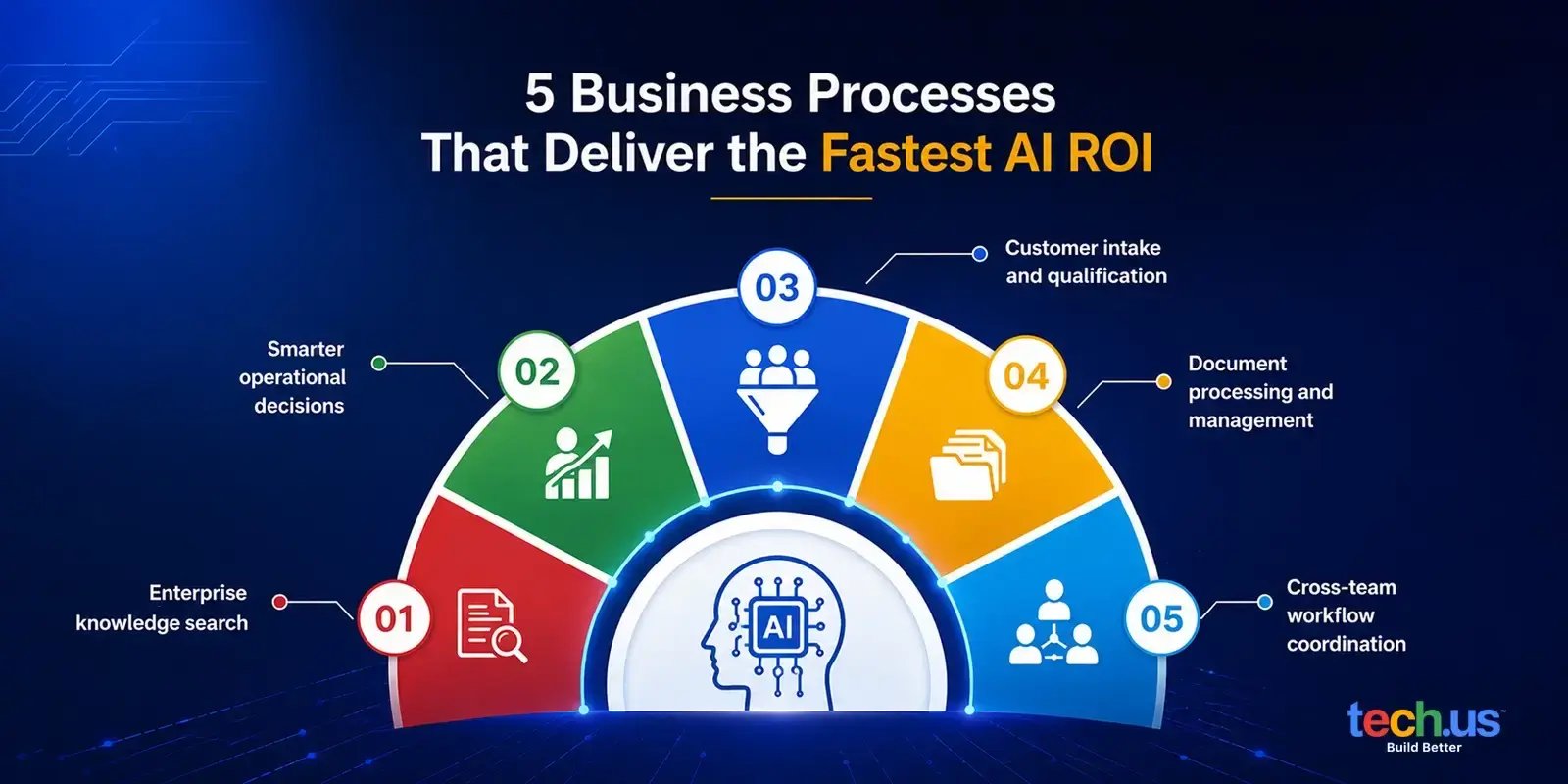
Some AI opportunities take time because they need deeper system changes. But a few process categories often show value faster because the pain is already clear, the volume is high, and the work follows repeatable patterns.
01. Internal Knowledge Search
In many companies, employees waste time looking for answers that already exist somewhere. The problem is not lack of knowledge. It is scattered knowledge.
AI can help teams find answers across documents, emails, tickets, policies, and internal systems without asking five people or opening ten tabs. Similar approaches are also being used to improve document processing accuracy using Document AI.
This works well when:
- The same questions keep coming up
- Information is spread across many tools
- Employees depend on senior people for routine answers
02. Operational Decision Support
AI is useful when teams make similar decisions every day but still need human judgment. In fact, many of the top business processes for AI automation fall into this category.
03. Customer Intake and Qualification
Customer intake is often full of small but important decisions.
04. Document-Heavy Workflows
Contracts, claims, invoices, onboarding forms, and compliance documents are strong AI candidates because they usually follow familiar patterns and this workflow automation can be made easily.
05. Internal Workflow Coordination
A lot of operational delay happens between steps.
A request is submitted, but nobody owns it. An approval is needed, but it sits unnoticed. A task should be escalated, but the signal comes too late.
AI can help route work, trigger follow-ups, identify stalled items, and recommend the next action.
This is often where ROI appears quietly. The business does not change overnight, but work starts moving with less friction.
To Sum Up
If there's one takeaway from this discussion, it's that high-ROI AI opportunities are rarely found by looking for places to use AI.
They're found by looking for places where the business is struggling to operate efficiently.
Work gets stuck in review queues. Employees spend too much time searching for information. Decisions depend on a handful of experienced people. Processes become harder to manage every time the business grows. Those are usually the signals worth paying attention to.
The organizations seeing the strongest results from AI are not necessarily automating the most processes. They're applying AI where it can support meaningful business transformation. They're solving the most important constraints first.
FAQ
A good starting point is to look for work that is slow, repetitive, dependent on manual reviews, or constantly waiting for someone to make a decision. If people regularly complain about the process, it's worth investigating.
Not necessarily. Some of the highest returns come from processes that create bottlenecks for multiple teams, even if they don't consume the most hours on paper.
Not always. Many AI initiatives start with existing documents, workflows, support tickets, knowledge bases, or operational data that businesses already have.
No. Smaller businesses often see value faster because a few operational bottlenecks can have a much bigger impact on growth, customer experience, and team productivity.
They focus on the technology before understanding the business problem. The strongest projects usually start with a clear operational challenge and then determine whether AI is the right solution. That's also why evaluating whether your business is ready for artificial intelligence development is often the first step.

Tech.us is an AI development company that builds custom AI solutions for businesses seeking measurable results. We partner with organizations to design, develop, and deploy scalable AI systems that solve complex challenges and unlock new opportunities for growth. Our team delivers practical AI applications that create tangible business impact across industries.

Continue reading the blog
with a Tech.us subscription
You’re now subscribed!