Overview
Generative AI is safe for healthcare when it is deployed with human oversight and strong governance, and it becomes risky when those guardrails are missing. That distinction matters more than the technology itself.
Consider where things stand. Some models now match or outperform physicians on diagnostic accuracy and patient communication in controlled studies. At the same time, the same systems can fabricate a clinical detail with complete confidence. Both things are true. That is the tension every health system is sitting with right now.
Adoption, meanwhile, isn't waiting for the debate to settle. Roughly three in four leading healthcare companies are already experimenting with generative AI or working to scale it, according to Deloitte's Survey.
So the real question isn't whether the technology works. It's how to capture the upside without exposing patients to harm. This piece maps the use cases, the risks, and a practical framework for doing exactly that.
What Is Generative AI in Healthcare?
Generative AI in healthcare refers to systems that create new content, like text, images, or synthetic data, rather than simply sorting or labeling what already exists. In practice, that splits into two families doing very different jobs, and the distinction matters more than most overviews let on.
Two model types, two very different jobs
The first family is large language models. These are the GPT-4s and Med-PaLM 2s of the world, trained to predict the next word across enormous amounts of text. In a clinic, that translates to drafting notes, summarizing a tangled patient history, or answering a clinical question in plain language.
The second family generates images. Tools built on GANs and newer diffusion models learn what real medical images look like, then produce synthetic ones, an MRI, a CT slice, a pathology slide, that never came from an actual patient. That sounds like a party trick until you hit the real problem it solves: training data is scarce and privacy-locked, and synthetic images sidestep both.
Why "foundation models" changed the game
Here's the shift that made all of this clinically interesting. Older medical AI did one thing. You trained a model to spot diabetic retinopathy, and that's all it could ever do; ask it anything else and you started over with a fresh dataset.
Foundation models broke that ceiling. As Michael Howell put it in BMJ Quality & Safety, these systems can handle many different kinds of tasks without being retrained on new data. One model, many jobs. That flexibility is precisely why generative AI spread through healthcare faster than any tool before it.
A market betting big, fast
The money tells the same story. The generative AI healthcare market was valued at roughly $800 million in 2022, with projections reaching $17.2 billion by 2032, according to figures cited in the Journal of Medical Systems. Whether that exact number holds is anyone's guess. The trajectory is the point.
Where Generative AI Is Already Delivering Value
The clearest wins so far are in documentation, diagnostic support, and medical imaging, where the evidence has moved past hype into measured results. These are also the areas where AI optimizes clinical operations most directly today.
Notice what these have in common: they assist a clinician rather than replace one. That's not a coincidence. It's exactly where the technology is strong and the risk is containable.
Can generative AI reduce clinician burnout?
Yes, and this is the most validated use case of the bunch. Documentation is the slow bleed of modern medicine, the paperwork that keeps doctors at their desks long after the last patient leaves. Generative AI takes a real bite out of it.
The standout evidence comes from a 2024 quality-improvement pilot at Stanford Health Care, where a HIPAA-compliant LLM was wired into the EHR to draft replies to patient portal messages. Across 162 clinicians, even modest use produced something striking:
- A meaningful drop in task load, the composite measure of effort and frustration with inbox work
- A measurable reduction in work-related emotional exhaustion, both results statistically significant
- This from an average AI-draft utilization of only around 20%, meaning small adoption, real relief
Worth sitting with that last point. Clinicians weren't leaning on the tool heavily. They still felt the difference. Separately, researchers testing LLMs on discharge summaries found readability jumped dramatically when the AI rewrote dense clinical language for patients, though reviewers flagged occasional omissions, which is the whole reason a human still signs off.
Diagnosis: a tireless second opinion
Here generative AI works best as a safety net, not the final word. In studies of complex, real-world cases, the newest large language models have reached the correct diagnosis a clear majority of the time, a marked step up from the generation that came just before them.
In one look at delayed diagnoses among older patients, a leading model surfaced relevant differentials more often than the clinicians and the traditional decision-support tool it was measured against, at least in that particular comparison.
There's also the now-familiar pattern of cases that stumped several doctors, where a model quietly flagged the condition everyone else had anchored past. Any single story proves nothing on its own.
But paired with the trial data, the direction is consistent: these tools surface possibilities a busy clinician might miss under time pressure. The catch, and it's a real one, is that the same models occasionally invent details with total confidence, which is why "second opinion" is the honest framing, not "diagnosis."
Imaging and synthetic data
Two quieter wins round this out:
- Synthetic medical images. Generative models can produce realistic scans that protect patient privacy, then use them to train diagnostic algorithms. In neuroimaging work, feeding a model synthetic MRIs alongside real ones improved how well it generalized to outside data, the kind of gain that matters when a tool meets patients it wasn't trained on.
- Report drafting. Multimodal models can turn imaging findings into draft radiology reports, speeding high-volume reading rooms, though subtle findings still need a radiologist's eye.
The thread running through all of it: generative AI earns its keep as a force multiplier for expertise, not a substitute for it.
A Framework for Safe Generative AI Deployment
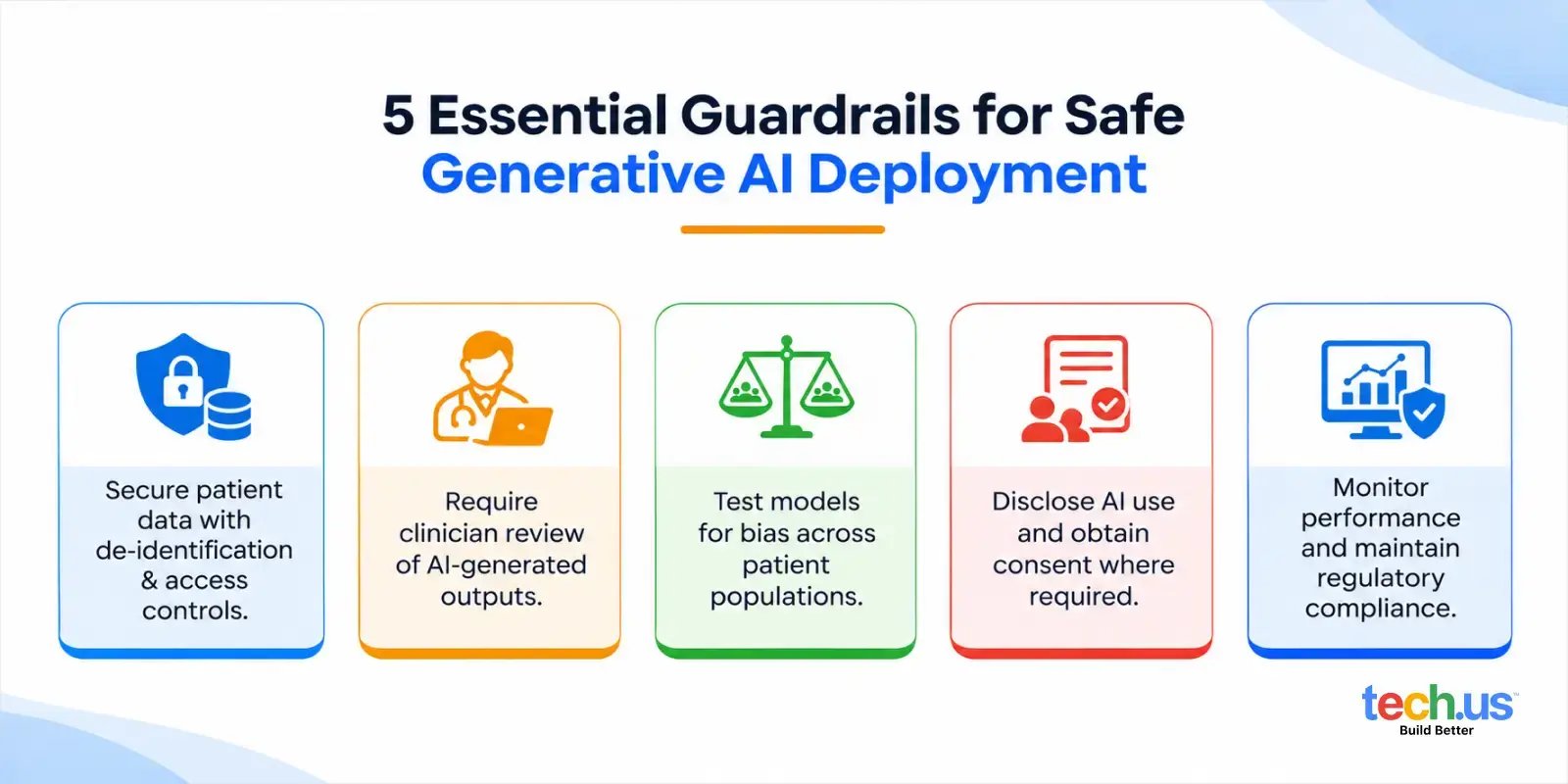
Generative AI becomes safe to deploy when five guardrails are in place before the technology touches a patient, not bolted on afterward. None of these is exotic. What's rare is doing all five together, and treating them as the cost of entry rather than a wish list.
1. Lock down the data first
De-identification isn't a checkbox. Strip the obvious identifiers, then have someone qualified confirm the re-identification risk is genuinely low. Pair that with encryption and role-based access so only the right people touch protected health information. Get this wrong and nothing downstream matters.
2. Keep a clinician in the loop
This is the single most important rule, and the one most tempting to skip under pressure. Generative AI drafts; a human decides. The model proposes a note, a diagnosis, a reply, and a qualified clinician reviews and signs off before it reaches a patient. The legal and ethical responsibility never transfers to the software, so the workflow shouldn't pretend otherwise.
3. Audit for bias on real-world diversity
A model trained on a narrow slice of the population will quietly fail the people who weren't in the data. Train and validate on demographically diverse datasets, then keep checking. Bias isn't a one-time clearance; it resurfaces as populations and use cases shift, so the audits have to repeat.
4. Be transparent with patients
People want to know when AI is involved in their care, and they're largely fine with it when they're told and their data is handled responsibly. Explain what the tool does, where it's used, and secure informed consent. Trust, once dented, is expensive to rebuild.
5. Monitor continuously and track the regulators
Deployment is the start, not the finish. Watch performance against real outcomes, update as medical knowledge moves, and keep pace with evolving FDA and EMA guidance. A model that was safe at launch can drift, and the rules around it are still being written.
Adopting Generative AI for Healthcare with Guardrails
So, is generative AI safe for healthcare? The honest answer is that safety isn't a property of the technology. It's a property of how you deploy it. The same model that lightens a clinician's load can endanger a patient if it's turned loose without oversight. The tool doesn't decide which outcome you get. Your guardrails do.
What actually separates safe from unsafe
The dividing line is rarely the model itself. It comes down to a few choices made before launch:
- A human signs off. Generative AI drafts; a clinician decides. That order never flips.
- The data was handled responsibly. De-identified, secured, and checked for the gaps that breed bias.
- Someone is still watching after go-live. Performance gets monitored, not assumed.
Skip these and even a brilliant model becomes a liability. Build them in, and the question stops being "is it safe?" and becomes "how well did we implement it?"
Where to go from here
Most failures in healthcare AI aren't model failures. They're deployment failures, the result of treating a clinical tool like a consumer app. Understanding how AI is transforming healthcare operations end to end is what separates a clean rollout from a costly one.
That's the work worth investing in, ideally with partners who've built this kind of safety scaffolding before rather than learning it on live patients. The right AI development services partner treats governance as the starting point, not an afterthought. Generative AI has genuinely earned its place in healthcare.
FAQs
Some specific tools are; generative AI as a category is not. Clearance happens product by product, and a lot of what's in use today sits in administrative or draft-support roles that don't require it. Always check the individual tool.
No, and that's not really the goal. It drafts, summarizes, and flags things a clinician then reviews and decides on. Think capable assistant, not replacement. The accountability stays with the human, by design.
Because these models predict plausible-sounding text, they don't look facts up. That's how you get a confident answer that's simply invented, what people call a hallucination. It's exactly why a clinician has to verify anything that touches care.
Only with the right protections in place. That means de-identification, encryption, and HIPAA-compliant systems, not pasting records into a public chatbot. The tool matters less than how the data around it is governed.
Begin where the stakes are lowest and the payoff is clear, usually documentation and administrative work. It also helps to vet AI healthcare solution providers for governance experience before you commit. Get the oversight and governance right on those before going anywhere near diagnosis or treatment decisions.