Overview
Right now, almost every business is investing in AI in some form. The interesting part is that AI is no longer the difficult decision. The difficult decision is figuring out where AI actually belongs.
For a while, companies approached AI the same way they approached software purchases. Need AI-powered customer support? Buy a tool. Need AI-generated reports? Buy another one. Need AI for sales insights? Add a third platform.
Before long, teams end up juggling a collection of disconnected AI products that don't really talk to each other.
According to PwC's 2025 AI Agent Survey, 88% of executives say their companies are increasing AI-related budgets due to growing interest in AI agents and automation. Yet many organizations are still struggling to move beyond isolated AI tools and create meaningful business impact.
The companies getting the most value from enterprise AI are often not the ones buying the most tools. They're the ones embedding AI directly into the systems employees already use every day.
In this article, we'll look at five practical signs that tell you when AI should stop being a separate tool and start becoming part of your custom software.
What Does It Mean to Build AI Into Custom Software?
When people talk about adopting AI, they're often talking about buying an AI tool.
That's not the same thing as building AI into custom software systems.
Think about a sales team. If a salesperson has to leave the CRM, open ChatGPT, paste customer information, generate a response, and then return to the CRM, AI is being used as a separate tool instead of a custom AI solution.
Now imagine the CRM itself automatically summarizes customer interactions, identifies buying signals, recommends next actions, and drafts personalized outreach. The salesperson never leaves the system.
That's AI embedded into software.
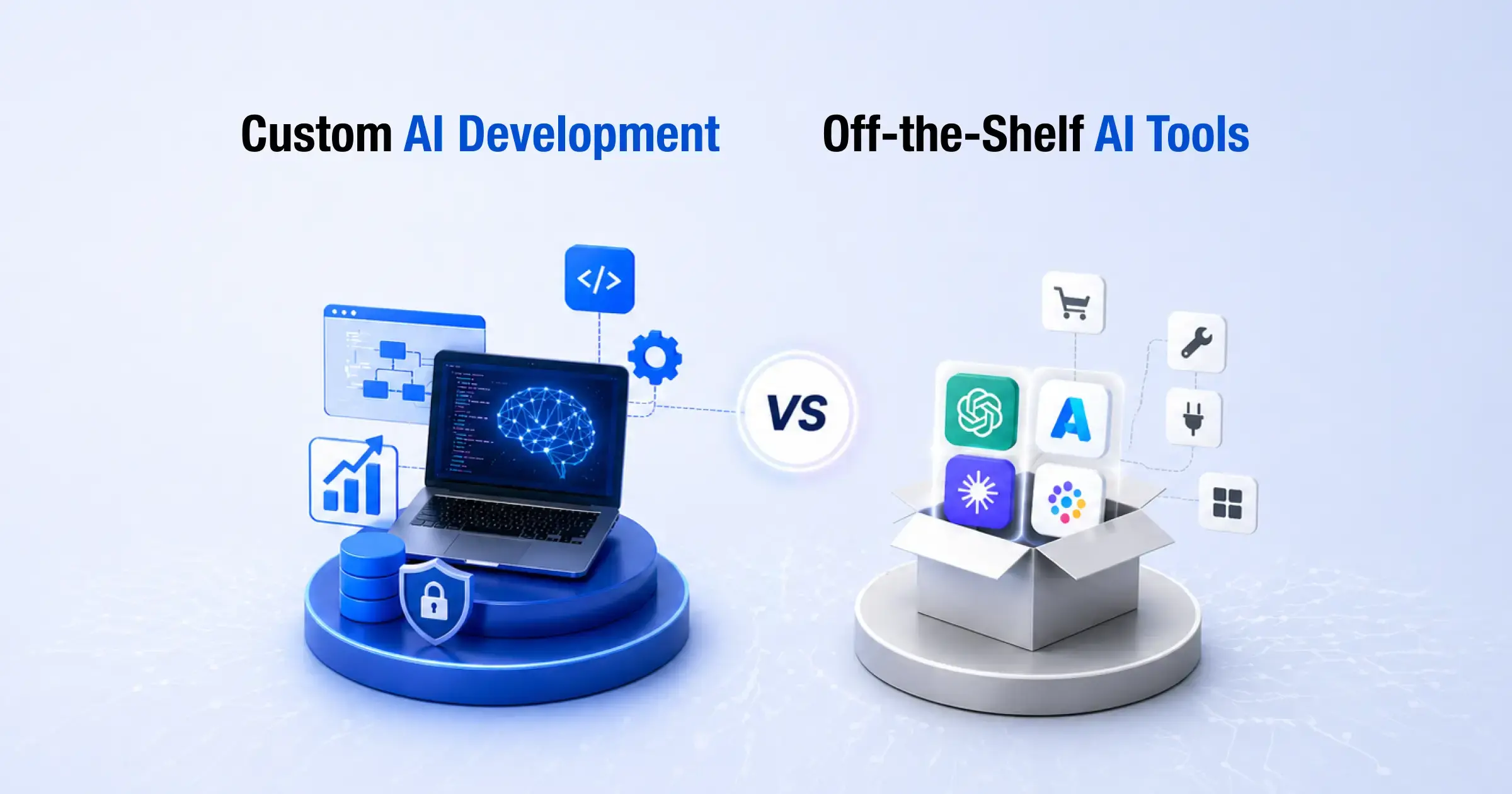
|
If You Buy an AI Tool
|
If You Build AI Into Custom Software
|
|
You're improving how employees perform work
|
You're redesigning how work gets done
|
|
AI remains an add-on
|
AI becomes part of the operating model
|
|
Benefits are usually incremental
|
Benefits can be transformational
|
|
Competitors can replicate the same approach quickly
|
Competitors cannot easily copy proprietary systems
|
|
Best for common business functions
|
Best for mission-critical business functions
|
|
Creates efficiency gains
|
Creates efficiency plus differentiation
|
|
Works well for experimentation
|
Works well for long-term strategic investment
|
5 Signs Your Business Should Build AI Into Custom Software
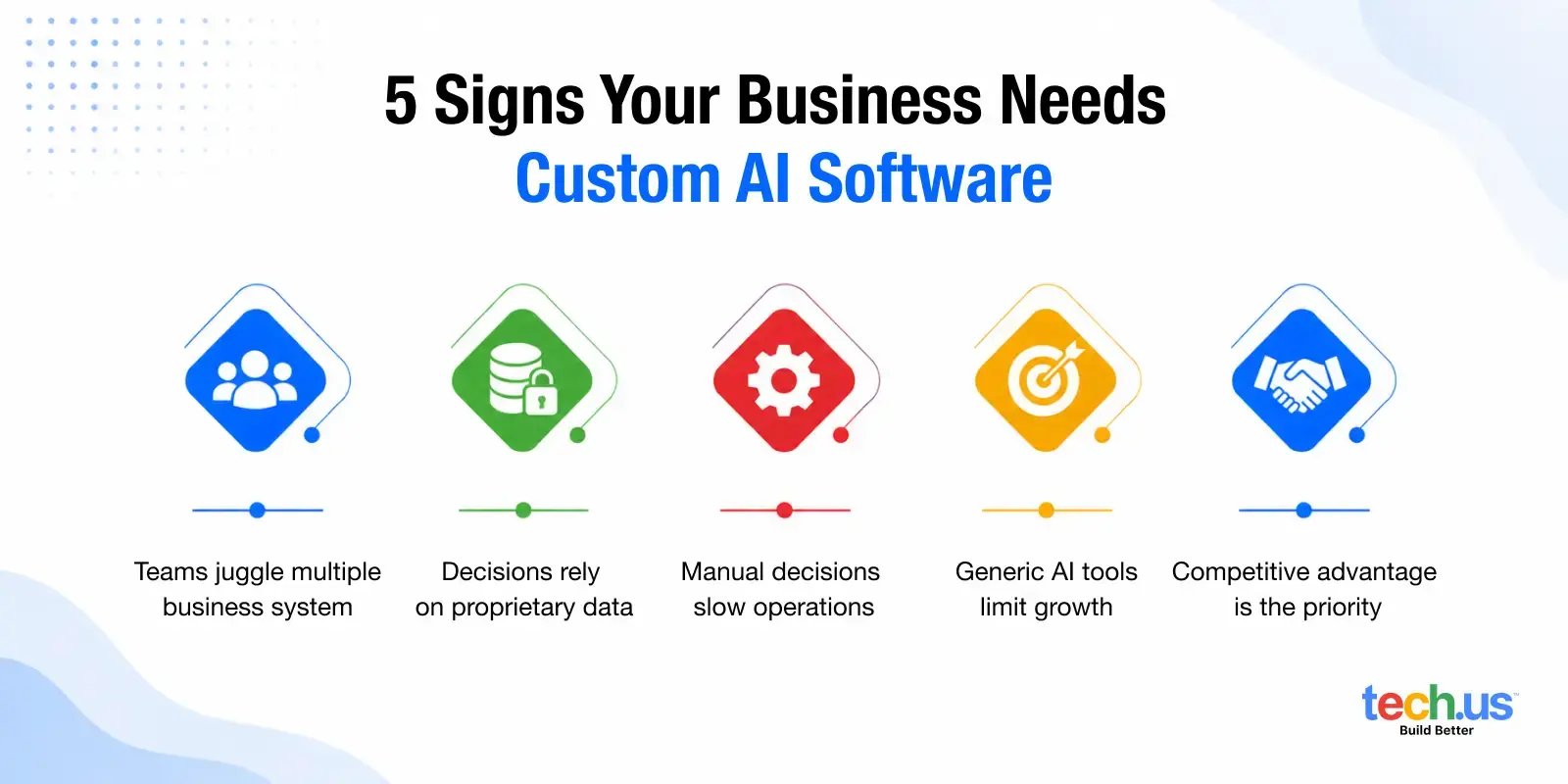
Let us look at the signs that your business may show that ushers AI capabilities into your custom software systems.
1. Is Your Team Constantly Switching Between Multiple Systems to Complete One Process?
One of the clearest signs that AI belongs inside your software is when employees spend more time navigating systems than doing actual work.
The problem is that every handoff creates friction. Information gets missed. Context gets lost, which is one of the most common AI integration mistakes in existing systems. Decisions take longer than they should. What many businesses discover is that the bottleneck isn't a lack of AI. It's the fact that AI exists outside the workflow.
When AI is embedded into the software employees already use, it can pull customer history, operational data, documents, and business rules without requiring anyone to manually assemble context first.
The result is not just faster work. It's fewer process breakdowns, fewer mistakes, and decisions made with more complete information.
2. Are Your Critical Decisions Dependent on Company-Specific Data?
Most businesses eventually hit the same wall with off-the-shelf AI.
The answers sound impressive, but they don't reflect how the company actually operates.
Generic AI tools cannot automatically understand your customer history, internal policies, operational constraints, pricing models, or risk thresholds. This is where custom AI development services start making sense.
Instead of generating responses based on public information alone, the AI can evaluate decisions using the same internal knowledge your experienced employees rely on every day.
When decisions depend heavily on proprietary information, embedding AI into your software usually creates significantly more value than relying on standalone AI platforms.
3. Is Manual Decision-Making Becoming a Bottleneck?
Many growing businesses eventually run into a scaling problem that has nothing to do with technology. Too many decisions depend on too few people.
A senior manager reviews every exception. A specialist approves every request. An experienced employee decides which customers receive priority attention.
At first, this feels manageable. Then volume grows. Suddenly the business is waiting on a handful of people to keep operations moving. This is where AI can create outsized value when embedded directly into operational systems.
The objective is not replacing decision-makers. It's helping them focus where their expertise matters most.
For example, AI can automatically identify high-risk cases, prioritize requests based on business impact, route work to the appropriate teams, or surface recommendations before a human review occurs.
The biggest gains often come from removing unnecessary reviews, not removing people. When experienced employees become the bottleneck to growth, businesses often begin evaluating business processes suitable for AI automation.
4. Do Existing AI Tools Force You to Change How Your Business Operates?
This is a problem many businesses don't recognize right away.
An AI platform gets purchased to improve efficiency. The implementation begins. Then teams discover that the software expects them to work a certain way.
Fields need to be structured differently. Approval flows need to change. Teams are asked to adapt processes that have evolved over years of real-world experience.
Sometimes that's fine. Many processes genuinely need improvement. But there are situations where a company's workflow is actually part of its competitive advantage.
A logistics company may have a unique dispatching process. An insurance provider may have specialized underwriting rules. A healthcare organization may follow operational procedures developed around years of patient outcomes and regulatory requirements.
Forcing those processes into the constraints of a generic AI platform can create more problems than it solves. Building AI into custom software allows the technology to adapt to the business rather than the business adapting to the technology, which is a key part of successful AI-driven business transformation.
That's an important distinction.
If your AI initiative requires significant compromises to how your organization operates today, it may be a sign that AI belongs inside your software rather than inside someone else's product.
5. Are You Looking for Competitive Advantage Rather Than Temporary Productivity Gains?
Most AI tools deliver efficiency improvements. But that rarely creates a lasting competitive advantage because the same tools are available to everyone else.
If your competitors can subscribe to the exact same platform next week, the advantage is usually temporary. This becomes particularly important when AI starts influencing customer experience, operational execution, pricing decisions, service delivery, or business intelligence.
These are areas where differentiation matters.
For example, a financial services company might build AI that identifies risk patterns unique to its portfolio. A healthcare provider may develop AI-powered workflows based on its clinical processes. A field service organization might use AI to optimize scheduling based on years of operational data and performance outcomes.
None of those capabilities can be easily replicated by purchasing a generic off-the-shelf AI solution.
This is often the point where businesses shift from asking, "How can AI make us more efficient?" to asking, "How can AI help us operate differently?"
When the second question becomes more important than the first, building AI into custom software usually deserves serious consideration.
How to Evaluate Whether an AI Capability Belongs Inside Your Software
At this point, the question isn't whether AI can help your business. The real question is whether a particular AI capability is important enough to become part of your core software, which is one of the most important AI development considerations for businesses.
A simple way to evaluate this is to look at where the capability creates value.
Does It Influence Revenue, Cost, or Customer Experience?
Start here.
If the AI directly affects sales performance, operational costs, customer retention, service quality, or response times, it's probably too important to live in a disconnected tool.
The closer AI gets to business outcomes, the stronger the case for embedding it into your software.
Does It Depend on Knowledge Unique to Your Business?
Some AI use cases work with public information. Others depend on years of customer interactions, operational history, pricing logic, internal policies, or domain expertise.
If the AI becomes smarter because it understands your business context, custom integration usually creates more value than a standalone platform.
Will Employees Use It Every Day?
Frequency matters.
A capability used once a month can live in a separate tool. A capability employees rely on dozens of times a day should ideally exist inside the systems where work already happens.
Otherwise, adoption becomes a constant challenge.
Would Losing It Create Operational Risk?
Imagine the capability disappears tomorrow.
Would approvals slow down? Would service quality drop? Would teams struggle to make decisions?
If the answer is yes, that capability has likely become part of your operational infrastructure rather than a productivity add-on.
Can Competitors Easily Buy the Same Capability?
This is often the deciding factor.
If competitors can purchase the same AI tool and get similar outcomes, you're gaining efficiency. If the capability is built around your data, workflows, and expertise, you're creating differentiation through enterprise AI services tailored to business operations.
And that's usually when AI belongs inside custom software.
To Sum Up
Not every AI initiative justifies building custom software. In many cases, a standalone AI tool is the right choice, especially when you're solving a common business problem.
The equation changes when AI starts influencing how your business operates, how decisions get made, or how customers experience your services.
At that point, AI stops being another tool in the stack. It becomes part of the system that drives the business forward.
The organizations seeing the strongest long-term results are not necessarily the ones buying the most AI products. They're the ones thoughtfully embedding AI into the workflows, data, and processes that make their business unique. That's where AI moves beyond productivity gains and starts creating a genuine competitive advantage.
FAQs
Is building AI into custom software always better than buying an AI tool?
Not necessarily. If you're solving a common business problem, an off-the-shelf AI tool is often enough. Custom AI makes more sense when the capability becomes central to operations or decision-making.
How do I know if an AI use case is important enough for custom development?
A good test is to ask whether it directly impacts revenue, customer experience, operational efficiency, or business-critical decisions. If it does, custom integration deserves consideration.
Can small and mid-sized businesses benefit from custom AI software?
Yes. The decision is less about company size and more about business complexity. Many mid-sized companies have workflows and data that create a strong case for custom AI.
What's the biggest mistake businesses make when adopting AI?
Many companies start with technology instead of the business problem. The most successful projects begin with a workflow bottleneck, operational challenge, or customer need.
Should AI replace human decision-makers?
In most cases, no. The strongest implementations help people make better decisions faster rather than removing human oversight entirely.
Is proprietary business data really that important for AI?
Absolutely. In many organizations, the greatest value comes from AI's ability to use internal knowledge, historical outcomes, and business-specific context that generic tools cannot access.
When is the right time to move from AI experimentation to custom AI development?
Usually when AI moves beyond occasional use and starts influencing daily workflows, operational performance, or customer-facing experiences.